

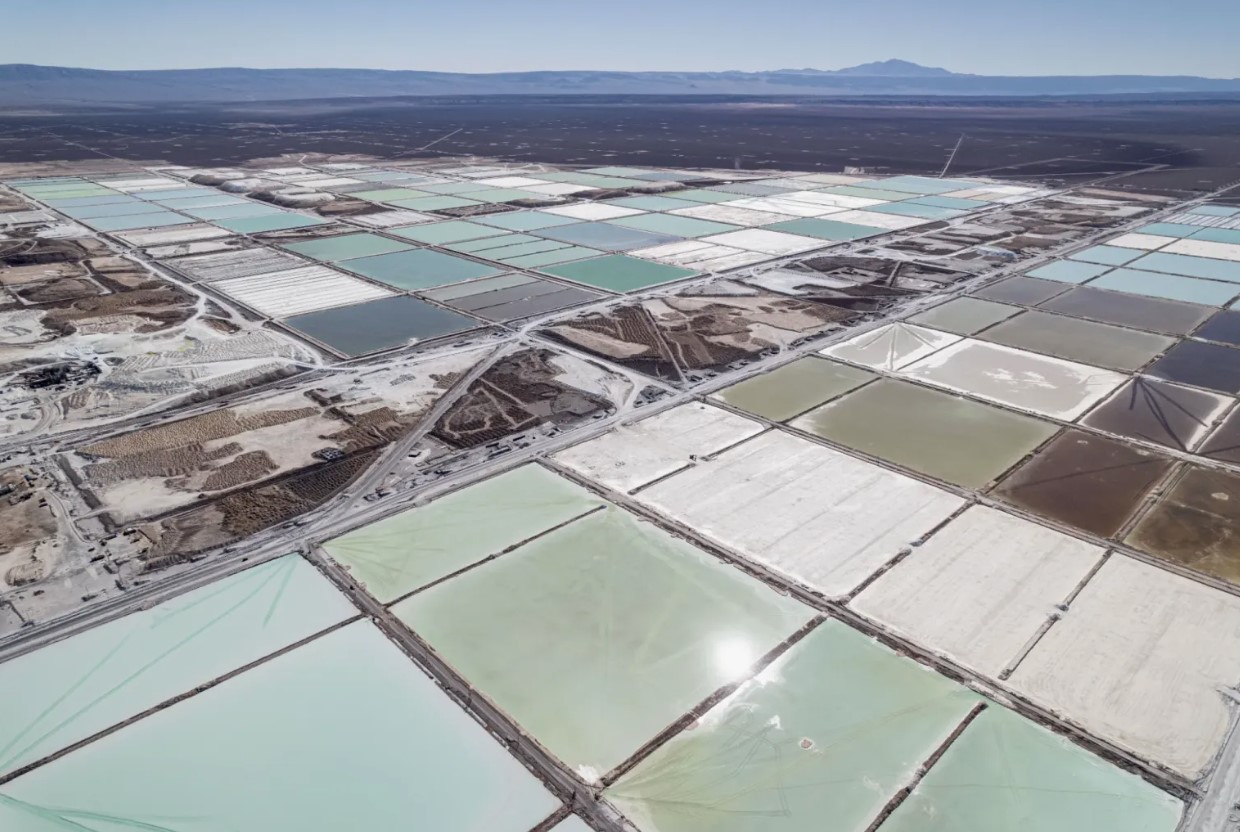
Lithium in Latin America is controlled not by corporations but by the rules of the game in three countries. Chile is steering toward the state, Argentina is courting investors, and Bolivia has still not started production. Who is actually pumping the brine? Whose money is behind the projects? And where does Russia fit in?
Three Countries, Three Models
The lithium triangle of Chile, Argentina and Bolivia holds more than 40% of the world's measured and identified resources, according to the U.S. Geological Survey. Other analysts put the share at up to 60% of global reserves; the figures depend on the counting methodology. One thing is clear: these three neighbors will determine how much lithium battery makers get ten years from now.
Their approaches are opposite to one another. A study by lawyers at the University of California describes it this way. In Bolivia, the constitution assigns lithium, and the entire extraction chain, to the state. In Argentina, the mineral belongs to the provinces, which readily hand out rights and tax breaks to investors. In Chile, the state remains the owner, but it bargains hard over terms and admits only two private players.
Chile: The State Returns, but Not Right Away
Chile remains the anchor of the region. In 2025, the country produced 56,000 tonnes of lithium in metal equivalent, while Argentina produced about 23,000. The main asset is the Salar de Atacama, the world's second-largest lithium operation. Benchmark forecasts that in 2026 it will account for about 12% of all lithium mined worldwide.
At the end of 2025, state-owned Codelco and private SQM closed a deal: the joint venture NovaAndino Litio received rights to the Atacama until 2060. Codelco holds 50% plus one share. But operational control remains with SQM until 2030, and SQM consolidates the venture on its books. Codelco itself acknowledges in its reporting that it does not manage the venture in 2025-2030. The wheel passes to the state only in 2031.
Capacity will grow from about 210,000 tonnes of carbonate equivalent per year to 300,000 by 2030. Next door operates the second company, Albemarle, which in March 2026 filed an application for a permit for a direct lithium extraction project in the Atacama. It turns out that Chile's "nationalization" is stretched over five years and looks more like a deferred transfer of power.
Argentina: Open Doors and Construction Sites
Argentina is moving faster than anyone. The country produces about 34,000 tonnes a year and, according to CRU estimates, could become the world's third-largest producer by 2027. Its potential is estimated at up to 260,000 tonnes, and 18 projects are due to start by 2027.
This is no longer just plans. Eramet's Centenario reached 90% of design capacity in June 2026. Cauchari-Olaroz produced 9,280 tonnes of lithium carbonate in the second quarter. Rio Tinto will invest $2.5 billion in expanding Rincon to 60,000 tonnes per year, with first output promised in 2028. Against this backdrop the main point is clear: in Argentina, decisions are made by investors, while the provinces compete over who will offer more incentives.
This model has a downside. Control over the resource is dispersed among foreign companies and provincial authorities, leaving the federal center with few levers. If global demand falls, the regions that bet their entire budget on lithium will suffer most.
Bolivia: The Most Resources, the Least Lithium
Bolivia holds one of the largest lithium reserves on the planet but in practice produces almost nothing. The state-owned YLB turns out several thousand tonnes a year at a plant designed for 15,000. The 2026 reactivation plan envisaged only 3,600 tonnes of lithium carbonate.
The reason is that the constitution requires the state to retain at least 51% in any project. In 2024, under President Arce, YLB signed two contracts for direct extraction plants in Uyuni with a combined value of more than $2 billion. The first was with Uranium One, a subsidiary of Rosatom: a plant of 14,000 tonnes per year and roughly $970 million in investment. The second was with a Chinese party. But a court suspended their consideration in Congress in May 2025, and as of the end of September 2026 neither contract has been ratified.
The current government of Paz proposes an international tender and a new lithium law, which still has to pass Congress. So the Russian bet on Bolivian lithium is, for now, hanging in the air.
Whose Money and Whose Politics
Looking at control, the picture is mixed. In Chile, the state is regaining its levers through Codelco, but with a five-year delay. In Argentina, Western and Asian investors are in charge. In Bolivia, the political struggle is in charge, and it freezes any investment. For the market, the most important thing is that no one in the region owns the price: on August 28, 2026, Chile, Argentina, Bolivia and Peru signed a declaration on strategic minerals in Santiago, but without quotas or production targets. It is a statement of intent, not a cartel.
Hence a practical conclusion for those following the topic. Supply will be expanded by Argentina and Chile, with the former moving faster. The risks will remain in Bolivia and in politics: a new president, new taxes or a change in the rules can reshuffle the lineup within a year.
What This Means for Russia
For Russia, Rosatom's Bolivian contract was a way to enter the lithium market while bypassing sanctions. For now, its fate is uncertain. If Bolivia holds a tender, the Russian side will face competition, and the law requiring a 51% state share remains an unchanging condition.
In addition, Russian processors and battery makers depend on raw materials that today flow mainly to China. Any attempt to obtain lithium from Latin America runs into the fact that the main flows are already contracted by Chinese and Western buyers. The realistic path is long-term contracts for small volumes or partnership with Chinese processors, rather than owning deposits.








.png)
.png)

.png)
.png)