


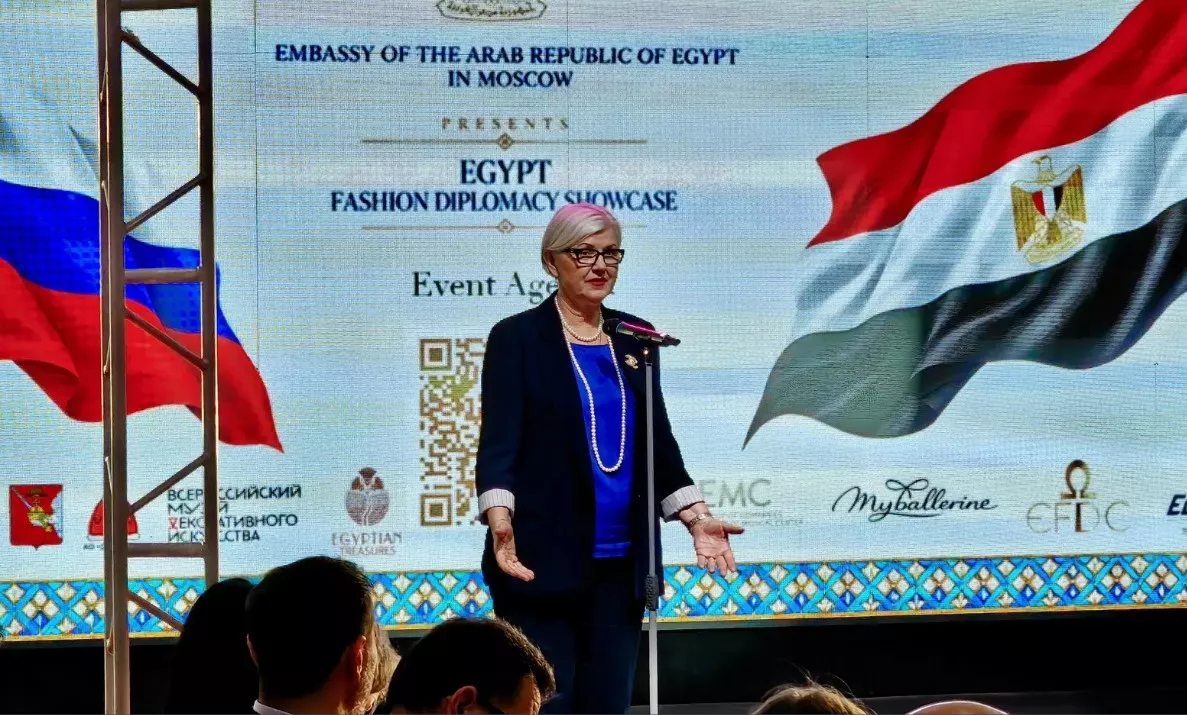
While politicians around the globe engage in endless talks about talks, there are people who don't wait for peace to arrive—they create it. Right now, with their hands, with fabric, with embroidery, and through a dialogue of cultures. That is exactly how one might describe what took place at the All-Russian Decorative Art Museum, which hosted a showcase of contemporary Egyptian design—an event that served as the prologue to a major exhibition, "Costumes of Egypt: Continuity Beyond Time and Space," set to open in October under the curatorship of Tatiana Vyacheslavovna Rybkina.
Diplomacy Without Neckties or Protocol
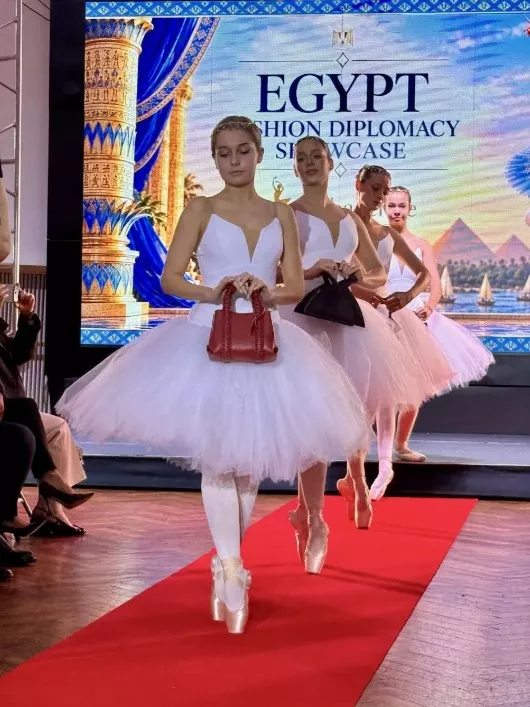
Formally, this was a fashion show. In substance, it was an act of cultural diplomacy executed with such elegance that professional diplomats could learn a thing or two from it. Together with the Egyptian Fashion and Design Council (EFDC) and the Kosygin Russian State University, the museum presented premium brands and independent design projects—Okhtein, Mix and Match, Paz Cairo, Sara Onsy, Huwa, and Ramla. On the runway, contemporary interpretations of traditional garments met everyday and evening wear, accessories, and jewelry—in other words, the entire spectrum of how an ancient civilization speaks the language of the twenty-first century.
It seems to me that this is precisely the central point: culture here is not an exhibit under glass but a living, breathing process. Egyptian designers are not copying the pharaohs—they are conducting a dialogue with them, weaving millennia-old ornamental motifs into silhouettes that could just as easily be seen tomorrow on the streets of Cairo, Moscow, or Dubai.
A Collection That Traveled the World and Has Now Arrived in Moscow
At the heart of the October exhibition is the collection of Shahira Mehrez, one of the most influential figures in Egyptian art and a renowned collector. Her collection is regularly exhibited at leading venues around the world, and this will be its first showing in Russia. Traditional costume from various regions of Egypt—clothing, jewelry, and objects of decorative art—will bear witness to local tradition, craft technique, and an artistic language shaped over centuries.
This is not simply a beautiful exhibition. It is an ethnographic document presented through the lens of contemporary costume reconstruction—an attempt to see how the past continues to converse with the present, and how craft becomes a universal language that needs no translation.
Tatiana Rybkina: Director, Diplomat, Keeper of Cultural Dialogue
Behind this project—as behind dozens of other cultural bridges the All-Russian Decorative Art Museum has built in recent years—stands its director, Tatiana Vyacheslavovna Rybkina. A candidate of art history and a graduate of the Urals Conservatory and the postgraduate program of the Gnessin Russian Academy of Music, she took the helm of the museum with a clear understanding of its mission: to turn it into a space for dialogue between past and future while preserving the depth of tradition.
It is under her leadership that the museum on Delegatskaya Street has transformed from a mere repository of beautiful objects into a genuine platform for cultural diplomacy. This year, marking its 45th anniversary, the museum has carried out dozens of exhibition projects, signed a cooperation agreement with the Nizhny Novgorod region, presented exhibitions dedicated to Vrubel and Vera Mukhina, and now has opened its doors to a dialogue with Egypt. And this is far from the only international vector: the museum is already preparing a research exhibition titled "Russian Egypt" and a showcase of Russian Art Nouveau collections in China.
It's worth saying plainly: what Tatiana Rybkina is doing is not simply museum management. It is a quiet yet remarkably effective form of philanthropy and peacemaking. While some are busy arguing over who is right in the latest international dispute, she is finding artists, collectors, universities, and entire countries willing to sit down at the same table—or rather, to stand together on the same runway—and demonstrate that what unites their cultures is greater than what divides them. This is the true role of an ambassador of peace: not delivering grand speeches, but building bridges with hands, fabric, and art—bridges that will outlast any political storm.
The Miracle Lies in What's Common Within Difference
Showing how the decorative art of different cultures interacts with and enriches one another is an important direction of the museum's work, and this is not the first time it has turned to the traditions of other countries. Each time offers an opportunity to see what is common within difference, to understand how craft and art become a language comprehensible beyond time and borders.
And perhaps this is the most hopeful lesson of that September evening at the museum on Delegatskaya. Egyptian ornament and Russian embroidery, Cairo silk and Moscow linen—different materials, different eras, different latitudes. Yet lay them side by side on a single runway, and suddenly it becomes clear: the language of beauty needs no interpreter. It is understood by viewers in any country, under any political climate, in any historical era.
While diplomats debate protocols and heads of state argue over borders and sanctions, someone simply shows the world a dress embroidered with motifs drawn from ancient Egyptian ornament—and that alone is enough to fill a hall with delight rather than tension. Perhaps this is the most persuasive argument for what culture can achieve where politics cannot: it does not build borders, it erases them—stitch by stitch, display case by display case, exhibition by exhibition.










.png)
.png)

.png)
.png)