


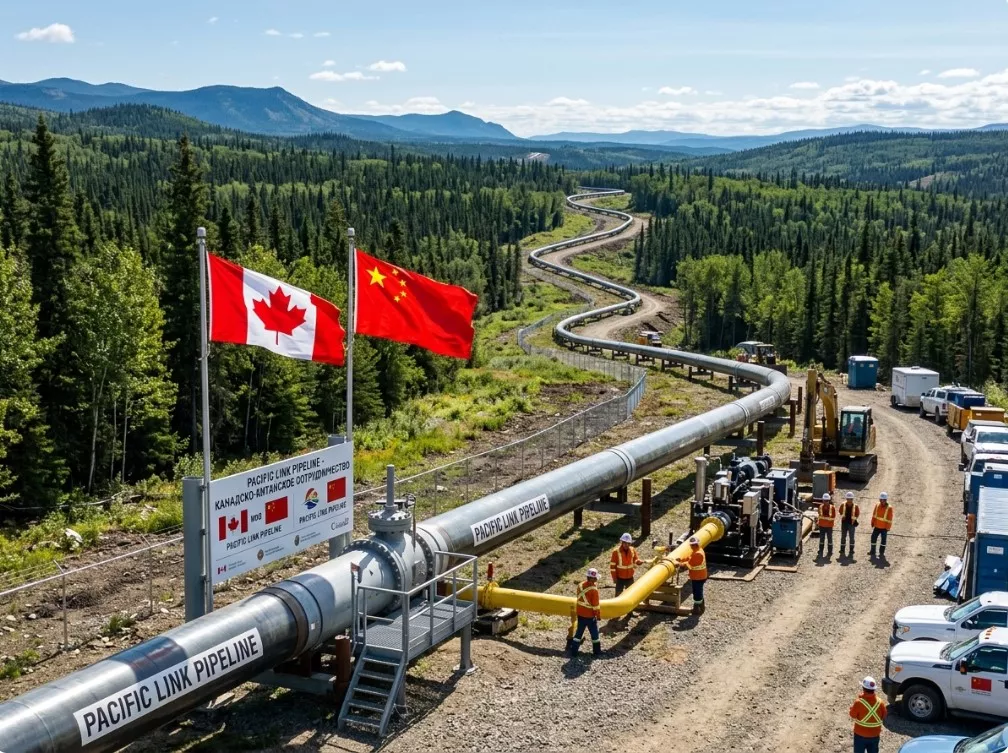
Pacific Link: Canada Launches a Pipeline to Stop Feeding the American Market
Canada has designated the Pacific Link pipeline a project of national interest: 1 million barrels per day, C$35.2–43.7 billion, and exports to Asia. What this means for the United States.
Canada has officially turned oil into an instrument of geopolitics. Prime Minister Mark Carney has added the Pacific Link pipeline to the list of national-interest projects: the new line is meant to divert up to a million barrels a day of Alberta crude from the American market to Pacific terminals. Why did Ottawa decide on such a turn, how much will it cost, and what will Washington lose?
Not Just a Pipe, but a Change of Route
Pacific Link is not just another infrastructure project from a government presentation. It is an attempt to change the very architecture of Canada's energy dependence.
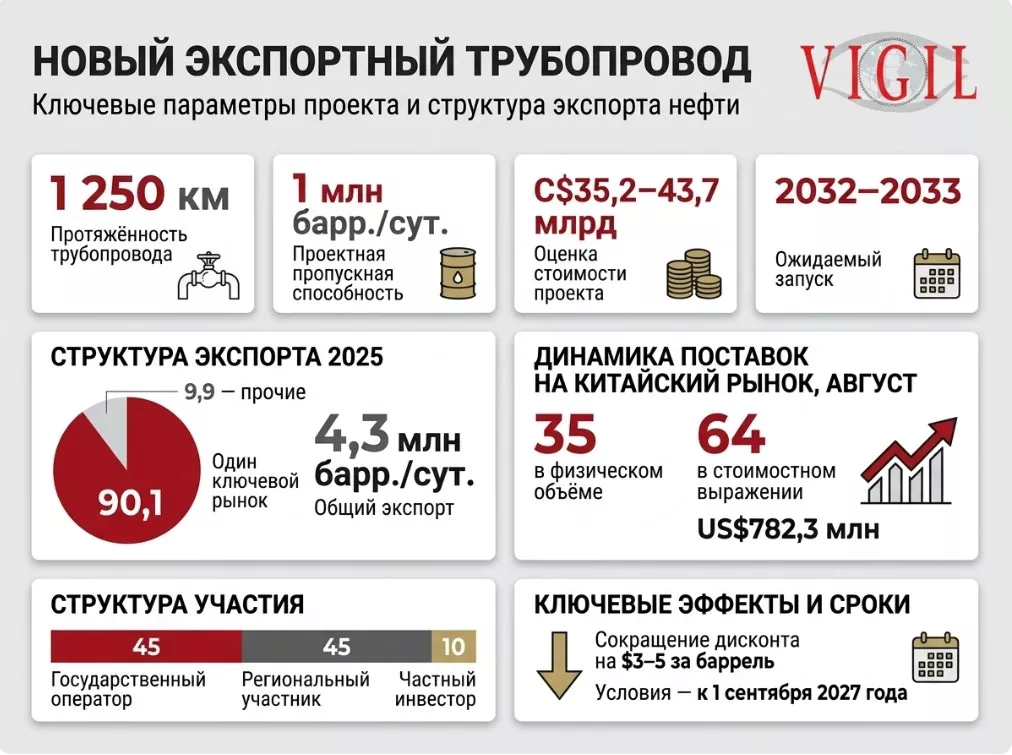
The roughly 1,250-kilometer pipeline is to run from Bruderheim, Alberta, to a deepwater port in Delta, British Columbia. From there, Canadian oil will go by tanker to Asia, primarily to China, South Korea and Japan. Its capacity is up to one million barrels per day. By comparison, the expanded Trans Mountain system, the only existing outlet for Canadian oil to the Pacific, is rated at roughly 890,000 barrels per day and is already operating at its limit.
In other words, Ottawa is not simply adding capacity. It is creating a second, independent corridor to the global market.
Alberta estimates the project's cost at C$35.2–43.7 billion, or roughly US$24.7–30.7 billion. The figure already includes a reserve for inevitable cost overruns. The experience of Canadian megaprojects suggests this reserve is unlikely to remain untouched.
Why This Is a Blow to the US
The numbers here matter more than any loud statements.
In 2025, Canada exported 4.3 million barrels of crude oil per day. Of that, 90.1%, or 3.9 million barrels, went to the United States. In other words, almost all of Canada's oil exports have flowed for decades through a single pipe, into the American economy.
For Washington, this was convenient. Canadian heavy crude arrived in a steady stream, and American refineries became accustomed to its quality and price. Western Canadian crude has traditionally sold at a discount to the American benchmark WTI, because it effectively had a single buyer and limited access to the sea.
Now that discount may narrow. The Canadian government expects Pacific Link, together with the optimization of Trans Mountain, to cut the gap between Western Canadian Select and WTI by $3–5 per barrel. That is a direct loss of margin for American refiners, who for years bought Canadian crude below the market price.
But the problem for the US is not only price. It is a question of vulnerability. If Canada gains an alternative outlet to the Pacific, Washington loses part of its leverage. Alberta's oil stops being a hostage of American logistics.
Carney Calls It Economics, but It Is Politics
Formally, Pacific Link is an economic project. Ottawa promises more than C$20 billion in annual GDP growth, 140,000 jobs and C$100 billion in government revenue through 2060.
It sounds impressive, though such estimates should always be read with a calculator in hand. Jobs, taxes and multipliers appear in these calculations with remarkable ease. But that is not the point.
The point is that Carney has for the first time used the Building Canada Act to declare a pipeline a project of national interest. This allows the project to move through a single accelerated federal approval mechanism instead of the usual string of separate permits and departmental procedures.
The conditions are to be ready by September 1, 2027. If all goes to plan, early construction work could begin immediately afterward, and the pipeline would start operating in 2032–2033.
For a country where major energy projects have for years been bogged down in approvals, this is a revolution. For the US, it is an alarming signal: Ottawa is no longer prepared to wait for Washington to decide whether Canadian oil suits it.
Environmental Rules Not Abolished, but Subordinated to Strategy
Critics are already calling Carney's decision a rejection of the green agenda. That is too crude a simplification.
The government has not repealed environmental legislation. It has changed the order in which it is applied. Under the accelerated procedure, a single final statement of conditions is to replace the separate permits previously issued under the laws on fisheries, endangered species, marine activity and environmental protection.
This is not the abolition of rules but their concentration in one set of hands. From a business perspective, that is efficiency. From the environmentalists' perspective, it is a risk that complex issues will become appendices to a political decision that has already been made.
There is also a compensatory element. Ottawa links its support for the pipeline to the Pathways project, one of the largest carbon capture and storage programs in the world's oil industry, located in Alberta. The Pacific Link route follows a southern corridor and, according to the government, bypasses the sensitive ecosystems of British Columbia's northern coast. The ban on oil tankers off the northern coast remains in place.
One can argue about how convincing this construction is. But the fact remains: Canada has not abandoned climate rhetoric. It has simply decided that energy security and access to Asian markets matter more than another decade of regulatory uncertainty.
Asia Is Already Voting with Its Money
While Pacific Link remains a project on paper, the market is already changing.
In August, imports of Canadian oil into China rose by almost 35% year on year. In monetary terms, the increase was even more striking: 64%, to US$782.3 million. This is not an abstract trend but a tangible redistribution of flows.
The reasons are clear. China needs heavy crude for petrochemicals, and Canadian grades are well suited to the task. At the same time, the trade conflict with the US is pushing Beijing to seek suppliers outside the American orbit. Canadian oil moving across the Pacific fits this logic perfectly.
Trans Mountain's management expects Asia to eventually take about 70% of Canadian oil exported via the Pacific route. China, according to the operator's forecasts, will remain the largest single buyer.
This shifts the balance. Previously, Ottawa could talk about diversification but physically lacked a sufficient pipeline to the Pacific. Now it has a chance to turn rhetoric into barrels.
Who Pays and Who Gains
The project's structure is also telling. Through the construction phase, the federal Trans Mountain Corporation and the Alberta government are to own 45% each, and Calgary-based Pembina Pipeline 10%. Indigenous communities are being offered a minimum 10% stake through government loan guarantee programs.
In effect, the state is taking on a significant share of the risk. That is logical: private business was in no hurry to invest billions in a project whose fate depended on political circumstances and endless litigation. Now the risk is shifted onto the taxpayer, while the potential benefit is promised to be shared more widely.
Opponents of the project are already warning of risks to the coast, marine wildlife and Indigenous rights. Their arguments cannot be dismissed. But the political reality is this: after years of blockades, Ottawa chose speed. And it chose it not for the sake of abstract modernization, but to reduce dependence on a single buyer.
What Washington Loses
For the US, the loss is not immediate. Pacific Link will start operating, if it does at all, only in the early 2030s. Until then, American refineries will continue to receive Canadian barrels.
But the long-term signal is already clear. Canada is ceasing to regard the US as an alternativeless market. It is building infrastructure that will allow it to sell oil to Asia even when relations with Washington are bad. And judging by the trade war, they are bad.
For the American economy, this means three things.
First, competition for Canadian crude. Asian buyers are willing to pay, and the more Canadian oil goes east, the weaker the discount on which American refiners have grown accustomed to profiting.
Second, a weakening of energy interdependence. For decades the US regarded Canadian oil as a guaranteed resource. Now it is a resource with an alternative route.
Third, political cooling. A pipeline can be built in a few years, but trust between countries erodes faster. Carney makes no secret that Pacific Link is a response to a structural vulnerability of the Canadian economy. And that vulnerability arose not in Beijing or Brussels. It arose in the relationship with Washington.
Not an Oil War, but an Exit from Dependence
Calling what is happening an "oil war" is striking but not quite accurate. Canada is not bombing American tankers or imposing an embargo. It is doing something more boring and more dangerous for the US: building an alternative.
Pacific Link will not destroy Canada's trade with the US. The volumes are too large, the integration too deep, and too many American refineries are configured for heavy Canadian crude. But it changes Ottawa's negotiating position.
Previously, Canada could only voice indignation at American tariffs and trade threats. Now it has a material response: a million barrels a day that can go not south but across the Pacific.
Therein lies the main irony. For years, Washington pressed its allies to pursue "strategic autonomy" and to reduce dependence on unfriendly suppliers. Canada listened. It simply applied the principle to Washington itself.
And if Pacific Link is built on schedule, the next US administration will inherit not just a problem in bilateral relations. It will inherit a Canada that has learned to sell its oil without looking over its shoulder at the American market.















.png)
.png)

.png)
.png)