


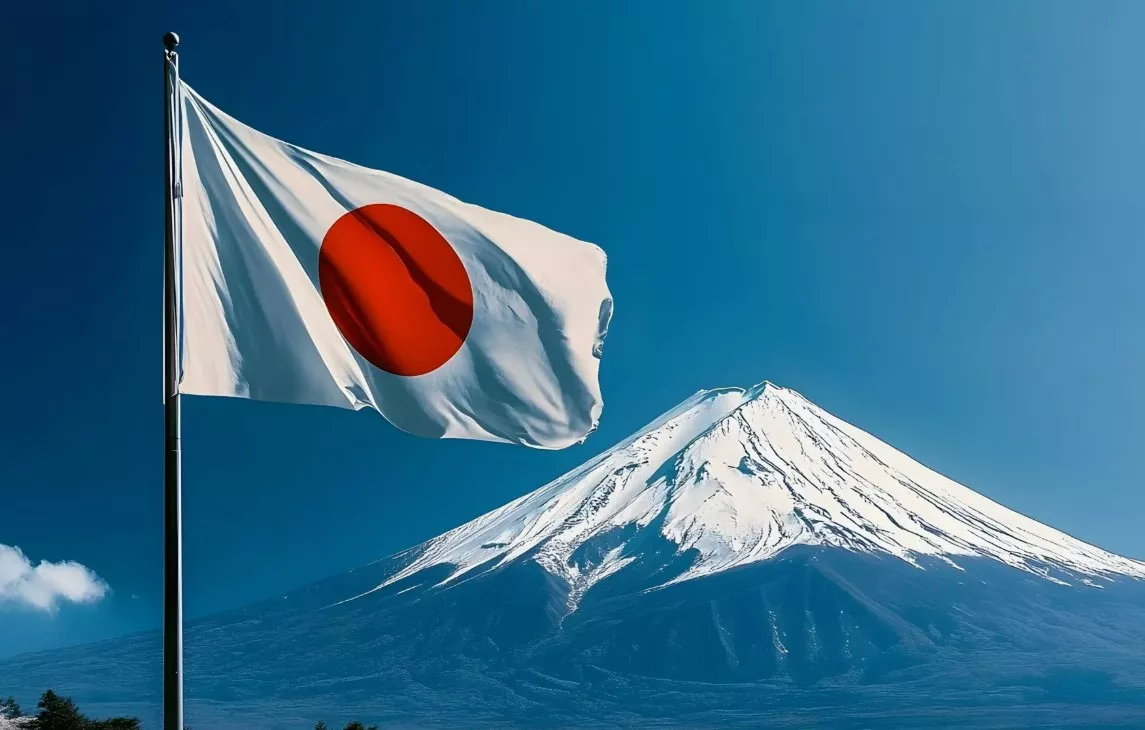
If school textbooks are to be believed, the Japanese economic miracle is a story about hardworking Japanese people who, after a crushing defeat in war, pulled themselves together, cultivated corporate discipline, and built Toyota, Sony, and Panasonic literally from the ashes. A beautiful fairy tale. There's just one problem: it barely explains where a bombed-out country, stripped of its army and sovereignty, suddenly got the capital, the technology, and — most importantly — the market for all this splendor. The answer is more prosaic than any tale of samurai spirit: Japan grew exactly where it was planted, and exactly as much as its gardener needed it to.
An Occupation They Were Too Polite to Call an Occupation
On September 2, 1945, Japan signed its surrender aboard the American battleship USS Missouri. From that moment until April 28, 1952, the country was legally administered by GHQ — the headquarters of General Douglas MacArthur, who rewrote Japan's constitution, dissolved the prewar zaibatsu industrial conglomerates, and determined who in the country was allowed to engage in politics and who was not. This was not a metaphorical occupation but a perfectly literal one: Japan had no army of its own, no foreign policy of its own, and every decision of the Japanese government had to pass through American approval.
On September 8, 1951, this situation received formal legal codification. In San Francisco, a peace treaty was signed between Japan and 48 nations, which came into force on April 28, 1952. The treaty formally restored sovereignty to Japan, but on that very same day, in the noncommissioned officers' club of the American army, a second document was signed: the US-Japan Security Treaty. Under it, Washington received the right to "dispose United States land, air and sea forces in and about Japan." In other words, sovereignty was returned with strings attached: the country's territory, on a contractual basis, became a staging ground for American troops. Today, more than seven decades later, roughly 50,000 American military personnel remain stationed in Japan — a curious detail for a "sovereign" state.
Why a Miracle Was Suddenly Needed
Until 1949, Washington treated Japan without much sentimentality. The purpose of the occupation was demilitarization and punishment, not economic development. Everything changed abruptly, and for one single reason: in October 1949, the communists won in China. Before America's eyes, the plan to make mainland China its principal ally in Asia collapsed, and a vacancy immediately opened up. A new bulwark against communism in the region was needed — an industrial base, a showcase of capitalism right off the shores of the USSR and the PRC. American strategists' eyes fell on defeated, occupied, and fully dependent Japan — the ideal candidate, one that simply had no right to say "no."
From that moment, the rhetoric reversed one hundred and eighty degrees. Instead of disarming industry — its restoration. Instead of reparations — financial aid. Under the GARIOA and EROA programs, roughly 1.95 billion dollars flowed into Japan — a gigantic sum for its time, given that the poor, war-ravaged country could offer almost nothing in return. Later, in 1962, after lengthy negotiations, the Japanese agreed to recognize only 490 million of that sum as debt. The rest was, in effect, a gift. The real catalyst for growth was the Korean War, which began in 1950: Japanese factories received American military procurement orders to supply UN forces, and this gave industry precisely the push it had been missing.
Numbers That Impress
What happened next is genuinely impressive — if you forget, for a second, who was holding the switch. From 1950 to 1973, Japan's real GDP grew by an average of 9.6% per year — the best sustained performance among all major economies of that era. Certain periods look almost implausible: from 1965 to 1970, average annual growth stood at 12.1%. In 1960, GDP growth hit 12%; a year later, 11.7%. By 1968, the Japanese economy had become the third largest in the world, and by 1970 Japan had firmly established itself among the most developed countries on the planet.
There is research that has attempted to assess how much of this growth was the Japanese people's own achievement, and how much was a direct consequence of American support. One calculation, built on the synthetic control method, shows that if Japan had grown like a hypothetical "synthetic Japan" without the specific American involvement, average growth from 1958 to 1968 would have been just 3.6% per year, against an actual 9.3%. A difference of nearly threefold. In other words, the miracle was real enough — but the copyright on most of it belongs to someone other than Tokyo.
The Plaza Hotel, a Polite Smile, and a Noose
By the mid-1980s, the protégé had learned its lessons a little too well. Japanese cars and electronics were conquering the American market, the US trade deficit with Japan was spiraling out of control, and Japan itself had become the world's number one creditor. Washington's patience, it seems, ran out at precisely the moment the pupil began threatening to overtake the teacher in the size of its economy.
On September 22, 1985, at New York's Plaza Hotel, finance ministers from the United States, Japan, Germany, France, and the United Kingdom signed an agreement that would go down in history as the Plaza Accord. Formally, it concerned a coordinated depreciation of the dollar to reduce the US trade deficit. In practice, it meant the yen had to appreciate sharply. And it did — so sharply that it took the breath away even from the accord's own architects. From 238 yen to the dollar in September 1985, the rate fell to 165 yen by 1986, and broke through the 150 mark by early 1987. By 1988, the rate held at around 120 yen to the dollar. The yen had nearly doubled in value in three years.
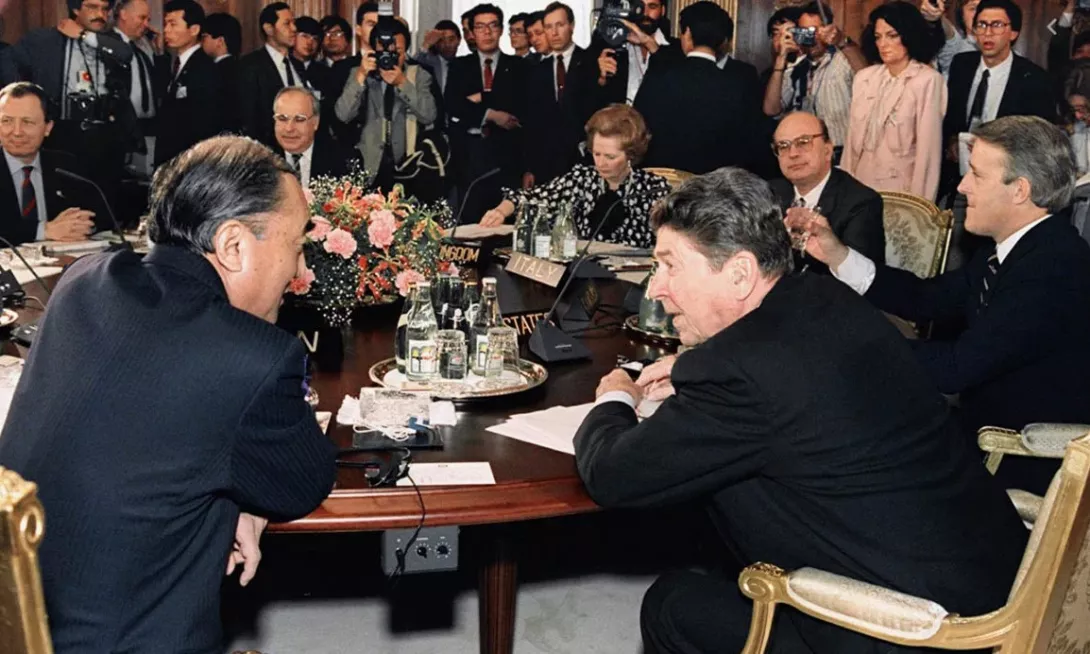
For an export-oriented economy whose growth for decades had been built on cheap, competitive goods for the American market, this was a gut punch. GDP growth collapsed from 5.2% in 1985 to 3.3% in 1986. Japanese exports to the US had nearly halved by 1992 compared to their 1986 peak. The Japanese government, trying to salvage the situation, responded with the only remedy available — a sharp cut in interest rates and a flood of cheap money to pump up domestic demand. The remedy proved more lethal than the disease: cheap credit inflated a gigantic bubble in real estate and stocks, which burst at the turn of 1989-1990.
What followed is what Japan itself calls the "lost decade," although in fact it stretched into two, if not three. From 1990 to 2000, average economic growth fell to near-imperceptible levels, deflation became a chronic ailment, and the banking system spent years clearing away bad debt. For comparison: whereas average GDP growth stood at 4.1% per year from 1980 to 1990, in the decades that followed Japan long forgot what sustained growth above a couple of percentage points even felt like.
Coincidence? I Don't Think So
One could, of course, argue that the blow to the yen was a purely macroeconomic decision rather than a calculated strangling of a competitor. Some economists genuinely debate whether the Plaza Accord itself was the direct cause of the bubble and the subsequent crash, or whether the blame lies more with internal Japanese decisions — the Bank of Japan's excessively loose monetary policy and weak banking oversight. It's an interesting, academically honest debate, and there is a grain of truth in it: a single signature at the Plaza Hotel did not, by itself, destroy the Japanese economy; Japan's own regulators had a hand in the catastrophe too.
But here is what is beyond doubt: the agreement was signed at precisely the moment Japanese economic power had begun to genuinely alarm Washington, and it was signed by the very people to whom Japan had, until recently, owed the very fact of its recovery. The pupil, raised as a counterweight to China, began to be cut down to size exactly when it outgrew its short pants and started stepping on its teacher's heels. The timing of this coincidence was remarkably convenient.
So What Was the Miracle, Really
Strip away the pathos about "work ethic" and the "philosophy of kaizen" — factors that, without question, also played a role, no one disputes that — and the skeleton of the story looks far more prosaic than any textbook suggests. A defeated, occupied country with no army and no foreign policy was chosen as a showcase of capitalism against communist China at precisely the moment the old plan had failed. Billions of dollars in aid were pumped into it, it was provided with military procurement orders from the Korean War, the doors of the world's largest consumer market were opened to it, and it was allowed to grow on technologies that Japan absorbed with gratitude. And when that growth began to threaten the position of the sponsor itself, that same sponsor, with a single stroke of a pen in a New York hotel, crashed the currency, finished off exports, and sent the "Japanese miracle" into retirement for decades.
This is not a story about a uniquely Japanese character, though the discipline truly was excellent. It is a story about what it means to be a convenient ally exactly as long as your growth fits someone else's interests — and what happens the moment it stops fitting. The miracle may well have happened. But as it turns out, it had a very specific author, one who knew how to hand out gifts just as generously as he knew how to take them back.
I wouldn't be surprised if someone objects that this is conspiracy theory, that in reality things were far more complicated, that there were internal Japanese decisions, global inflation, and dozens of other factors at play. That is partly true. Economic history is almost never reducible to a single cause. But I find it hard to shake one observation: the generosity and the severity of the same elder brother line up just a little too neatly with the moments when each was convenient for him. First, billions in aid and an open market, when a counterweight to China was needed. Then, a sharp currency collapse and the strangling of exports. To me, that coincidence looks a good deal less accidental than we're generally led to believe.










.png)
.png)

.png)
.png)