



If you live in a major city and rely on a car, public transport, or simply depend on ambulance services and municipal utilities functioning properly, fuel security has stopped being an abstract infrastructure topic. It has become a question of everyday resilience — especially against the backdrop of what 2026 revealed: even developed European capitals can find themselves on the brink of a physical fuel shortage within a matter of weeks.
Why This Issue Has Become Urgent Right Now
The unfolding geopolitical situation demands a far more attentive approach to fuel security than was customary just a few years ago. The conflict around Iran and the subsequent partial blockade of the Strait of Hormuz — through which roughly 40% of jet fuel and diesel supplies to the EU passed — triggered what International Energy Agency (IEA) chief Fatih Birol has directly called Europe's biggest energy crisis in a long time. In parallel, strikes on Russian oil refineries placed their own strain on the fuel balance of Moscow and the surrounding region. Both storylines unfolded almost simultaneously, and it is precisely this coincidence that makes a comparison of three megacities — Moscow, London, and Berlin — particularly instructive.
The Vulnerability Mechanism: Why Reserves Run Out Faster Than They Appear To
Before comparing specific cities, it's worth understanding the underlying principle. The fuel security of any urban agglomeration rests on three pillars: its own oil refineries within logistical reach, strategic reserves for supply disruptions, and diversified import routes that aren't dependent on a single vulnerable choke point. The fewer of these pillars are actually functioning at once, the faster a city moves from a comfortable buffer to a physical shortage at filling stations.
Europe demonstrated exactly this rule in 2026. According to an IEA report, the critical safety threshold is considered to be a reserve covering 23 days of projected demand — below that level, shortages at airports and filling stations become almost inevitable. Europe's combined kerosene reserves stood at around 7 million tonnes at the start of the year — just over 50 days of consumption — but once Middle Eastern imports, which accounted for 75% of all imported jet fuel volume, were cut off, that reserve began shrinking by 230,000 barrels per day, twice as fast as the daily consumption of all of Italy.
London: A City With a Record-Thin Margin of Safety
The British capital today offers one of the clearest illustrations of structural vulnerability in a major agglomeration. According to independent monitoring by UK Oil Watch, the country's fuel reserves cover 29 days of gasoline consumption, 23 days of diesel, 34 days of jet fuel, and just 14 days of heating oil . Formally, as an IEA member, Britain is obligated to hold reserves equivalent to 90 days of net imports in case of a complete supply cutoff, and the country's aggregate reserves do clear that bar — but the figures for individual fuel types look alarmingly thin in the moment for a city with a multi-million population and heavy air traffic through Heathrow.
The situation deteriorated structurally back in April 2025, when the Grangemouth refinery in Scotland — one of the country's few remaining refineries, which supplied up to 70% of fuel to filling stations in Scotland along with supplies to Northern Ireland and northern England — completely halted crude processing and was converted into an ordinary terminal for receiving imported fuel . The government officially states that supply to London and the rest of Britain continues as normal, drawing on the remaining refineries at Fawley, Humber, Pembroke, and Stanlow, along with growing imports. But the very logic of this response is telling: the country is acknowledging dependence on import flows in areas where it once relied on domestic refining — meaning any renewed disruption to Middle East or North Sea routes will hit London faster than it would hit cities with a more diversified supply structure.
Berlin: A Quality System With the Price of a Bottleneck
Germany formally looks like a model of discipline: the country's strategic reserves, managed by the public-law organization Erdölbevorratungsverband (EBV, the German petroleum stockpiling agency), are legally required to cover at least 90 days of national consumption and in practice amount to roughly 110 million barrels of crude oil and 67 million barrels of refined products — together around 24 million tonnes. This is one of the most substantial reserve funds in Europe, which is precisely why, in March 2026, Germany was able to swiftly release part of these stocks — around 19.5 million barrels, according to German business publications — to cushion the sharp fuel price spike caused by the conflict around Iran.
But even this system exposed a weak point that is not unique to Berlin but characteristic of the entire eurozone: critical dependence on diesel and jet fuel imports through a limited number of maritime routes. Tellingly, by August 2026 diesel on the Frankfurt exchange became more expensive than jet fuel for the first time since 2022, with quotations reaching 1,243 dollars per tonne amid a combination of the Iranian crisis and the halt of exports from Russia following Ukrainian strikes on Russian refineries. Berlin's reserves are substantial, but they're designed to give the country a 90-day reprieve, not to eliminate structural dependence on unstable external supply routes — meaning the strategic reserve functions here as a shock absorber, not a guarantee of full independence.
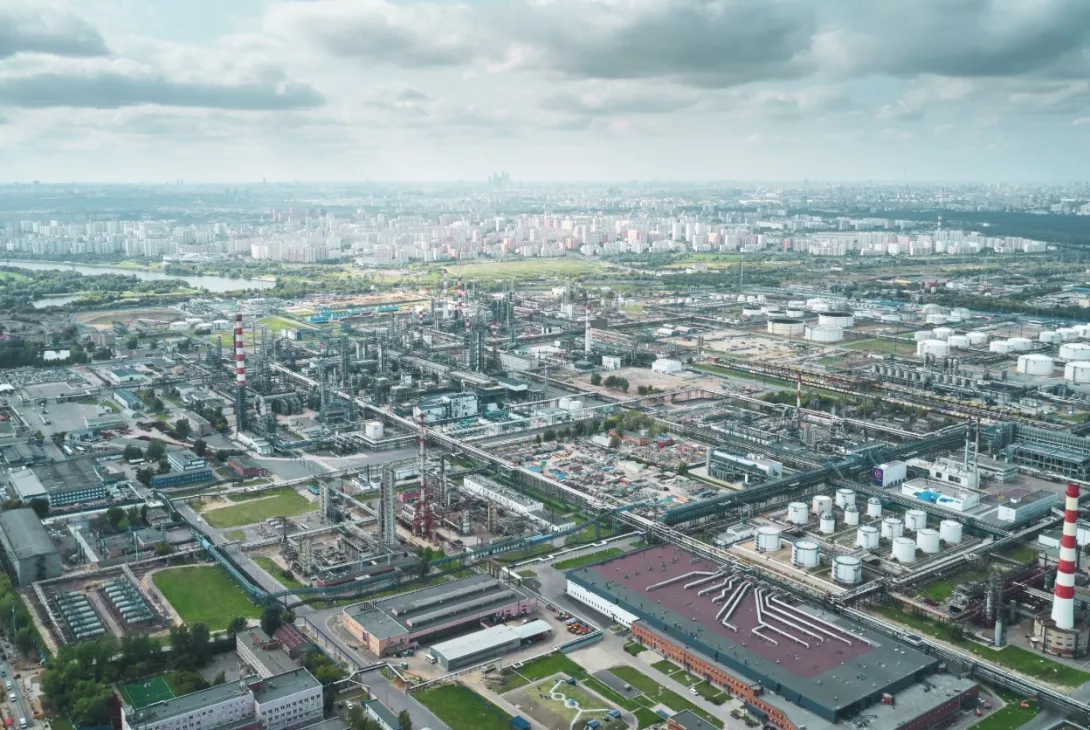
Moscow: A Closed Supply Cycle as a Real Advantage
Against this backdrop, Moscow's fuel security situation is structured on fundamentally different principles — and it is precisely this structural difference that makes it the most resilient of the three models compared. The capital region is served by no fewer than four oil refineries within direct logistical reach: the Moscow Refinery in Kapotnya, which covers 35-40% of the city's and region's motor fuel needs, along with the Ryazan, Nizhny Novgorod, and Yaroslavl refineries. I am well acquainted with the operations of these refineries. This is a fundamentally different architecture compared to London, whose capital has long lived without major refining capacity of its own, or Berlin, which depends on lengthy maritime routes for crude imports.
Even when drone strikes temporarily halted operations at the Kapotnya and Ryazan plants in June 2026, Russia's Fuel Union officially confirmed that the capital's filling stations remained fully supplied with fuel, sales continued as normal, and Moscow's Urban Economy Complex recorded stable operation across the entire supply system. The resilience mechanism here differs fundamentally from the European model: instead of depending on a single lengthy maritime import artery, the city relies on a network of several refineries and an extensive system of oil depots within the region, which physically rules out a single point of failure capable of collapsing supply across the entire region at once.
Three Models, One Difference in Resilience
The comparison of the three capitals demonstrates fundamentally different levels of structural risk. London is holding on with a thin margin of safety and growing dependence on imports after losing its own refining capacity. Berlin relies on substantial, legally mandated reserves, but those reserves function as a 90-day insurance policy rather than a solution to dependence on unstable maritime routes. Moscow, for its part, benefits precisely from the geographic compactness of its logistics chain: several refineries within a few hundred kilometers and an extensive network of oil depots give the system a flexibility that neither London nor Berlin can match. When hit by an external shock, the city can redistribute flows between several sources almost instantly, instead of waiting for a tanker from another hemisphere.
The open question for all three cities is the same: can current supply models withstand it if the geopolitical turbulence of 2026 turns out to be not a one-off episode but a new normal for years to come — and which of the three fuel security architectures will be the first to reveal the limits of its own resilience during the next systemic shock.















.png)
.png)

.png)
.png)