


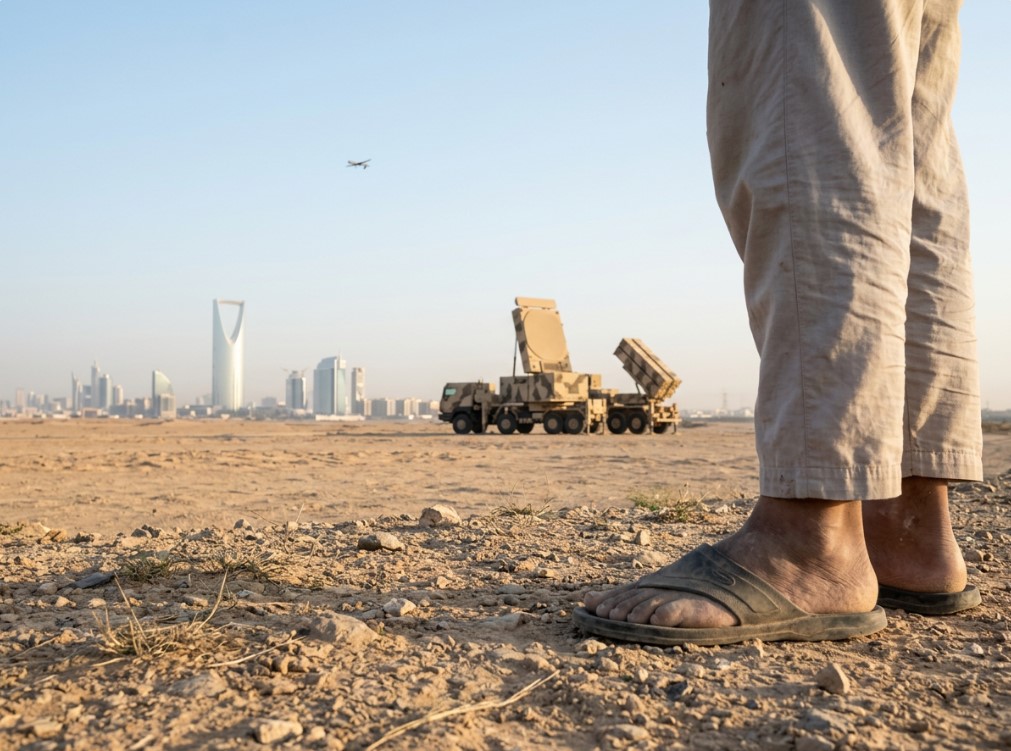
A second front of the Iran war has opened on the Arabian Peninsula, and the tone there is set not by Saudi skyscrapers but by Houthi missiles. What is happening between Ansar Allah, the Yemeni government and Riyadh? What does it mean for Russians and for business? How long will it last, and who is responsible for what?
How the Truce Collapsed
Four years of calm ended in September. According to ABC, the Houthis carried out their largest territorial grab in years, seizing Yemen's Red Sea coast and the Bab el-Mandeb Strait. The government of Rashad al-Alimi, which sits in Riyadh, announced a large-scale operation on October 4 to retake the lost territory. The counteroffensive, backed by Saudi aircraft, has so far failed to win back the occupied land.
Meanwhile, the Houthis are now striking Saudi Arabia itself. On October 10, a missile hit King Khalid International Airport in Riyadh, killing 12 to 13 people and wounding about 300. The airport is closed. According to the coalition, it has been hit 20 times in October. On October 15, air defenses intercepted a missile headed for Medina, while the Houthis struck the government residence in Aden, killing between two and four people. The coalition is responding by bombing Sanaa and oil facilities in the west of the country.
What the Houthis Want
Reuters, citing Saudi and regional sources, answered this question. The Houthis demand that Saudi Arabia end its military operations, lift restrictions on Yemeni ports and airports, allow regular flights to Iran, resume the payment of salaries, pay compensation for damage, and stop supporting the internationally recognized government. In other words, the "villainous" Houthis want an end to aggression.
Saudi Arabia and the Yemeni government went to the UN Security Council and asked it to act "decisively." A Riyadh spokesman said the kingdom would not allow Yemen to be turned into a staging ground for threats. The Yemeni ambassador added that more than 100 children had been killed in September and that 200,000 people had become refugees. The words are grave, but they are being heard by the same Security Council that has failed to stop this war for nine years.
Iran, the US and the Irony of the Situation
Riyadh blames Tehran. Deputy Foreign Minister Rayed Krimly said the Houthi escalation is being "encouraged by Iran," which arms and trains the group in violation of UN resolutions. The Houthis deny this: their representative, Mohammed Abdulsalam, says their demands concern long-standing humanitarian issues with Saudi Arabia. But Reuters also describes a different logic. Iran and its allies are striking Saudi infrastructure and investment events to pressure the crown prince, and through him Trump, while the American blockade strangles the Iranian economy. Saudi Arabia has turned out to be a convenient pressure point.
Washington's position is amusing. On October 11, Trump told reporters "maybe we'll look" when asked about joining Saudi strikes. A day later he wrote that the Houthis had returned "probably at Iran's direction" and wanted to push up oil prices before the November 3 election. At the start of the campaign, bin Salman asked Trump for help and was refused airstrikes, receiving instead an offer to share intelligence and assist with targeting. The kingdom, which for decades paid for the American umbrella, got a map and some tips. Sources familiar with Saudi thinking add that the US has no appetite for another long campaign against the Houthis: last year it already bombed them and agreed a truce.
What This Means for Russians and Business
First, safety. Russia's Foreign Ministry condemned the strike on Riyadh airport and called for an end to attacks on civilian infrastructure. There were no Russians among the dead. But the Houthis have warned all airlines not to use Saudi airports and airspace. For tourists and for those transiting through Riyadh, this is a serious factor: flights may be cancelled without warning. Double-check your route and insurance, and when traveling to the country, follow the Foreign Ministry's advisories.
Second, logistics. The Houthis declared a blockade on vessels linked to Saudi Arabia back on July 20. The US Maritime Administration (MARAD) reported that since September 23 they have again been attacking commercial ships. The European Union has urged member states to send more escort ships to the Red Sea, because carriers are once again diverting around the Cape of Good Hope, which adds roughly two weeks to an Asia-Europe voyage. In 2024, Russian tankers passed through the Red Sea almost without attacks, because the Houthis targeted ships linked to Israel, the US and Britain. Now the circle of targets is wider, and with it the risk to insurance and freight rates.
Third, oil. After the attacks on Riyadh, oil prices rose, and that is precisely what hurts Trump's approval ratings ahead of the election. For Russian exporters, higher prices are beneficial but not free: freight rates and insurance premiums eat up part of the gain, especially for those shipping via Suez to India. In addition, closed airports and threats to the Strait of Hormuz make deliveries to partners in the Gulf less predictable.
How Long Will It Last
This is my forecast. I do not expect a quick resolution: too many issues are interlinked. The key lies not in Sanaa but in Tehran and Washington, and as long as US-Iran talks remain stalled, the Houthis are getting a signal from Iran to keep going. Trump has said the decision on Iran will be made "very soon," and the November 3 election pushes him either toward tough steps or, conversely, toward a deal to secure low fuel prices.
In my assessment, the most likely scenario is intermittent fighting until at least early 2027, with peaks of activity around key dates: the US election, the decision on Iran and Saudi investment forums. A more optimistic variant, three to four months to a tactical truce, is possible only with a US-Iran deal under which the Houthis receive part of their humanitarian demands. The pessimistic variant is a widening of the war with direct US involvement and a resumption of strikes on Iran, in which case the conflict would drag on for a year or longer.
I see no winners here. Saudi Arabia has lost in terms of image: a country that has spent hundreds of billions on weapons cannot protect its main airport. The US has acquired an oil headache on the eve of the election. Iran, for now, looks like a player squeezing the maximum out of a very difficult position. As for Russians and Russian business, the most useful thing is to assess the risks in advance: routes, insurance and contracts in this region are now being stress-tested.









.png)
.png)

.png)
.png)