

Dear friends,
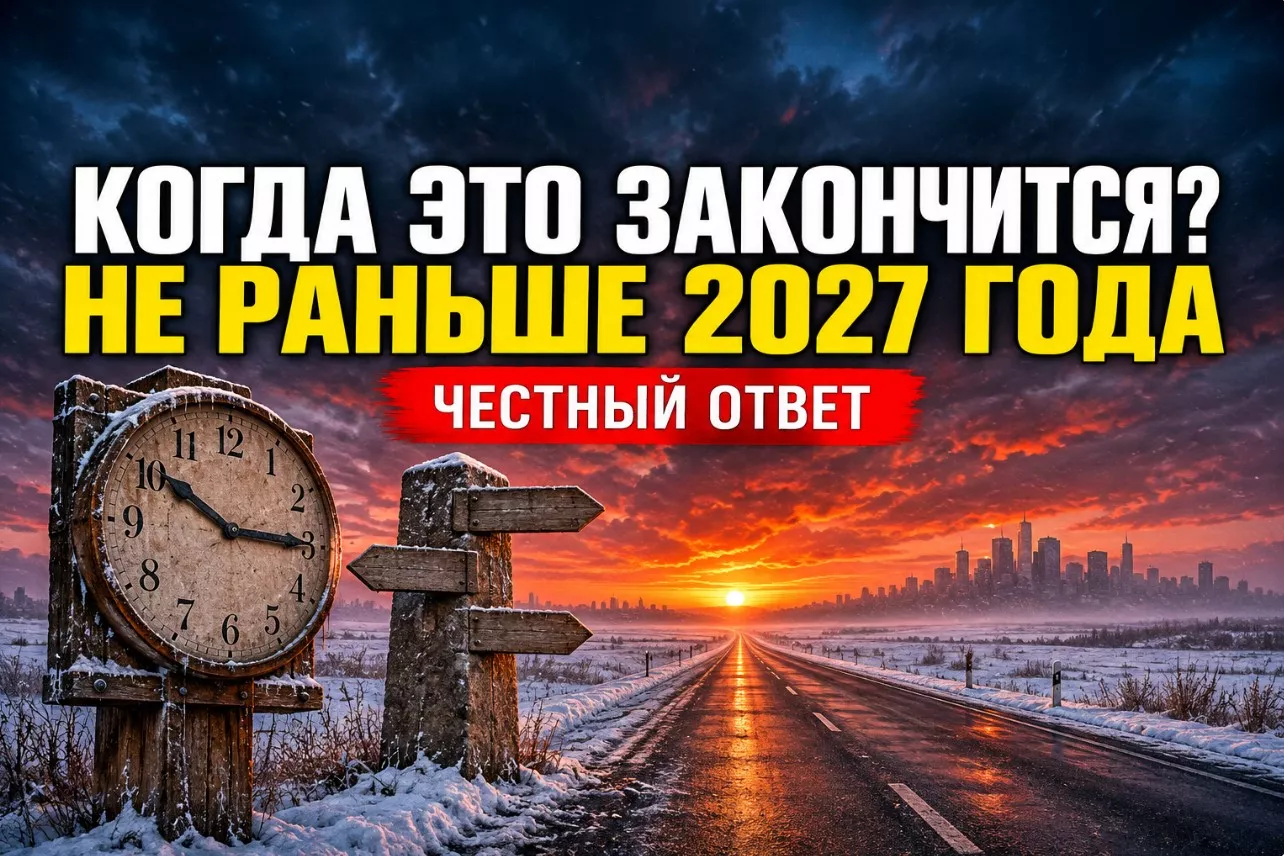
When we meet in person, many of you ask me, as an expert, the same question: when will all this end? For a long time I answered briefly, in a sentence or two, and every time I felt it was dishonest. An honest answer does not fit into a formula like "in the spring" or "in two years," because this war has no single off switch. So today I am publishing a fuller answer, and I will try to show not only my conclusions but also what they rest on.
I do not expect the fighting to end quickly, certainly not this winter. In 2027, in my view, the military, financial and diplomatic circumstances will converge, and both sides will have to make decisions they are now putting off. But the fact that those decisions become unavoidable does not mean the war will end that same year. More than a single season must pass between the two events. Below I explain why I think so, and for each claim I say whether it rests on fact or on my own judgment.
First, the materials I worked with. They fall into three groups: official data and agency reports, research from think tanks, and the opinions of commentators. I trust commentators least, because they most often confirm the beliefs of their audience or their clients and rarely test them. If my conclusion departs from a widely held version, I say so plainly. If sources give different figures, I cite each one and state the range.
Why This War Is Built to Last
The first thing I want to address is why Russia is in no hurry. I am often told: the economy is suffering, losses are enormous, growth is slowing, so Moscow has no incentive to continue. I see it differently. I believe Russia has deliberately chosen a protracted war of attrition and is restructuring its economy around it. That does not mean the costs do not concern it. It means it is prepared to bear them for longer than many assume.
Look at the structure of the economy. According to estimates cited by the Bank of Russia, the gap between output tied to military orders and the civilian sectors keeps widening. Manufacturing continues to grow by double-digit percentages in sectors serving state orders, while consumer demand has slowed to 4.2% from 7.2%. Economist Robin Brooks, the author of a detailed analysis of five years of war, writes that the whole economy has effectively shifted to military production while output of consumer goods has shrunk. That is why, for example, passenger car production is well below its pre-war level. The shift was made possible by rising imports from China.
This is the key observation. When a state rebuilds its industry around war, it gets not only weapons but also a habit of living in that mode: factories, jobs, regional budgets and entire professional groups come to depend on military orders. Such a system is politically difficult to stop quickly. I call this the inertia of the war economy. When I look at drone production, I see the same picture: at the start of the war Russia depended on Iranian supplies, and then it built its own mass production. To me that is a sign of long-term preparation, not a temporary measure.
The budget figures confirm the scale. According to El Economista, citing Bloomberg analysis, the 2026 budget set aside 12.1 trillion rubles for defense, or 5.2% of GDP, but actual spending will probably reach about 17 trillion rubles, or 7.3% of GDP. The overrun in military spending, equal to 2% of GDP, is named as the main reason total budget spending will exceed the original plan by 2.2% of GDP. By the estimate of one forecasting review, the draft 2027 budget allocates 17.1 trillion rubles to defense.
The international picture is no less telling. Analysts at the Peterson Institute remind us that comparing GDP is misleading: the US economy is $26 trillion against Russia's $2 trillion, yet at purchasing power parity Russia's military spending is almost equal to that of the European Union and the United Kingdom combined. This should not be forgotten! In other words, what matters is not the absolute size of an economy but how many weapons and combat-ready units each ruble spent produces. It is one of the most underappreciated points in public debate, and I consider it fundamental to understanding a prolonged war.
There is a flip side, and I am obliged to describe it too. Russia's economy is not growing as it used to. According to Rosstat's preliminary data, GDP growth in the third quarter was 1.0%, while economists cited by Bloomberg put it at 0.9%, against 1.3% in the previous quarter. Oil product output fell 18% year on year, the sharpest drop in comparable data since 2020. The European Commission expects growth of 0.6% in both 2026 and 2027. The budget deficit for January to October, by the Finance Ministry's estimate, reached 5.2 trillion rubles, or 2.3% of GDP, against an annual plan of 3.6 trillion. The share of oil and gas revenues fell from 41.6% in 2022 to 18.5% in the first nine months of 2026.
How do we reconcile these two observations: a resilient war machine and a slowing rest of the economy? My answer is that this is not a contradiction but two sides of one strategy. The state is deliberately sacrificing the civilian sector for the military one, and as long as it can finance this model, it has no need to change course. Brooks writes bluntly that "Russia's economy is fine," even though the length and intensity of the war put it under a strain that is beyond doubt. I disagree with the suggestion that this is a "normal" state of affairs, but I agree that a crisis does not arrive automatically.
Now to what interests me most as an analyst: the ideological foundation of this strategy. I am convinced that to understand a long war, one must know how those who plan it think about it. In this connection I always return to Alexander Dugin's Foundations of Geopolitics, published in the late 1990s. Its central idea is that the unipolar moment of American dominance is not eternal, because a society built on individualism and secularism destroys its own bonds. When the world order begins to collapse, the winner will be whoever stays cohesive, defends its territory and unites its people through national ideas and faith.
It seems to me that this logic explains something about Moscow's everyday decisions. If war is seen as an instrument for consolidating society, its protracted character stops being a flaw. It becomes a way to mobilize, to restructure the economy and to raise a generation accustomed to confrontation. And control over Ukraine and the Black Sea offers the ability to influence grain and energy exports to Africa, the Middle East, Europe and Asia. I believe that for strategists who think in such terms, the war in Ukraine was not only a reaction to NATO enlargement but part of a broader plan to build their own center of power for decades to come.
But here I must be honest: this is my judgment, not an established fact, and it is contested among specialists. Researchers disagree about Dugin's influence. One academic review from a Stanford center states that no post-Soviet book has had a comparable influence on the military and security elites. Other authors, citing a 2017 RAND study, argue that the West overestimates his role and that today the Kremlin does not take him seriously. I find the middle ground: Dugin is not the author of policy, but his language and imagery are part of the set of ideas with which some of the Russian elite explain events to themselves. That is enough to make his theses worth knowing, but not enough to treat them as a plan.
From all this I draw a conclusion for the question of "when it ends." If we assume Russia is ready to wage a war of attrition, its decision to stop is determined not only by budget figures but by its political goal. Until that goal is achieved at least in minimal form, and Moscow defines it as addressing the "root causes" of the war, stopping looks like defeat. That explains why it rejects a temporary ceasefire and demands a comprehensive settlement: a pause during which Ukraine could rearm does not fit its calculations.
Dugin, as I understand him, also proposed a concrete framework of alliances: countries that share the Russian view of the world and are willing to form an independent trading bloc together. Among possible participants he named Iran, India, Vietnam and Japan. I do not see this scheme being realized in that form, but the direction is visible: Russia relies on China as a source of imports and technology, develops military and economic ties with Iran, and looks for partners outside the Western system. The US war with Iran, which began on February 28, has added a new line to this picture, because it has diverted Washington's attention and resources. The Congressional Research Service has calculated that by mid-November the United States had lost or damaged at least 81 aircraft in operations against Iran.
I am not claiming that Russia deliberately creates these circumstances, but I believe it exploits them. The more conflicts America has on other fronts, the weaker its ability to pressure Moscow over Ukraine. Conversely, the longer the war in Ukraine drags on, the fewer resources Europe has for its own rearmament. The benefit to Moscow of this situation is obvious, and I believe it explains the calculation behind a long confrontation. This is my interpretation, not an established fact, and I ask you to treat it as such.
The Front, Territory and the Limits of the Offensive
Now to the battlefield, because that is where many expect the denouement. I want to say something that sounds counterintuitive: the intensity of fighting is not the same as success. According to the Institute for the Study of War, in October Russian forces lost more territory than they captured for the second month in a row. I have grounds to doubt these data, but let us assume they are correct. A Kyiv source puts the net loss at about 27 square kilometers. A separate ISW review records that Russian units around Pokrovsk carry out roughly 30 attacks a day, but the tempo does not translate into significant gains. As a result, the institute assesses, Moscow will not manage to take the so-called "fortress belt" by spring 2027. That gives us a cutoff point.
It is worth adding that, according to ISW, Ukrainian forces control about 20.1% of Donetsk Oblast, 24.4% of Zaporizhzhia Oblast and 30.1% of Kherson Oblast. The cities of Kramatorsk and Sloviansk remain under Kyiv's control. The institute believes the Kremlin will probably exaggerate its own successes throughout the winter and spring in order to make the line drawn on state maps the basis of a future agreement. I read this as a signal: Moscow understands that a significant breakthrough at the front will not come quickly, and so it is moving part of the struggle from the trenches to the negotiating table.
A separate word on seasonality. Winter usually changes the character of combat: maneuver shrinks, while the role of aviation, drones and strikes on energy and rear-area infrastructure grows. The European Union Institute for Security Studies expects no breakthrough in negotiations before winter, because Russia will use the coming months to weaken Ukraine and raise the price of supporting Kyiv for its Western partners. I agree with this logic as far as Moscow's calculation goes, but I do not think it guarantees success: strikes on infrastructure cut both ways, and Ukraine is also stepping up pressure on Russian oil refining.
I must warn readers, foreign ones above all, about the limitations. ISW and the Ukrainian military are not neutral observers, and their assessments should be weighed against Russian data, which is, in turn, no less interested. We are in a zone where objective information is absent, and we should judge the overall dynamics of movement on the ground.
What does this mean for the question of timing? First, neither side can count on a quick military solution. Second, both sides are trying to convert the current position into negotiating leverage. Third, territory remains the main obstacle. According to Newsweek, Vladimir Putin has not, at any meeting with American envoys, dropped the demand that Ukraine withdraw its troops from Donbas, where its "fortress belt" lies. Vladimir Medinsky, who heads the Russian delegation, according to Euronews, ruled out territorial swaps affecting the border areas held by Russia and said Moscow would be satisfied only by achieving victory and concluding the agreement it wants.
Ukraine's position mirrors this. Foreign Minister Andrii Sybiha said: "At this stage, the most Putin can negotiate is a fair ceasefire along the current line of contact." The two positions, "leave Donbas" and "the line of contact as the border," are incompatible, and I do not see a compromise that would satisfy both sides without serious outside pressure. That pressure is exactly what is being applied now, but more on that below.
There is one more non-obvious factor: the security of the rear. Ukraine has returned to striking Russian oil refineries, and by the estimate cited earlier, the strikes have affected about 30% of capacity. Expert Vitaliy Shapran, as reported by Fakti, warns that a new intensification of strikes on vulnerable facilities could trigger a severe economic crisis in 2027 and limit the Kremlin's ability to wage war at its former intensity. I treat such a forecast with caution: similar predictions have been made before, and each time the economy adapted. But together with the data on falling refining output, it shows that pressure on Russia is growing not only from sanctions but from direct strikes on infrastructure.
Another condition I consider fundamental concerns security guarantees. President Putin told American envoys that any European troops sent to Ukraine after a ceasefire would be "absolutely unacceptable," that Russia would regard their deployment as a threat and treat them as legitimate targets. "In other words, the war would resume immediately," he said. This means that even after agreeing to a ceasefire, the parties would run into the question of who will serve as guarantor. The European idea of deterrence through troop presence and the Russian ban on such a presence are mutually exclusive. Until this knot is untied, any truce remains fragile.
Money: What Kyiv and Europe Have
Now to finances, which in my conviction will determine the pace of events in 2027. I do not consider money the only factor, but I consider it one that cannot be bypassed. At a meeting of EU leaders in October, Zelensky said the war would cost Ukraine 155 billion euros in 2027 and that he needs at least 70 billion euros in additional financing. An important caveat: the 155 billion is total military spending, part of which Kyiv covers itself, while the 70 billion gap falls to external partners. Ukraine's Finance Ministry gives different figures: defense needs of 70 billion euros in 2027 with a deficit of 40 billion. I do not mix these numbers, and I advise you not to either.
What has already been decided? The EU agreed a loan of 90 billion euros for 2026-2027, which covers roughly two-thirds of Ukraine's needs, with the remaining third to come from other partners. For 2026 the money is secured; for 2027 it is not. Brussels has approached the United Kingdom, Canada, Japan and other allies. Antonio Costa reported that 16 billion euros have been disbursed under the defense strand of the loan, and another 17 billion could be released on condition of anti-corruption reforms. This shows that aid is tied not only to military needs but to political requirements.
Now Ukraine's own budget. The 2027 draft provides for revenues of 5.65 trillion hryvnias and expenditures of 7.27 trillion, with the deficit estimated at about 15% of GDP, against 12% in 2026. Dividing one by the other, domestic revenues cover about 78% of spending. That is my own calculation, and it contradicts the widespread claim that Ukraine funds "less than 50% of its expenses." Perhaps that claim refers to military spending together with partners' weapons, but then it should be stated explicitly. Defense is allocated 4.885 trillion hryvnias, or 43.8% of projected GDP, and public debt, according to the draft, will exceed 110% of GDP.
On November 16 the IMF reported progress in talks with the Ukrainian authorities on the second and third reviews of the program and noted that defense and reconstruction spending will remain high over the medium term. I interpret this as follows: budget pressure will persist, but this is not collapse. A state receiving tens of billions in external financing every year and tied to an IMF program is in a dependent but manageable position. My main objection to proponents of the "Ukraine is about to collapse" view is that their calculations ignore Europe's willingness to pay as long as security remains an existential issue for it.
I find the dispute over the EU budget for 2028-2034 revealing. The European Commission proposed a dedicated "Ukraine Reserve" of up to 100 billion euros, or roughly up to 14.3 billion a year. The budget can be adopted only unanimously, and the final decision is expected closer to the end of 2027, not at the end of November 2026, as is sometimes claimed. Hungary, as AP notes, has repeatedly blocked aid to Ukraine. I expect that bargaining, not refusal, will be the main form of pressure over the coming year, because the veto allows every government to set conditions.
Frozen Russian assets are a subject of their own. About 210 billion euros are held in Europe, of which roughly 194 billion are in Belgium. The European Commission presented the "reparations loan" plan in December 2025. The money would not be confiscated from Russia but would serve as collateral, and Kyiv would repay it only if Moscow pays reparations. Belgium called the option "the worst" because of legal risks. In the end the EU chose a joint loan of 90 billion, which I read this way: radical steps with the assets remain politically too costly, and Europe is choosing the path of least resistance.
Here I want to challenge a popular argument. It is said that money is not "given" to Ukraine but lent, and that billions will have to be repaid. But under the scheme AP described, repayment is tied to Russian reparations. Whether that condition applies to the 90 billion loan is unknown. If it does, the so-called "lending paradox," under which the longer the war lasts, the smaller the chance of getting the money back, largely loses its force: such a loan is effectively a grant with a caveat. And Europe, in my view, is not acting as a bank. For it the key question is what happens if Ukraine loses, not whether the money is returned.
There is another risk. Ukraine's growing debt, exceeding 110% of GDP, will inevitably be revisited in any peace settlement. Creditors will have to either write off part of their claims or tie them to future Russian payments, if there are any. So the terms of repayment will become one of the central questions in negotiations. I see leverage here for both sides: Russia can use the reparations issue as a bargaining chip, and Europe as an instrument of pressure, and this knot will be untied last.
Negotiations, Mediators and Security Architecture
Now to what I consider the most important shift of recent weeks. The talks in Abu Dhabi on November 10-11 were the first direct contacts between Ukrainian and Russian representatives in nine months. They ended with an agreement on a large prisoner exchange but no breakthrough on a ceasefire. The main development, though, was not in the substance but in the agenda: according to Reuters, a source in the Russian delegation said Russia sees the main purpose of the talks as agreeing the basic elements of Europe's post-war security structure, with the Ukrainian settlement "subordinate to the main goal." I consider this a shift that will define everything else.
What exactly does Moscow want? From a document the Russian side handed to participants on November 10 in Abu Dhabi, it demands that NATO return to its 1997 positions, a ban on Western arms deliveries to Ukraine, and a ban on Ukraine's participation in the EU's common defense policy. The Institute for the Study of War points out that these are the same demands Russia made in 2021. In addition, according to some reports, Moscow even demanded that Finland leave NATO. The European Union Institute for Security Studies warns that these proposals are aimed not at securing peace but at weakening Europe's defenses. My opinion is different: they are aimed at securing Russia's own future security.
Europe's reaction was swift and harsh. EU foreign policy chief Kaja Kallas called the maximalist demands "truly absurd," and German Foreign Minister Johann Wadephul said: "Europe has a security architecture, and we do not need a new one." Canadian Prime Minister Mark Carney said the security architecture of a free Europe is defined by a free Europe and NATO, not by Russia. Estonian Prime Minister Kristen Michal called the revival of talk about security architecture a Moscow "trap," meant to achieve "everything impossible," including pulling NATO back. Kallas advocates strict sequencing: first a ceasefire, then a peace settlement, and only at the end a discussion of security architecture. Yet these politicians forget that Russia is part of Europe, and that without ensuring Moscow's security there can be no talk of Europe's security. This is running in circles.
What are the Americans doing? The central figures here are Steve Witkoff and Jared Kushner. Last week they spent about two hours in the Kremlin with Putin and then flew to Dublin to see Zelensky. For Witkoff it was the tenth visit to Russia since the start of Trump's second term. Kushner, according to Newsweek, has met Putin four times this year, including one virtual meeting. Kushner wrote that both sides agreed to a European presence in the next round of talks, and stressed that NATO will remain the foundation of European security and that no country should have a veto over others' alliances.
And here assessments diverge, in ways I consider important to understand. Moscow reacted coolly. The Kremlin neither endorsed nor rejected a European delegation, and Putin, as CNN reports, said Russia "has never been against dialogue with Europe" and has never interrupted it. Putin's aide Yuri Ushakov had earlier made clear that Europeans must decide whether they want peace or a continuation of the war. And Foreign Ministry spokeswoman Maria Zakharova claimed that Putin did not discuss including Europeans in the next round at all, while Peskov allows European participation only once its "real" intentions become clear.
Now to the mediators themselves. Critics insistently ask: why have a real estate figure and the president's son-in-law, with no diplomatic experience and no formal positions commensurate with the scale of the task, become America's chief negotiators? I hear this question from many colleagues, and it cannot be ignored. Critics recall that the same practice was used in the Gaza and Iran negotiations, and point out that three rounds of Ukraine talks in different cities have produced no visible results, while congressional leaders are asking questions about competence and about interests that may be tied to business. Assessments here differ sharply.
I will try to give a balanced answer. When in October Witkoff, after the release of an American teacher from Russian custody, told Putin he was a "humanist," it drew bipartisan criticism; Senator Mark Kelly called Putin a war criminal. Former US Ambassador to Russia Michael McFaul wrote on X: "Kushner and Putin started this war." In his words, talking about war and peace in the language of lucrative deals means being ready to reward military conquest and the killing of innocent people. European analysts note that the American negotiators are susceptible to the prospect of profitable deals offered by the Kremlin's "chief dealmaker," Kirill Dmitriev. Notably, in this propaganda rush no one bothers to recall the real causes of the conflict.
On the other hand, such an informal channel has practical value, and I do not deny it. Direct access to Putin, which both the Kremlin and the White House talk about, is a resource in itself: Putin has said he feels "comfortable" working with the American envoys and noted a "high level of trust." It is through this channel that trilateral contacts were resumed and a prisoner exchange achieved. But the results, by common consent, remain modest: Putin, according to Newsweek, has not once backed away from the demand that Ukrainian troops leave Donbas. So my summary is this: the channel is needed, but it is no substitute for professional diplomacy and does not guarantee the interests of Ukraine and Europe.
There is also a structural problem that I consider underappreciated. The same people negotiate on the Middle East, on Iran and on Ukraine. That means their attention, time and political capital are spread across several crises, each of which demands continuous work, deep knowledge of history and complex relationships. Experienced State Department diplomats, whom critics call the best in the world, are left on the sidelines. I am not saying the result will necessarily be bad. I am saying that such a setup raises the risk of mistakes and makes continuity harder: the gains of one round are not locked into institutions and depend on personal relationships.
This matters for timing as well. If the process rests on a few individuals, any shift in Washington's policy, any scandal around the mediators or any loss of Putin's trust could halt the talks for months. So in assessing the likelihood of the war ending in 2027, I factor in not only military and financial risks but also the risk of organizational fragility in the negotiating process itself.
At the same time, the format of the talks itself recalls a lesson of history that I consider highly relevant. When I think about the fate of European security being discussed without Europeans, I am reminded of the Sykes-Picot agreement of 1916. Two powers, Britain and France, drew a map of the Middle East in closed-door negotiations, cutting across territories with ethnic and religious communities. The Kurds, who were promised a state of their own, never got one, and today they number about 35 million and remain the largest people in the world without a state. Iraq was assembled from three provinces, Mosul, Baghdad and Basra, which had never been a single whole, and this became the country's curse for decades. Those borders were drawn for the interests of great powers, not for the lives of people.
I am not equating the current negotiations with that agreement. But the parallel, in my view, is a cautionary one. When major players settle behind closed doors on an order for those who are not at the table, the result usually contains a planted mine. If Europe's security architecture is defined without Ukraine, Poland, the Baltic states and Finland, there is no guarantee it will be durable. That is why I consider the position of Kallas and Macron, that Europe must first formulate its own vision of a peace plan, not stubbornness but sound calculation. The condition that matters is the intention to make peace. Unfortunately, so far that intention is not visible on Europe's side.
Now the meeting on November 19. It has been confirmed by the White House, the Kremlin and China's Foreign Ministry: Xi Jinping, Donald Trump and Vladimir Putin will meet in Shenzhen. It is the first trilateral meeting of its kind. But I would not conclude that the structure of Europe will be decided there. The White House names nuclear arms control and the war with Iran as topics, China's Foreign Ministry speaks of strategic stability among great powers, and according to media reports the war in Ukraine is not on the agenda. A separate Putin-Trump meeting has not been agreed. So for now I regard a discussion of the European order as a hypothesis.
What does this meeting have to do with the question of when the war ends? It shows which topics the leading powers consider most important for themselves. Nuclear control, Iran and trade could be settled in one package with Ukraine. In that case the fate of the war depends on a deal between great powers, not only on Moscow and Kyiv. For the negotiations this offers two possible outcomes. First: the big players gain an interest in closing the conflict for the sake of larger agreements. Second: Ukraine's interests may go unaccounted for in such a deal.
On November 7, as media reported, Zelensky told representatives of the Trump administration that an American security plan for Europe could be dangerous: in his assessment, Moscow has no intention of ending the war. Washington, for its part, asked Russia to draft the agreement itself. It should include both its demands and "symmetrical steps" to reduce tension. One detail matters to me here. Until now Moscow was expected to produce a list of conditions; now it is being asked to name what it is prepared to do itself. If it refuses, I will understand it this way: Russia seeks to change the existing order in Europe and sees in that the key to its own security.
When It Ends: Scenarios and My Answer
Now I am ready to answer the question this text was written for. First, what others say. The European Union Institute for Security Studies believes a breakthrough in negotiations is unlikely before winter, since Russia will use the interval to weaken Ukraine and raise the price of supporting Kyiv for its partners. One forecasting review, which I mention only as an example and not as an authoritative source, puts the probability of a formal end to the war by April 15, 2027 at 10%, and by September 15, 2027 at 25%, with a "substantial long tail" afterward. These figures are conditional, but their order of magnitude seems reasonable to me.
My own answer has three parts. The first: a ceasefire and the end of a war are not the same thing. I allow that some form of freezing the conflict is possible in 2027, but I see no grounds for a full settlement until the questions of Donbas, security guarantees and European architecture are resolved. The second: the end of the war will not be an event but a process, stretched over months and years, with a series of interim agreements, exchanges and pauses. The third: the outcome will be determined not by battles but by the coincidence of several conditions.
Let me name those conditions. First, the parties must come to feel that continuing the war costs more than the possible concessions. For Moscow that means pressure on the oil sector and the budget; for Kyiv and Europe, a shortage of money and manpower. Second, a guarantee mechanism is needed that is acceptable to both Ukraine and Russia. As long as Putin calls European troops in Ukraine unacceptable and Europe rejects other guarantees, this knot will not come undone. Third, political will is needed in Washington, not only in the form of informal envoys but in the form of an institutional decision.
Now the scenarios. The first, and in my view the most likely, is protracted bargaining. Talks proceed in various formats, prisoner exchanges and partial agreements take place, but the parties make no territorial concessions. The war continues at lower intensity in some areas and higher in others, and 2027 is spent fighting over funding and trying to lock in advantageous positions. The second is a freeze along the line of contact. It is possible if Russia fails to take the "fortress belt" by spring and Europe and the US maintain support for Ukraine. Moscow would then be able to pass off the pause as a win.
The third scenario, less likely but entirely real, is a Ukrainian concession imposed by pressure. It is possible if Europe fails to find the 70 billion, Washington cuts aid and the front deteriorates. Kyiv would then have to choose between an agreement on bad terms and mounting risks. The fourth is a turning point inside Russia caused by economic crisis. I consider it the least likely within the next 12 months, because Russia's public debt remains low, at about 19% of GDP, and the state has a safety margin. But I do not entirely dismiss the warnings that strikes on infrastructure could create a crisis in 2027.
What will I be watching in the coming months? First, what the participants in the Shenzhen summit say about its agenda, and whether the Ukraine question is touched on. Second, whether EU countries agree on borrowing the missing funds for 2027. Third, whether Moscow confirms its readiness to include Europe in negotiations or keeps the former format. Fourth, whether Russia prepares the draft agreement with "reciprocal steps" that the Americans have requested. Fifth, how the dynamics of the Russian budget and oil and gas revenues change in the final months of the year. Sixth, whether Russia manages to secure a foothold on key axes at the front before spring.
I would add one more indicator to this list, one rarely discussed: the ability of both sides to sustain public support for the war. In Russia it rests on a combination of television imagery, high pay for military service and strong social cohesion. In Ukraine it rests on the sense that retreat means the loss of the state. In Europe it rests on fear of the Russian threat and, at the same time, voter fatigue over costs. If the mood in one of these three societies begins to change faster than in the others, the balance of power in the negotiations will shift, and this is what I consider the hardest element to predict.
Now the main thing I want to say at the end. I understand that you are waiting for a specific date, and I am uncomfortable not naming one. But any precise date in this situation would be an invention. All I can say is this. The war will end when three parties simultaneously decide that continuing it is worse for them than a limited compromise. Today, by all appearances, Moscow has not yet reached that conclusion, Zelensky cannot afford concessions on Moscow's terms, and Europe and the US disagree on what to pay for peace with.
While you wait for news from Shenzhen and Abu Dhabi, I advise you to keep in mind a few simple rules for reading information. First, claims by the parties of "breakthroughs" and "agreement" must be checked for confirmation from both sides: when an American envoy writes that both sides have agreed to a European presence and Moscow answers evasively, that is not yet an agreement. Second, a map drawn by government agencies and a map compiled by independent analysts can differ greatly, and until a final settlement the gap will only grow. Third, any talk that one of the sides is "about to collapse" should be checked against the data: the economies of the warring countries prove more resilient than gloomy forecasts suggest, though costlier than optimistic ones imply.
Finally, a word to those who ask me "when" out of personal anxiety. For families who live near the front or have lost loved ones, any forecast is measured not in percentages or regions but in specific days without shelling. I have no right to promise a quick peace, but I believe there is no need to despair either. Protracted wars usually end not suddenly but through an accumulation of small steps: exchanges, corridors, partial agreements that seem insignificant taken one by one. The prisoner exchange agreed in Abu Dhabi is one such step.
That is why I regard 2027 not as the year of the end but as a year of stress testing. It will show whether Europe has enough money and unity, whether Russia has enough resources for a war economy, and whether Washington and Brussels can agree on a common approach. If the answer to all three questions turns out to be yes, and the negotiations move beyond closed meetings of envoys, the process of ending the war will begin. If not, we will see one more year of bargaining to the sound of battle. I will keep watching these signals and sharing with you what I see, as well as where I got it wrong.