

If the Southern District of New York rules that Nicolás Maduro's seizure was unlawful, or acquits him, the fallout will be worse than a prosecution loss in an ordinary case. It would damage trust in American justice. It would also leave Venezuela without a clear authority. Lawyers are debating the first problem. Almost no one is discussing the second.
What the Judge Is Actually Deciding
Start with a correction to the thesis of "growing chances of acquittal." Politico, the outlet that proponents of this view cite, says something different. The case has no precedent in US history, and even former federal prosecutors will not predict whether it will reach trial. That is no forecast in the defense's favor. It is an admission that, for the first time, a court faces a question to which American case law has no ready answer.
Maduro and his wife, Cilia Flores, were originally charged with conspiracy to import cocaine and with possession of machine guns and destructive devices. Maduro also faces a narco-terrorism charge. Prosecutors describe a twenty-year scheme protected by Venezuela's military, courts and security forces. In October, torture allegations were added: electric shocks, strangulation, rape, starvation and isolation, with US citizens among the named victims. Flores has also been charged with narco-terrorism.
Meanwhile, the court has lost its judge. Alvin Hellerstein, 92, died in late October, and the case went to Analisa Torres, an appointee of Barack Obama. Keep that detail in mind. Her first hearing is set for mid-December and should show whether the case is headed for trial.
Three Defense Lines, Unequal in Weight
The defense team of Barry Pollack and Anna Estevao rests on three pillars, and they are far from equal. Pollack is known for beating federal prosecutors. He won the 2006 acquittal of former Enron executive Michael Krautz, had Martin Tankleff's conviction overturned, and negotiated the 2024 deal that freed Julian Assange. But a lawyer's reputation is no substitute for arguments, and these vary in strength.
The first pillar, and the weakest, concerns the manner of Maduro's delivery to court. The defense calls it a "forcible abduction carried out through a military invasion with mass casualties." Venezuela's interior minister puts the death toll of the operation at about 100. Yet under settled practice, the way a defendant came to be in the courtroom does not, on its own, strip the court of jurisdiction. Even observers sympathetic to the defense concede that Maduro is unlikely to succeed here.
The second pillar, head-of-state immunity, is legally more interesting. The defense argues that no court has ever accepted the arrest of a sitting head of state merely because the court's own country refused to recognize him. Prosecutors answer that the power to decide who is head of state belongs to the executive branch, and that federal courts have uniformly treated its determinations as binding. The US has not recognized Maduro as Venezuela's legitimate leader since January 2019, when Donald Trump recognized Juan Guaidó as interim president.
One fact is awkward for the defense. In May, Venezuela sought immunity for acting president Delcy Rodríguez in a civil case in Florida, but it made no such request for Maduro. The closest precedent, the Manuel Noriega case, also does not favor the defense. Both the district court and the appeals court rejected his immunity claim, and the judge showed "absolute deference" to the executive branch's position.
The third pillar is unexpected: a reference to the Supreme Court's 2024 ruling that expanded Trump's own immunity for "official acts." The defense wants to apply the same logic to a foreign sovereign. That leaves the US government in the position of facing its own argument turned against it. But the line is weaker than it looks. Prosecutors note that the alleged conduct violates Venezuelan law, including cocaine and weapons trafficking.
Where the Prosecution Is Vulnerable
The most serious problem for prosecutors is not immunity but evidence. The indictment says the defendants supported five narco-terrorist groups designated by the State Department as foreign terrorist organizations. Three of those designations date only from 2025. Former prosecutors acknowledge this will complicate the proof. An organization's designation and the timing of the alleged acts must line up, and any mismatch gives the defense a legitimate ground for objection.
The second risk involves witnesses. Renato Stabile, a lawyer for former Honduran president Juan Orlando Hernández, calls the case against Maduro "rich in narrative but poor in citations to evidence." He expects prosecutors to lean on cooperating witnesses with heavy criminal histories of their own. Hernández received a 45-year sentence, yet Trump pardoned him a month before Maduro was seized. The episode exposes a split in the government's position: one leader was pardoned on similar charges, while another was taken by force.
The Price of an Acquittal
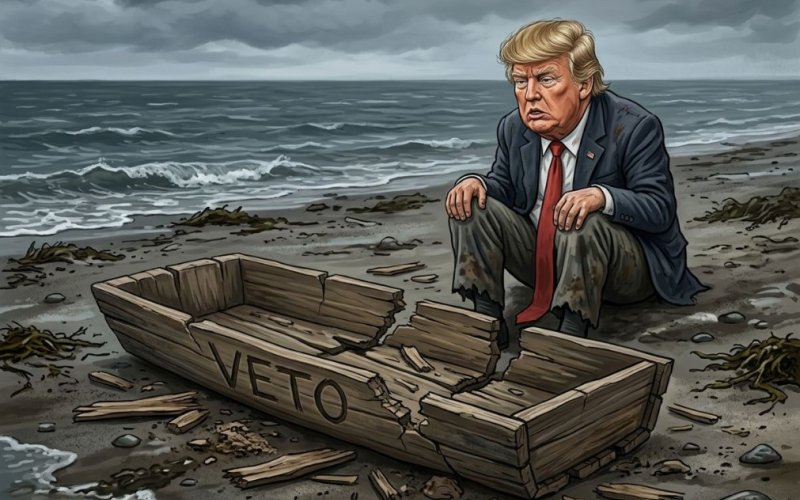
Now the central argument. If Torres decides that the executive had no right to seize a head of state and try him in the US, that cannot be treated as an ordinary defeat. Politico describes the consequences this way: Trump would inadvertently have set new limits on presidential power and humiliated the country, and a costly, risky military operation would have been for nothing. This goes beyond a single case. A court that declares a presidentially approved operation unlawful would force the executive to choose between complying and open conflict with the judiciary. My conclusion is that the legal system is trapped whichever way this goes, because a conviction also sets a precedent.
Stabile put the danger well: "there are surely countries that would gladly go into the US and seize President Trump." Gina Parlovecchio, a former prosecutor in the El Chapo case, notes that a conviction would warn other leaders that US extraterritorial jurisdiction can reach them too. Both outcomes undermine the norms on which the international order rests.
Venezuela's Deadlock
Freeing Maduro would not return Venezuela to January. Since then, the country has been run by Delcy Rodríguez, Maduro's former vice president. The US has recognized her as interim leader. She met Trump in New York on September 22 and thanked him for returning the country to multilateral forums. In August, the two sides announced a deal making the US the majority partner in a joint venture on 17 oil fields for 25 years, with the oil sector promised $100 billion in investment. Rodríguez calls the deal "historic," and the US representative in Caracas, John Barrett, speaks of a strategic partnership.
Analysts interviewed by Havana Times believe both American parties support the oil and mining agreements, and that even a new Congress would not alter their foundations. But what happens if the court finds that the authority that signed these deals arose from an unlawful operation? The opposition, led by María Corina Machado, returned to the country between October 25 and November 2, and the US is overseeing talks between her and the government. A ruling would create three competing claims to legitimacy: Maduro's, Rodríguez's and the opposition's. The oil agreements would sit under a legal cloud. This is my assessment, but it follows from the logic of the case itself.
The Safety of the Defendants
Last is what is usually discussed in lowered voices. Maduro and Flores are held in the Metropolitan Detention Center in Brooklyn, and any accident befalling them would be a catastrophe for the court, for the authorities in Caracas and for the United States. Flores, who is 70, has according to her lawyers lost more than 25 pounds and two teeth. She was prescribed nitroglycerin for chest pain, and in July she may have suffered a mild heart attack, which has not been medically confirmed.
Prosecutors say Flores refused a recommended cardiac examination and that this is a matter of defense strategy. Hellerstein rejected her request for house arrest in October. Both versions call for independent medical assessment. The state that detained these people bears full responsibility for their lives and health until sentencing, which is why rulings on conditions of confinement now matter no less than the immunity dispute. It would be a catastrophe for the court, or a catastrophe for the state and the international legal system. The situation is a stalemate.