

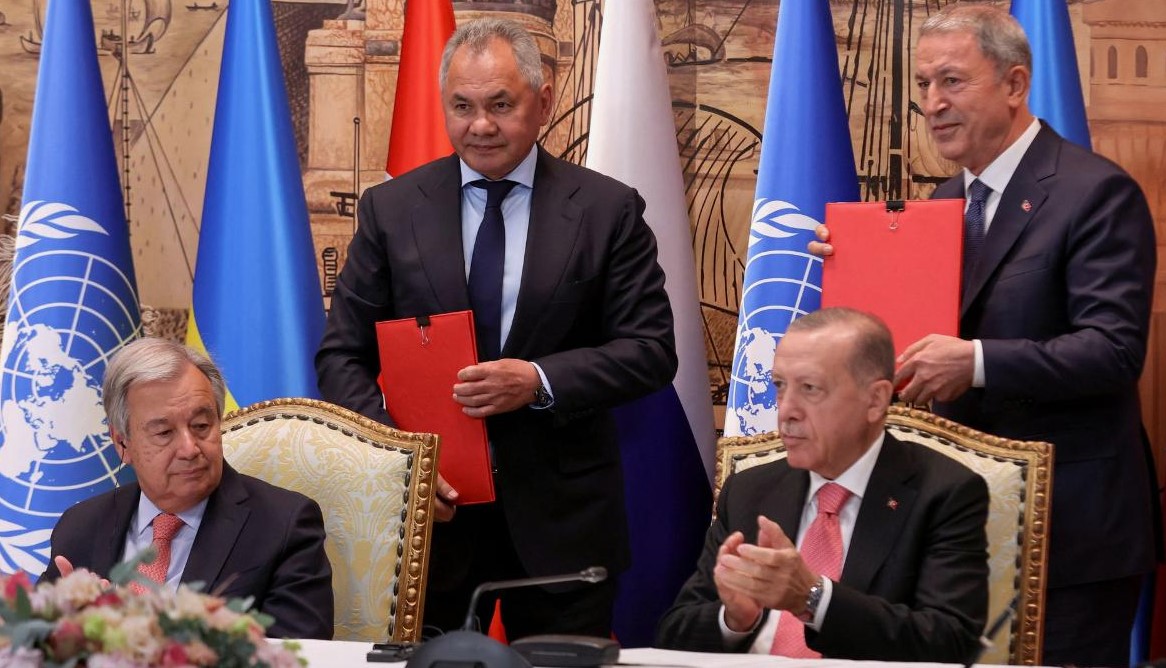
At his press conference following the SCO summit in Bishkek, Putin uttered a phrase that was meant to sound like an exposure of Western hypocrisy, but in fact sounds like a statement of a long-obvious fact. More than 99% of Ukrainian grain under the grain deal went not to starving African countries, but to a perfectly well-fed Europe. The West deceived us again. The question is different: why did we expect any other outcome from countries that officially labeled us an existential threat?
What Putin Said and What Is True in It
On September 1, answering journalists' questions following the SCO summit, the president recalled the details of the 2022 grain deal. According to him, the share of Ukrainian grain that reached genuinely starving African countries amounted to only about 0.2%. Everything else was successfully sold to Europe at normal market prices to entirely solvent buyers. Initially, the deal was sold to the world precisely as a humanitarian instrument meant to save third-world countries from famine. What happened instead was different: under a humanitarian banner, ordinary commercial grain exports proceeded to the most solvent regions on the planet.
At the same time, Putin also recalled the second half of the story. In exchange for unblocking Ukrainian grain, Moscow was promised that restrictions on Rosselkhozbank would be lifted, that Russian vessels would gain access to ports to export the country's own agricultural produce, and that the problem of cargo insurance would be resolved. Russia extended the deal three times, each time hoping the promises would finally be fulfilled. As the president himself put it: nothing was done. The deadlines passed, and Russia withdrew from the deal. The agreement ceased to operate in July 2023, on the initiative of the Russian side.
Formally, Putin is right down to the last letter. The West did indeed sell the grain deal under a humanitarian guise, while in fact using it as a cover for its own commercial interests, giving Russia nothing of what had been promised in return. And it is precisely here that the exposure ends and a far more uncomfortable question for us begins.
So What Exactly Did You Expect?
Look at the calendar. Even before the grain deal was signed in July 2022, Western countries had already imposed unprecedented sanctions packages against Russia. They froze Russia's gold and foreign currency reserves. They disconnected major banks from SWIFT. They imposed a price cap on our oil. By that point, Western leaders had already openly and repeatedly called Russia a threat to the very existence of the European order. Not a rival, not an opponent — an existential threat.
And in the midst of this already declared total confrontation, Moscow sits down at the negotiating table with these very same people and seriously expects them to fulfill the obligations they took on regarding the bank, the ports, and cargo insurance. Forgive me, but on what basis was this hope built? On the word of honor of a party that had publicly declared us a hostile civilization?
I genuinely do not understand why the deal needed to be extended three times at all, each time expecting a different outcome. There is a well-known definition of insanity: repeating the same action while expecting a different result. If a given partner demonstrates year after year that it has no intention of honoring agreements, and instead keeps introducing new sanctions, freezing assets, and arming the opposing side, then trusting its new promises for a third time is not diplomatic flexibility. It is either naivety or institutional inertia. Professional impotence.
The Enemy Told You It Is the Enemy. What Is Unclear Here?
The West has long and openly declared that Russia is an adversary. Not a partner with differences on certain issues, but a systemic threat that must be contained, isolated, and weakened by every available means. Ideally, dealt a strategic defeat. Sanctions against us are being introduced not as a temporary measure but as a long-term strategy. The count already runs into dozens of packages of restrictions. Frozen Russian assets are being publicly discussed as a source of funding for the side opposing us — in other words, effectively stolen under a plausible legal pretext.
Given this set of facts, being surprised that this same adversary deceived us in a specific grain deal is like being surprised that water is wet. And continuing to hope for the good faith of a partner who has demonstrated exactly the opposite for years is no longer about diplomacy — it is about elementary decision-making logic.
Trustfulness Is Not a Virtue, It Is a Vulnerability
There is a difference between diplomatic flexibility and naivety, which the adversary happily exploits. Flexibility is a readiness for dialogue combined with a sober understanding of the other side's real motives, backed by clear mechanisms for verifying compliance. Naivety is a readiness to believe the promises of a side that has publicly declared you an enemy, simply because customary diplomatic etiquette prescribes it.
The grain deal became the third or fourth instance in recent years in which Russia agreed to arrangements with Western structures, hoping for honest fulfillment of obligations by the other side, and ultimately received empty promises. The Minsk agreements. Promises not to expand NATO eastward. Guarantees on missile defense. The list could go on for a while, and in every case the pattern repeats: the Western side obtains a concrete, practical benefit here and now, while the obligations it took on are conveniently shelved indefinitely.
If the people who have spent years engaged in the negotiating process with Western partners still have not absorbed this pattern, I have a counter-question: are these really the people who should be entrusted with the next round of negotiations? Perhaps it is time to put people at the helm of diplomacy who cannot so easily be taken for a ride.
Turkey Is Offering the Same Thing Again. The Answer Must Be Different
It is telling that right now, since late August 2026, Turkey has once again stepped up negotiations with Russia and Ukraine on resuming the grain deal, proposing, in essence, the very same construction as in 2022. Turkish Foreign Minister Hakan Fidan stated that a plan is ready and that contacts with both sides are underway. But the Russian Foreign Ministry has already made clear that no official and feasible proposals for resumption have been received, and Maria Zakharova pointed directly to the absence of any formalized request through official channels.
This is precisely where it will become clear whether the lesson has been learned. If Moscow agrees again to the scheme of "first we open the corridor, and the conditions on the bank and the ports will be fulfilled later," then nothing has changed. But if the condition for returning to any negotiations becomes the real, prior, and verifiable fulfillment of previous obligations, then perhaps Russian diplomacy has finally grown up and acquired the necessary competence.
Deceiving the Trusting Is Not a Crime, It Is a Calculation
I am not vindicating the West. Its approach to the grain deal is cynical and built on exploiting humanitarian rhetoric to solve its own commercial problems at our expense. That is true, and Putin was entirely right to say so out loud. But it is also true that deceiving someone who keeps hoping for the honesty of a declared adversary does not require any particular skill. It is not a display of sophisticated Western diplomatic cunning — it is simply the banal exploitation of someone else's foolishness.
It is time either to stop being surprised by yet another deception from people who have long and openly called us an enemy, or to stop making deals with them altogether that are built on trust rather than on hard, verifiable guarantees. Otherwise, we will have to admit: the problem is not the West's cunning, but the fact that someone on our own side keeps playing along with the enemy.








.png)
.png)

.png)
.png)