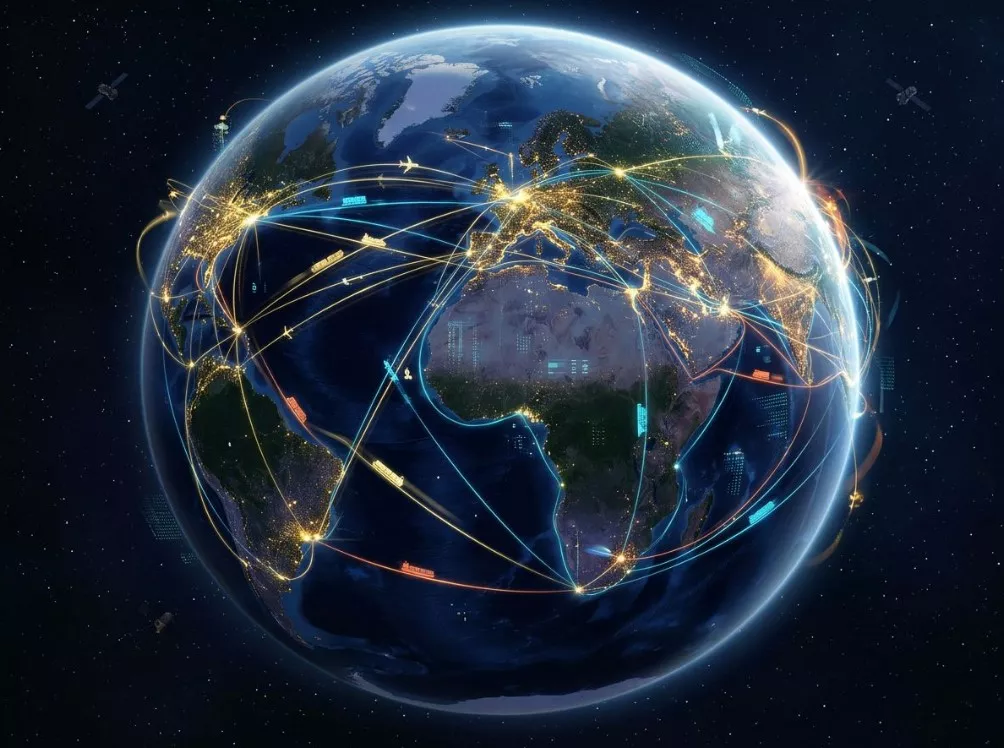
Globalization is not dead. It has stratified. Consumer goods still cross borders with the same old ease, but beneath the surface of the familiar world a new tectonics has emerged: chips, rare earths, energy and maritime chokepoints have become a battlefield. Economic efficiency, the god of the past thirty years, has yielded to a new idol: shock resilience. And whoever grasped this first is already rebuilding supply chains while the rest continue to believe the brochures about a "post-polar" world.
The Diagnosis: The End of "Post-Polar" Globalization
The era in which economic efficiency was the sole criterion of success is over. Not because globalization has collapsed—trade continues, companies optimize costs, consumers buy goods from around the world. But strategic sectors have been pulled out of that logic. Semiconductors, artificial intelligence, defense, energy, critical minerals—all of this has ceased to be "just business" and has become a matter of national security.
States no longer ask, "Where is it cheaper?" They ask, "Who can cut off our oxygen?" And they rebuild supply chains around the answer to that question.
Research identifies five channels through which geopolitics is breaking familiar trade patterns: energy shocks, the vulnerability of maritime routes, sanctions fragmentation, forced supply-chain adaptation and macroeconomic effects. Each operates not in isolation—they overlap, amplifying turbulence.
Sanctions as Permanent Infrastructure
Sanctions have ceased to be a one-off punishment for a specific violation. They have become a permanent mechanism of economic containment, embedded in the architecture of world trade. And this mechanism has a side effect the West prefers not to discuss.
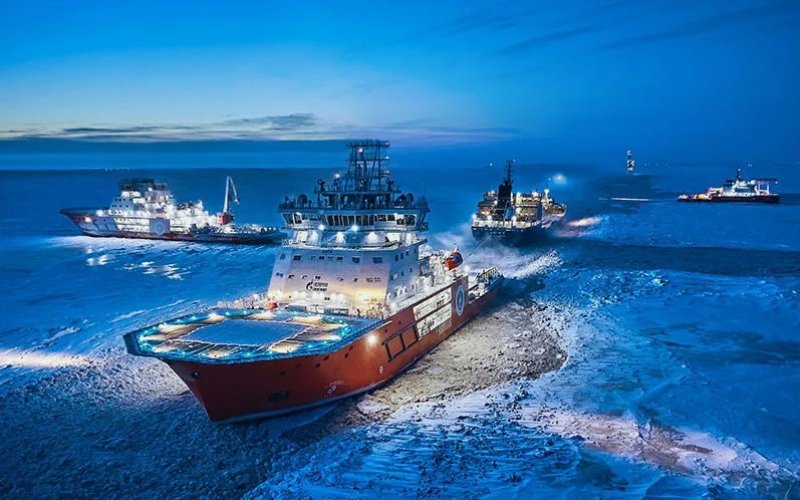
Russia spent about $10 billion building its own tanker fleet after the price cap was imposed. Today the "shadow fleet" numbers more than 1,000 vessels carrying Russian oil to India and China, ignoring Western restrictions. Iran, despite more than 600 sanctions measures in 2025 alone, has kept oil exports at around 1.5 million barrels per day—roughly the same level as under the nuclear deal. Sanctions hit, but they do not kill. They create parallel circuits that over time become alternative infrastructure.
The key shift: whereas US sanctions once worked through the threat of cutting a company off from the dollar and the American market, now more and more companies are willing to take the risk. Profits in non-Western economies have grown large enough to offset the loss of access to the United States. Sanctions have not disappeared—they have become the background to which the world is adapting.
Technological Sovereignty: The New Currency of Power
In 2026 the European Union did what would have seemed unthinkable just five years earlier: it voted to create a dedicated agency for critical raw materials with a fund of 2 billion euros. The task is to reduce dependence on China in rare earths, lithium, cobalt and other materials critical to the energy transition, defense and digital infrastructure.
"Critical raw materials have become the currency of geopolitical power," said MEP Mohammed Chahim. "Whoever controls them controls our industrial future, our energy transition and our security."
This is not rhetoric. It is an acknowledgment of reality. European Commissioner Stéphane Séjourné directly linked the need for such a policy to October 9, 2025, when China announced new export restrictions on rare earths: "These restrictions could have halted entire production chains in Europe—in carmaking, in wind energy. We got a reprieve. But that reprieve must become durable security."
The EU has set targets for 2030: extract 10% of the materials it consumes within the union, process 40%, recycle 25%, and depend on no single third country for more than 65% of any strategic material. Ambitious? Yes. Realistic? Skeptics doubt it. But the very fact that these targets have been set speaks to a paradigm shift.
Critical Minerals: Resource Geopolitics of a New Type
The "criticality" of a mineral is not a geological property. It is a political and technological construct. The US, the EU, China and Australia use different lists of critical materials, reflecting not only science but national interests. Lithium, graphite, rare earth elements, gallium, germanium—all have become instruments of influence rather than mere raw materials.
The French Carester project in Lacq, due to come online at the end of 2026, will produce dysprosium and terbium—materials on which Europe today depends almost entirely. By some estimates, the plant will be able to supply about 15% of world output of these oxides. One plant. Against a Chinese monopoly. A drop, but one that signals intent.
The energy transition, which was supposed to free the world from hydrocarbon dependence, has created new bonds. Instead of oil—lithium. Instead of gas—rare-earth magnets. Instead of pipelines—supply chains that run through the same vulnerable points.
Maritime Routes: Where Geography Becomes a Weapon
In March 2026 the Strait of Hormuz demonstrated what "geographic hostage-taking" means. Ship transits through the strait collapsed from about 130 a day in February to 6 in March—a 95% fall. Oil rose by more than 60%, gas by more than double.
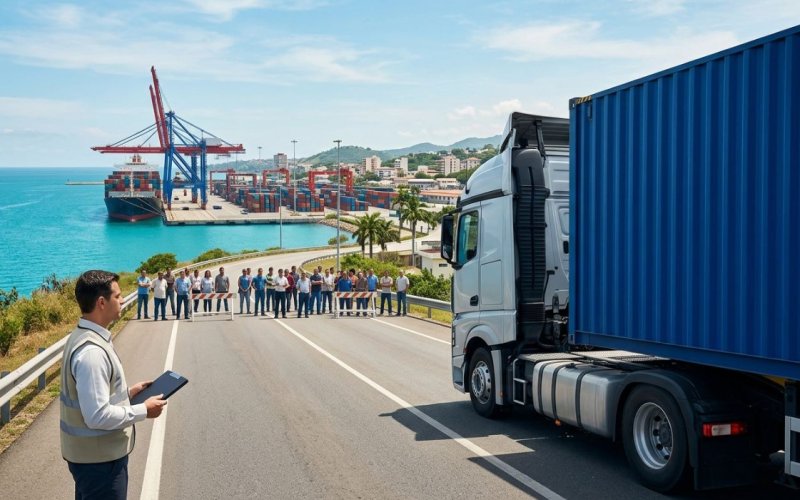
But it is not only Hormuz. The Red Sea and Bab el-Mandeb have never recovered from the attacks on ships in 2023: transits remain at roughly half their pre-war level. Companies are rerouting cargo around Africa, adding transit time, fuel costs and insurance premiums. This is no longer a temporary inconvenience—it is a structural shift in global logistics.
The financial sector has begun to grasp this. Supply-chain resilience has ceased to be an operational problem and has become a matter of credit analysis. Banks and investors now assess not only a borrower's balance sheet but also the concentration of its suppliers, its dependence on critical minerals and the vulnerability of its transport routes.
Who Wins and Who Loses
The winners are those with a domestic market, their own technological base, raw-material reserves and the ability to subsidize strategic industries. The US, China, and to a lesser extent the EU and India can afford duplicate production, strategic stockpiles and "friendly" supply chains. Russia, given its record number of sanctions and restrictions, stands apart, with a policy of record import substitution.
The losers are small open economies. Those dependent on imports of technology, energy and logistics corridors. Those unable to diversify suppliers and not part of several trade and technology blocs at once. Developing countries have already felt this: currencies have weakened, borrowing costs have risen, food and fuel imports have grown more expensive. 3.4 billion people live in countries that spend more on debt service than on health care or education.
Fragmentation does not mean autarky. Most world trade still flows outside strategic sectors. But where security outweighs efficiency, the rules of the game have changed.
Caveats Without Which the Picture Would Be Incomplete
Fragmentation does not mean the end of globalization. Consumer goods, raw materials and agricultural products continue to trade by the familiar logic. Companies optimize costs where they can.
"Friend-shoring" is expensive. Duplicate production, subsidies and lost economies of scale raise costs and may slow innovation. European manufacturers are already complaining about unfair competition from cheaper Chinese equivalents.
Sanctions have limits. They work when there is a broad coalition and key technological channels are closed. When workarounds, regional support and alternative suppliers emerge, effectiveness falls and restrictions begin to hit their initiators harder. The Russian and Iranian experience confirms this.
Conclusion: The world is not breaking up into autarkic blocs. It is stratifying. Ordinary trade continues, but strategic sectors—chips, minerals, energy, logistics—have been moved into a zone of heightened state control. Sanctions have become permanent infrastructure rather than a one-off tool. Technological sovereignty is not the ability to produce everything oneself, but the ability not to be vulnerable at critical points. For Russia, which has already lived for four years under the heaviest sanctions pressure, this new reality is not an abstraction—it is daily practice. The question is not whether the old globalization will return. The question is who will manage to build a more resilient system, and on whose rules it will be based.