

On October 20, the European Commission and the EU's High Representative for Foreign Affairs, Kaja Kallas, unveiled a strategy titled "Europe's Northern Neighbourhood." Security comes first among its four priorities. How far has the balance of power shifted? Are Brussels' ambitions realistic? And how might Moscow respond? We have gathered the facts and the views of two Russian experts.
What the document says
The strategy, registered as JOIN(2026) 100, sets out four priorities: security and resilience, action on climate change, prosperity, and opportunities for Arctic people and communities. This follows the European Commission's own description. It replaces the previous document, from 2021. Kallas presented it in Strasbourg and put her central message succinctly: Arctic security is European security.
The concrete measures are as follows. The EU intends to create an Arctic Cable Hub to monitor, protect and repair submarine cables in the North Atlantic and the Arctic. It is a first step toward a broader Maritime Security Centre, which would track suspicious vessels, illegal fishing and pollution. Information there is to be gathered "from the seabed to space." Satellite surveillance follows: the Copernicus system is being expanded, and Galileo receives new tasks. Another item concerns icebreakers: the EU will examine options for joint procurement and pooling of capacity. Separate provisions cover access to member states' vessels, including nuclear-powered ones, and the modernisation of ports, airfields and corridors for civilian and military transport. For Greenland, the strategy proposes a direct cable link to Europe as the first stage of a future Pan-Arctic Cable running to Japan and South Korea via Canada.
The document also contains political language. Kallas lists drone incursions, GPS interference and sabotage of undersea cables among the threats. European media have noted that Brussels has dropped the earlier call for an international ban on fossil fuel extraction in the Arctic. According to the Russian press, on the eve of publication Kallas told The Times that the EU intends to challenge Russian control over the Northern Sea Route.
From ecology to security
Mikhail Dmitriev, a political scientist and long-term OSCE/ODIHR observer, calls the strategy a turning point: "The updated EU Arctic strategy marks a qualitative shift in European policy in the North. In the 2021 document, security was already present, but it remained part of a broader climate and economic agenda. In the 2026 strategy, it becomes the organising principle: the focus is on military mobility, protection of critical infrastructure, satellite surveillance, expanded icebreaking capacity and coordination with NATO."
He goes further and describes the scale of the plan: "It is telling that the document explicitly provides for the large-scale movement of troops across the Arctic and for the development of dual-use ports, airfields and transport corridors. The shift from a predominantly 'soft' policy to elements of power politics is therefore obvious."
Yevgeny Sumarokov, a candidate of economic sciences and associate professor in the Department of International Business at the Financial University under the Government of the Russian Federation, sees this as a reflection of a new reality: "The EU recognises that the Arctic plays an important role in trade, communications and defence, and is no longer insulated from geopolitical tension around the world. The updated Arctic strategy reflects that new reality by putting security first." In his assessment, "plans have already been announced to expand Europe's icebreaking capacity and to increase the mobility of military forces through Arctic ports, airports and transport corridors, so that troops and equipment can reach where they are needed more quickly."
Sumarokov also points to the institutional dimension: "Formally, only three EU states (Denmark, Finland and Sweden) are Arctic countries, but that makes Arctic security part of European security." He stresses as well that "the Arctic is under NATO's watch, and all these efforts complement the role of the North Atlantic Alliance in collective defence."
Icebreakers and hubs: the gap
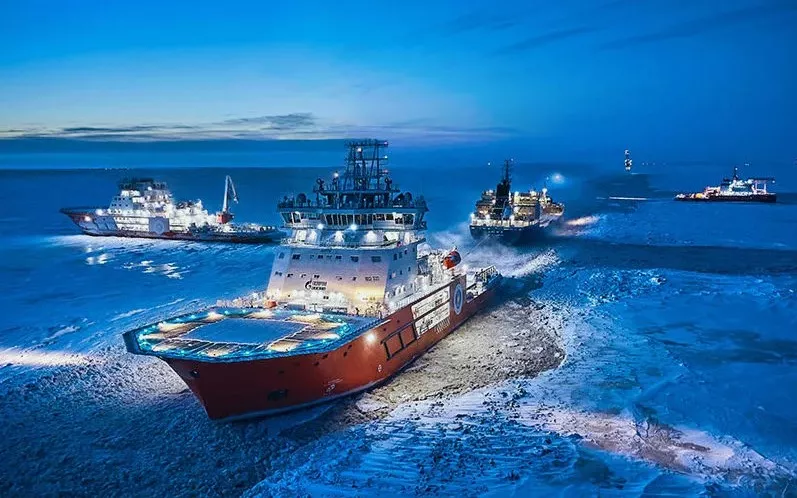
The most conspicuous weakness of the plan concerns the fleet. The Carnegie Center, in its analysis of the Northern Sea Route, writes that shipping is escorted by icebreakers from a fleet of roughly 45 vessels, eight of them nuclear-powered, the largest such fleet in the world. Transit permits are issued by the Northern Sea Route Administration, which operates under the aegis of Rosatom. Vladimir Panov, head of Rosatom's Arctic Directorate, said on October 27 that transit shipments this year would exceed 7 million tonnes and that total cargo traffic would top 40 million tonnes for the first time.
Dmitriev points to this gap: "Russia has eight operational nuclear icebreakers and remains the only country with such a fleet. European states have a strong shipbuilding base, but building comparable capabilities for high latitudes will take years and substantial investment. The EU strategy itself sets neither the number of new icebreakers nor a timeline for building them: for now, it speaks of joint procurement, pooling of capacity and access to icebreakers with high-autonomy power plants, including nuclear ones. In the medium term, therefore, Russia's advantage will remain."
Other measures, in his view, look more achievable: "The plans in surveillance and infrastructure protection are far more realistic. Copernicus and Galileo already give Brussels a serious technological foundation. The Maritime Security Hub and the Arctic Cable Hub are meant to bring together data on shipping, undersea infrastructure and potential incidents. Such a system could emerge much faster than a new heavy icebreaker fleet."
Threat or pretext: a dispute over facts
The divergence between the two sides is clearest on the question of the "Russian threat." Kallas speaks of an expanding Russian military presence in the Far North. Dmitriev proposes separating the facts from their political interpretation: "The 'Russian threat' argument must be divided into facts and political interpretation. Russia has indeed modernised its military infrastructure in the Arctic, and the Kola Peninsula is critical to the strategic forces of the Northern Fleet. There are objective risks linked to growing shipping traffic, the sanctions-evading 'shadow fleet', cyberattacks and the vulnerability of undersea cables. But there is a fundamental difference between the existence of a risk and proven responsibility for a specific act of sabotage. Not every cable incident has been attributed to Russia. Brussels is therefore responding to genuine changes in the security environment while at the same time building a political justification for expanding its own presence."
Sumarokov adds a question put to Kallas at the presentation: could Europe build its own surveillance bases in Greenland, given that its American allies have recently proved unreliable? The answer was: "We are open to cooperation with all countries that share our views and values, and so we are working together with Canada, Norway, Iceland, and also with the United States, if they wish."
The Arctic Council and Moscow's reply
Sumarokov believes the strategy partly seeks to compensate for the broken workings of the Arctic Council: "In part, the new strategy seeks to make up for the disrupted functioning of the Arctic Council." He recalls that in 2022, when Russia held the chairmanship, the other seven members suspended their participation, and work continued only on some projects. His conclusion: "The Council cannot continue to work without Russia. Russia is a key player in the Arctic, and its exclusion will undermine the effectiveness of many projects and will probably lead to the Council's eventual dissolution." And further: "Replacing the Arctic Council does not seem possible."
Dmitriev describes Moscow's response with caution: "In my view, Russia's response should not come down to a mechanical build-up of military forces. Protection of Northern Fleet bases, air defence, the Northern Sea Route, ports, communications and critical infrastructure is necessary. But the development of the icebreaker and transport fleet, satellite observation, the emergency-response system and logistics matters no less. At the same time, it is in Russia's interest to preserve channels of international Arctic cooperation. Turning the Arctic into a permanent theatre of military and political confrontation serves the interests of neither Moscow nor the European states."
The expert singles out China as a separate factor: "China is a factor in its own right. It is not an Arctic state, but it has held observer status in the Arctic Council since 2013 and is expanding its scientific, transport and economic presence. Russian-Chinese cooperation objectively heightens concern in the EU and NATO, but it would be wrong to equate the roles of Russia and China. For Russia, the Arctic is its own territory, a key transport route and a basing area for strategic forces. For China, it is above all a space of long-term economic, logistical and technological interest."
He sums up as follows: "The main effect of the new EU strategy should be sought not in an immediate change in the military balance. It creates an institutional basis for a long-term build-up of the European presence in the Arctic. That, over time, could change the character of the region: from a space of limited competition and practical cooperation to yet another front of confrontation between Russia and the West."