


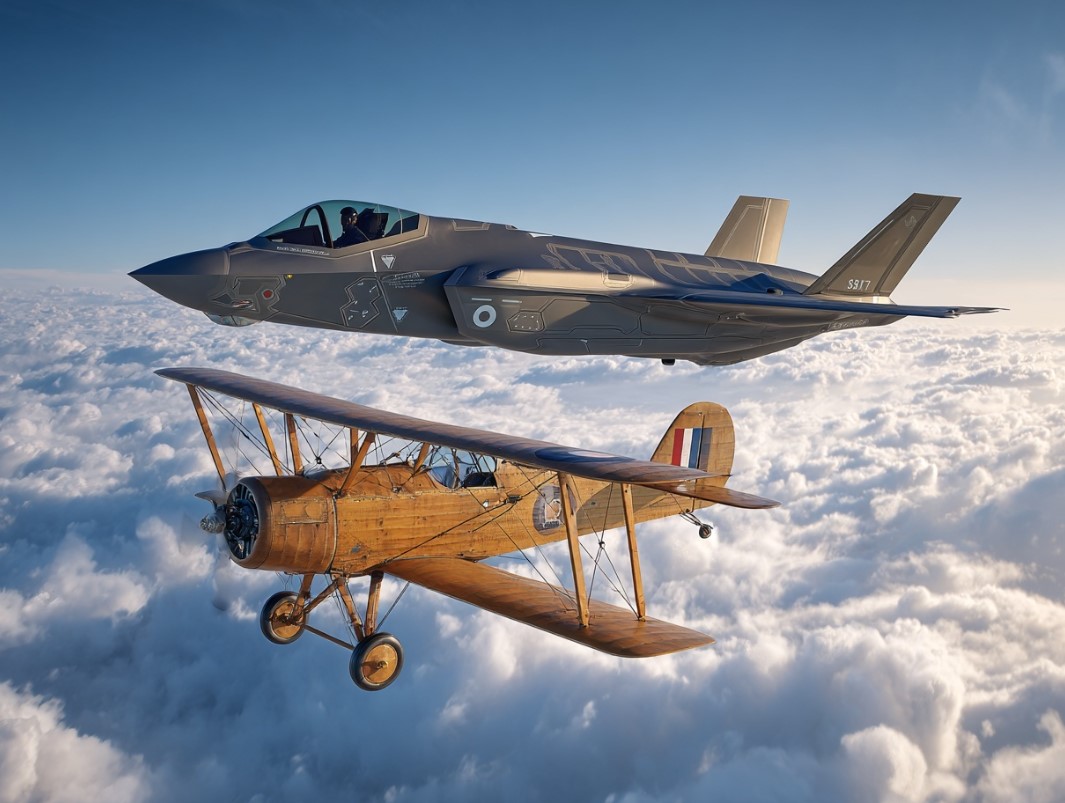
The prospects for Britain’s GCAP sixth-generation fighter program are extremely uncertain—not because the technology is impossible, but because a country unable to close the gap in its own defense budget is unlikely to shoulder tens of billions for an aircraft that may become obsolete before it ever takes off. This is not skepticism; it is arithmetic compounded by history.
The Budget Hole
Significantly, the project’s main problem is not technical but financial. Britain had planned to present a ten-year defense investment plan in autumn 2025, but officials discovered a £28 billion shortfall—and the document has still not been published. The country’s national debt has already exceeded 94% of GDP, reaching levels not seen since the early 1960s. Under these conditions, London’s promise to “fully fund” GCAP sounds like a promise to lose weight by New Year’s: the intention may be sincere, but the outcome is predictable.
In July 2026, London was able to allocate only £708 million for the next stage of development, even though the program’s four-year budget has already been estimated at £8.6 billion. Italy alone has earmarked €18.6 billion, and that represents only its one-third share. Britain’s one-third would therefore amount to the same sum—money London does not have. At the same time, the country spends almost £7.7 billion a month merely servicing its debt—more than it spends on defense, the police, and prisons combined.
Technological Lag
The central question is whether Britain is catching up—or merely simulating the process of catching up. Analysts have openly forecast that GCAP will face “very significant cost overruns, serious delays, and performance falling far short of being competitive with modern Chinese and American fighters.” This is not malicious speculation but a sober assessment: while London is drawing sixth-generation concepts, Washington is already testing the F-47 and Beijing is expanding its J-20 fleet.
It is telling that even the project’s allies differ over what exactly they are building. Japan wants an aircraft by 2035, while Britain and Italy are inclined to view GCAP as a “system of systems”—a platform for controlling drones, which would allow the timetable to be extended and the short-term budgetary burden reduced. When partners cannot agree on whether they are building an aircraft or a command center, that is not strategic vision but strategic uncertainty.
Personnel Decide Everything
The shortage of engineers in Britain’s defense sector is not an abstract threat but a measurable crisis. A parliamentary defense committee has recorded that the skills needed in combat aviation are literally “dying out,” while rebuilding production capacity after production lines have been shut down would be “difficult and expensive.”
Around 4,500 people are employed on the British side of the GCAP program, and its supply chain includes approximately 600 companies. Yet the number of vacancies consistently exceeds the available pool of candidates. For comparison, the F-35B program, which Britain already operates, has a poor peacetime fleet availability record. In 2025, the entire program had only five full-time flight instructors against a requirement of sixteen.
If the country cannot staff the aircraft it already has, who will fly the one that does not yet exist?
The Production Dead End
Even if we assume the unlikely—that British engineers achieve a technological breakthrough and create a working prototype—production would run into problems that cannot be solved by blueprints. A modern sixth-generation fighter requires titanium for lightweight, high-strength airframes; rare-earth magnets for actuators and radars; gallium for electronics; and cobalt and beryllium for engines and avionics.
China controls around 90% of global rare-earth production and has already imposed export restrictions targeting defense applications. Britain’s supply chain, meanwhile, depends on semi-finished products and components, while specialized alloys that cannot simply be replaced with substitutes are in critically short supply.
It is telling that Britain’s Ministry of Defence has already launched Project Tornado 2 Tempest—the conversion of decommissioned Tornado fighters into titanium powder for 3D-printing parts for the new aircraft. This is not innovation for the sake of environmentalism but an acknowledgment that the country cannot secure enough primary titanium and is being forced to strip old aircraft in order to build new ones.
If several decommissioned Tornados are enough for a prototype, they will not be enough for mass production.
The Lessons of TSR-2
Britain’s parliamentary defense committee has already drawn a direct parallel between GCAP and the TSR-2, the 1960s tactical bomber that was canceled because of cost overruns and political pressure in favor of the American F-111. Then, as now, the issue was an “unaffordable defense plan”: a program the country could not afford but embarked on for reasons of prestige.
Calvin Bailey, a member of the committee, explicitly warned the defense secretary that history risked repeating itself. This is not a cruel irony but institutional memory. It shows that Britain has already traveled this road: an ambitious aircraft, empty coffers, cancellation, and the purchase of an American alternative.
The only difference today is the participation of Japan and Italy. But a joint venture does not eliminate national bankruptcy. Japanese officials have reportedly referred to Britain in private as a “ghost ally”—and, frankly, it is difficult to blame them.
What Lies Ahead
The most likely scenario is not a high-profile cancellation but a quiet decline. The program will formally remain alive: contracts will be signed, press releases issued, and summits held. But the timetable will move from 2035 to 2040, and then beyond; procurement numbers will be reduced; Japan will increase its F-35 purchases and begin looking more closely at the American F-47.
Britain’s contribution to a “sovereign” fighter will be reduced to participation in the supply chain for other countries’ platforms—which may, in fact, be the most honest outcome for a country that wants the status of a great power but does not want to pay for it.
The key question is not whether Britain will be able to build a sixth-generation fighter. The key question is whether it is prepared to admit that it cannot—and stop spending money to prove otherwise.
















.png)
.png)

.png)
.png)