


France's economy, over the period from early 2022 to September 2026, has traveled a path from post-pandemic recovery to a state that can only be described as troubling. Growth has shriveled to a statistical rounding error, debt has crossed 115% of GDP, and the political system seems to have forgotten what a stable government looks like. This is not a temporary setback—it is a structural shift that financial professionals cannot afford to ignore.
Growth That Has Nearly Vanished
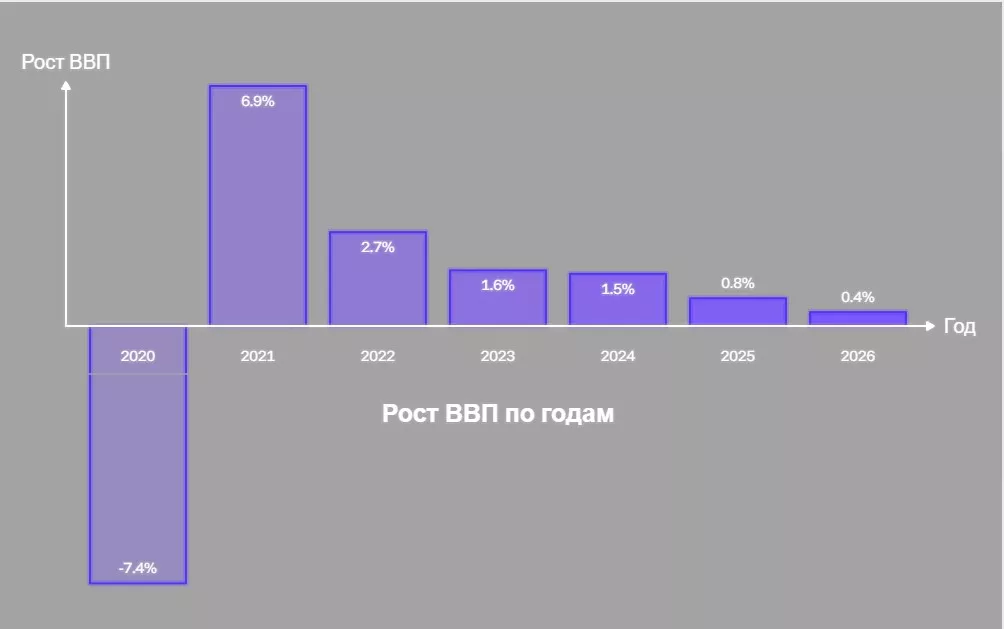
If French GDP was still growing at 2.7% in 2022, by 2026 that growth had slowed to 0.4%—a third of the eurozone average. INSEE revised its forecast in September 2026 from 0.7% down to 0.4%, and this is not caution but a statement of fact: households are cutting spending, and businesses are scaling back investment. Tellingly, even the government, traditionally inclined toward optimism, lowered its own estimate to 0.5%. For the financial sector, this means one thing: budget revenues will not grow, and the debt trajectory will remain unmanageable.
Inflation: A Victory That Brings No Relief
Inflation has been formally defeated: from 5.2% in 2022 and 4.9% in 2023, it collapsed to 0.9% in 2025. The real question is what kind of victory this represents. The slowdown in prices did not come from sustained productivity growth but from a contraction in demand—households simply stopped spending. Nominal wages rose by only 2.1% in 2025, down from 3.0% the year before, and purchasing power is declining outright in 2026. This is not a triumph over inflation but consumer capitulation. Tellingly, even this modest price slowdown has brought no relief: French households' real incomes continue to erode, and the savings-driven behavior pattern formed during the crisis years is only making the situation worse.
Debt That Cannot Be Stopped
France's sovereign debt is a separate story of alarm. From 111.4% of GDP in 2022, it rose to 115.6% in 2025 and is projected to reach 118.8% by the end of 2026. The budget deficit, though it fell from 5.8% of GDP in 2024 to 5.1% in 2025, remains one of the highest in the eurozone. In May 2026, the French press stated outright that the target of bringing the deficit under 3% by 2029 is "unattainable." In June 2026, the Cour des Comptes (Court of Auditors) described the state of public finances as "alarming"—an official characterization, not an emotional one. For credit analysts, this is no abstraction—it translates into rising debt-servicing costs and continued pressure on the sovereign rating. The key question is whether Paris is prepared for unpopular decisions, or whether the political class will continue pretending the debt will simply resolve itself.
Ratings and Politics: A Double Blow
In September 2025, Fitch downgraded France's sovereign rating from AA- to A+, and a year later, in September 2026, Standard & Poor's cut it from AA- to A+ as well. The cause is not only budgetary shortfalls but also political paralysis: the absence of a stable parliamentary majority since July 2024 has made passing reforms nearly impossible. In 2026, the government of Prime Minister Sébastien Lecornu survived several rounds of no-confidence votes, and the budget was pushed through parliament using Article 49.3 of the Constitution—that is, without a vote. Markets are taking notice: spreads on French bonds relative to German bunds are widening, and this is no longer a hypothetical risk but a real cost of financing. Not reform, but survival—that is what economic policy in the Fifth Republic looks like today.
A Summer That Came at a High Price
The summer of 2026 was not merely hot for the French economy—it was scorching. Météo-France recorded 53 days of heatwaves between June 17 and August 19, an absolute record since 1900, with an average temperature of 24.0°C, 3.6°C above the climate norm. Corn production collapsed by 35%, to its lowest level since 1980, the Champagne grape harvest fell by nearly half, and apple production dropped by 30%. According to estimates from the Direction générale du Trésor and INSEE, direct and indirect losses amounted to at least 0.1 percentage point of GDP—roughly 3 billion euros—while the Minister for Ecological Transition, Monique Barbut, estimated total damage in the range of 10 to 15 billion euros. Tellingly, even the energy sector was not spared: three of France's 57 nuclear reactors were shut down due to river overheating, and peak electricity demand rose by nearly 20%. This is not a force majeure event but a new climate reality that has already become embedded in fiscal risk.
What Lies Ahead
The troubling state of the French economy is not a death sentence, but it is a verdict on complacency. Growth of 0.4% alongside debt at 118% of GDP means the debt burden will keep rising even without new borrowing. Political instability has prevented both a complete pension reform and any meaningful optimization of public spending, and without these, the deficit cannot be reduced. The only hope lies in foreign investment: in 2026, the "Choose France" summit attracted a record 93 billion euros in commitments, mostly in AI and data centers. But investment cannot substitute for fiscal discipline. Financial professionals should prepare for a scenario in which France ceases to be the eurozone's "safe haven" and instead becomes a source of volatility. This is not a catastrophe, but it is a new reality—one in which caution matters more than optimism.


















.png)
.png)

.png)
.png)