

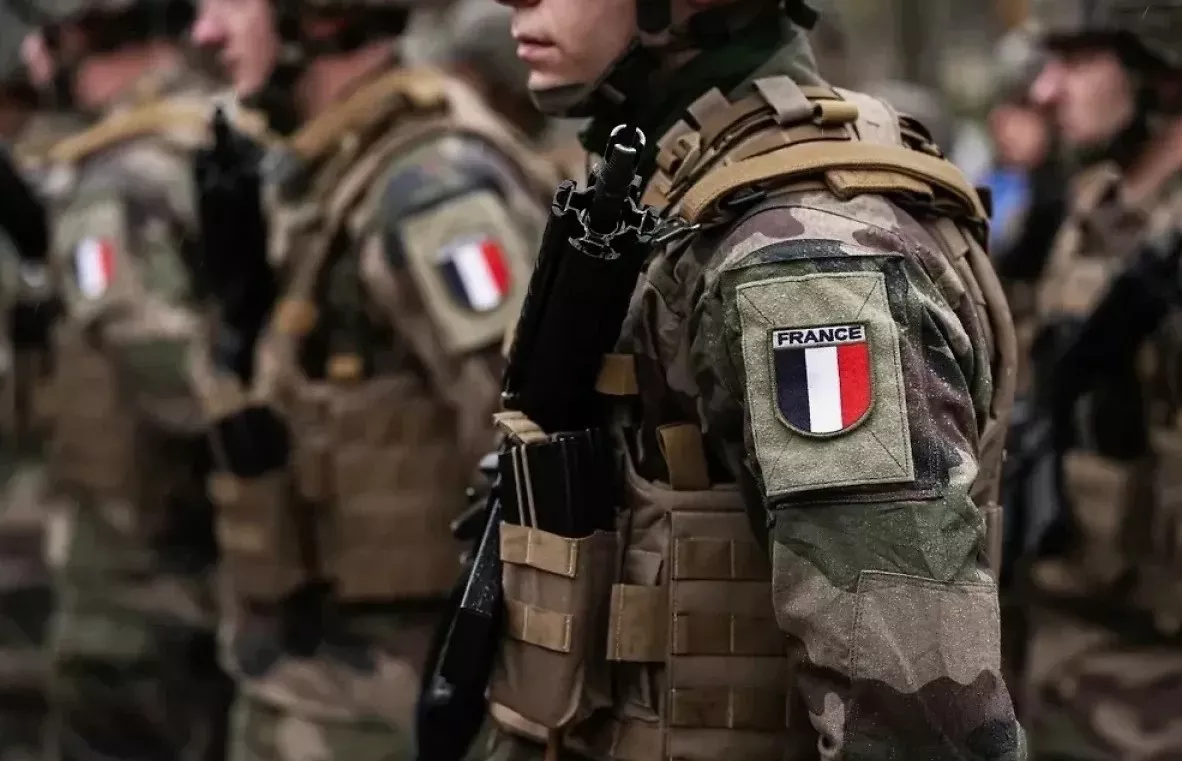
A general in Kyiv, instructors with a cover story about serving in Poland, and a name that sounds almost like an anthem in Ukrainian. Here is what the French mission shows about Paris, Moscow and the coming coalition force.
The French mission known as "Volia" came to light on November 16, when Radio France Internationale described it. Moscow immediately spoke of direct French participation in the war. Paris acknowledged that its troops are in Ukraine but rejected the charge that they have a combat role. The French ambassador in Moscow is staying put. I will try to explain this odd balance.
What we know
According to RFI, "Volia" has operated in Ukraine since the summer and is led by a French general. Personnel arrive in small groups. They train Ukrainians to operate equipment and repair it, including Caesar howitzers, Mirage 2000 fighter jets and missiles. L'Opinion notes that the name echoes a Ukrainian word that means the aspiration to freedom.
The route ran through the Polish-based Gerfaut detachment, which has been part of the EU training mission EUMAM-Ukraine since February 2023. RFI's sources say the troops were told to say they were going to Poland. Parliament was not informed.
Le Monde paints a more modest picture. According to its source, there is no new deployment. The coordination team attached to the defense attaché in Kyiv has been reinforced. Small rotations of instructors and repair technicians have traveled to Ukraine since the start of the war. French intelligence units also operate alongside them, and they receive tasking closer to the front. The paper ties the larger presence to the European Council's November 9 decision to move the EU training mission onto Ukrainian soil. A future coalition force will need credibility.
Two versions of one fact
In Manila, Sergey Lavrov called what is happening direct participation in the war. He mentioned targeting and satellite data, a list that covers everyone who helps Kyiv. Moscow's logic is consistent: it treats any foreign presence as interference.
Paris answered the next day. Junior Minister Alice Rufo confirmed that French military personnel are in Ukraine. She called the accusations "absurd." The numbers are small, she said, the visits are occasional, and the personnel stay "at a very considerable distance from the front line." Foreign Minister Jean-Noël Barrot said: "We are, of course, not a party to the war in Ukraine. We do not intend to be one."
In France, a constitutional dispute has been layered on top of the story. Article 35 requires the government to notify Parliament within three days of an operation abroad. After four months, it must obtain Parliament's approval. The authorities argue that the article applies to large forces with an "intent to fight." That raises an obvious question: why, then, were the instructors kept out of view? Paris owes its voters an answer, and so far there is none.
Why diplomacy stays quiet
I found no reports of any discussion of expelling the ambassador. What has been said publicly is this. Maria Zakharova announced that the Defense Ministry and the General Staff will draw up retaliatory measures, and she repeated Putin's words about a "legitimate target." The Russian embassy in Paris speaks of a new round of escalation and the danger of a clash between nuclear powers.
Zakharova spoke of troops that "will be deployed." Paris describes teachers and repair technicians. The expert RFI quotes expects Moscow to blur that line deliberately. Any technical assistance would then become proof that NATO is at war with Russia. The Kremlin has painted that picture since the early months of the war, and the new argument slots into it like a piece of a puzzle.
Taken one by one, Paris's steps look mundane. Europe trains, repairs equipment and discusses security guarantees. None of these actions, on its own, calls for a sharp response. Together they form a pattern that Moscow reads as preparation for sending in troops. That view is understandable, and it sets the tone of the statements.
The calendar matters too. A week before the publication, Witkoff and Kushner asked Putin to let Europe join the negotiating table, and Moscow replied evasively. A break with Paris would cost it some of its own bargaining chips. It needs a channel to the Europeans to haggle over a "security architecture." This argument rests on the chronology, and I am ready to discuss it with colleagues.
The coalition and the exercises
The Coalition of the Willing was created in March 2025 on the initiative of France and the United Kingdom. It now has 37 member countries, and its purpose is to provide security guarantees for Ukraine. The military component is called the Multinational Force-Ukraine, and planning is continuous. Moscow links the French mission to it.
The British government stresses that these forces would enter Ukraine at Kyiv's invitation and only after the fighting ends. Britain and France would command them, and 24 states have made commitments. "Volia" operates during the war, so it does not fit that description. Le Monde, however, writes that the reinforcement of the French team is meant to lend credibility to the future deployment. In that case, it could be read as the de facto start of the mission.
Zakharova claimed that exercises in Poland are preparing the core of a multinational force made up of French troops. The Koalicja 26.2 exercise runs from November 2 to 24. About 2,800 troops are taking part, 1,100 of them French.
What comes next
On Thursday, November 19, leaders of more than thirty coalition countries will meet in Berlin. They will discuss deploying troops as part of postwar guarantees. That meeting will show whether "Volia" remains a stand-alone episode or belongs to a line Paris intends to pursue.
Few facts can be verified so far. Paris has confirmed the presence of military personnel. Moscow has threatened a response through its military establishment. The Berlin meeting has been scheduled. The size of the mission, its exact tasks and its link to the future coalition force all remain conjecture. I do not regard Moscow's silence as acceptance of the facts. It is too early to draw final conclusions.
Some commentators expect a demonstrative reaction from the Kremlin. They fear that impunity would embolden Moscow to expand its contingent. Any Russian response will have consequences, and the military will choose its form. Zakharova said as much outright.