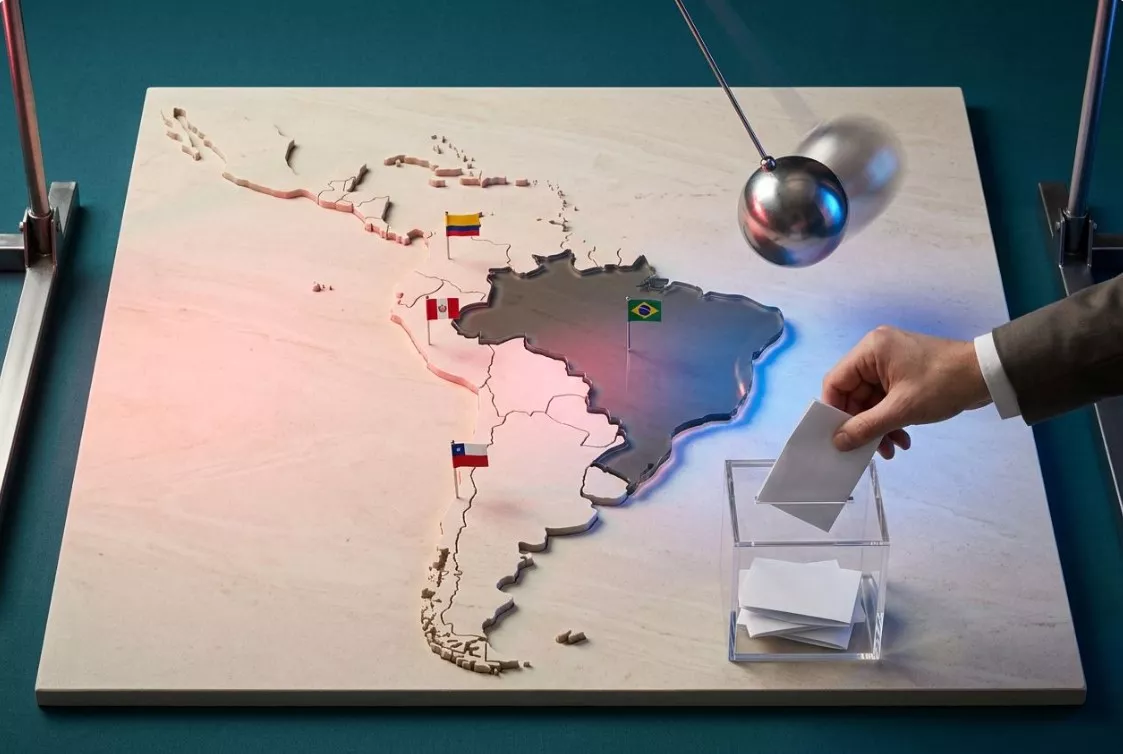
The pendulum that swung left two decades ago has swung back to the right. Colombia and Peru chose right-wing presidents in June by fractions of a percentage point, and on Sunday Brazil will settle a runoff between Lula and Flávio Bolsonaro. What is behind the turn? How does it resemble the "pink tide"? And what should the region expect?
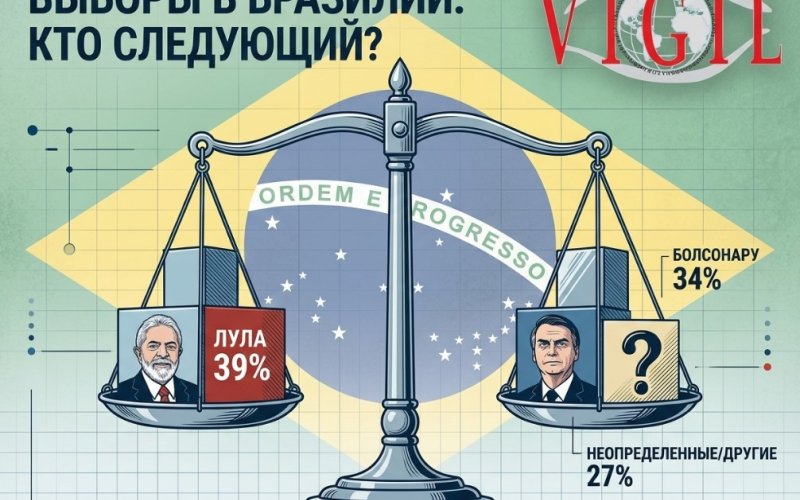
Brazil: The October 25 Runoff
The first round on October 4 defied the forecasts. Senator Flávio Bolsonaro, son of the former president, took 47.03% of valid votes, or 56,104,503 ballots. Incumbent President Lula won 45.16%, or 53,879,538 votes. Neither cleared the 50% threshold, so the decisive round was set for October 25. Pre-election polls, including a Datafolha survey on October 3, had put Lula ahead, 45% to 42%.
Now the gap between the two is razor-thin. A Nexus poll for BTG Pactual gives Bolsonaro 46.5% to Lula's 45.9%. Quaest, surveying October 17–20, has Lula and Bolsonaro at 45% and 44%. Datafolha's October 15 poll shows 51% to 49% of valid votes, and Real Time Big Data has 52% to 48%. The PoderData institute shows a dead heat at 50% apiece. The Rio Times tracker average puts Bolsonaro at 50.9% and Lula at 49.1%. Every gap falls within the margin of error, and in the week after the first round Bolsonaro led Lula by six points.
The stakes for the region are high. The Taipei Times notes that if Bolsonaro wins, Mexico will be the only major country in the region under a left-wing government. Results are due Sunday evening; polls are open from 8 a.m. to 5 p.m. Brazilian time.
Colombia: A Bare-Minimum Change of Power
In Colombia, President Gustavo Petro was barred from seeking a second term. In the first round on May 31, independent right-wing candidate Abelardo de la Espriella won 43.75%, while Iván Cepeda, the left-wing senator from the Historic Pact, took 40.90%. In the June 21 runoff, the margin was under one point: 49.66% to 48.70%, or 12,960,166 votes to 12,708,312, a difference of 251,854 votes on turnout of 63.6%. The electoral council certified the result on June 24. De la Espriella's 12.9 million votes are more than any candidate in Colombian history has received.
Washington openly backed the winner in June. He was inaugurated in August, and an October CB Global Data poll gives the new president 49.7% approval and 47% disapproval. The picture is symmetrical: the left-wing coalition lost but kept nearly half of the electorate, so the president lacks a comfortable mandate.
Peru: The Narrowest Result
Peru produced the closest outcome. In the June 7 runoff, right-wing candidate Keiko Fujimori won 50.13% to 49.87% for the left's Roberto Sánchez. The final count took nearly a month. The margin was 49,641 votes out of roughly 18 million, and overseas ballots decided the outcome. It was Fujimori's fourth attempt, after losses in 2011, 2016 and 2021. She was sworn in on July 28 for a five-year term.
According to USA Today, the U.S. administration did not openly back Fujimori, but it did support de la Espriella in Colombia and José Antonio Kast in Chile. The question for Peru now is whether a president with such a mandate can push reforms through a legislature where she has no majority, and keep the peace after a month of disputes over the legitimacy of the result.
Chile as a Warning
Chile shows what happens after the victory. Kast took office on March 11, 2026, and in his first hours signed six decrees, three of them on borders and migration. Interior Ministry statistics point to security gains: homicides are down 17%, violent robberies 13.2%, and illegal border crossings 87%, with 1,580 people expelled. Chile has also enacted its first tax cut in 30 years.
Yet the president's ratings are sliding. Cadem recorded approval of 34% against 61% disapproval in September, the lowest since March. CB Global Data's October figures show 38.8% positive and 56.8% negative. Criteria puts approval at 27%. Cadem notes that the economy and jobs have displaced security as voters' top concern. According to WSWS, the 2027 budget raises security spending by 9.1% and freezes the rest. Winning an election and sustaining public support have proved to be different things.
Parallels With the Pink Tide
The comparison with the left-wing drift of the early 2000s suggests itself. Back then, the victories of Hugo Chávez in 1998, Lula in 2002, Néstor Kirchner in 2003, Evo Morales in 2005 and Rafael Correa in 2006 formed a chain that lasted until roughly 2015. Scholars of the region rank the current wave, in scale, alongside the military dictatorships of the 1970s, the democratization of the 1980s, the market reforms of the 1990s and the pink tide. They count twelve right-wing governments (Argentina, Bolivia, Chile, Colombia, Costa Rica, the Dominican Republic, Ecuador, El Salvador, Honduras, Panama, Paraguay and Peru) and four left-wing ones (Brazil, Guatemala, Mexico and Uruguay). According to Latinobarómetro, the share of Latin Americans who describe themselves as center-right has since 2024 been higher than at any point in two decades.
The causes differ. The pink tide grew as a response to the market reforms of the 1990s and their social cost. The current wave, USA Today argues, is fed by disillusionment with left-wing governments, the rise of organized crime and inflation. Voters are choosing promises of security and economic reform. In Colombia and Peru, the winners beat their rivals by fractions of a percentage point, and that sets the current shift apart: back then, victories were often decisive, whereas now majorities are fragile.
The similarity is that both waves rested on specific leaders and a specific agenda, and then ran into the daily business of governing. The left-wing governments of that era split over inflation and corruption. Today's right-wing governments face the question of how to deliver security without losing popularity, and Chile's example shows the answer does not come quickly.
Outlook
Three outcomes in Brazil carry different consequences. If Flávio Bolsonaro wins, the right will control most of the large countries, and Mexico will remain the only major left-wing government. Claudia Sheinbaum's October approval rating was 69.3%, the highest in the region, and her opposition is fragmented. If Lula wins, the left keeps the region's largest economy, and the "right-wing wave" will prove incomplete. If the margin comes down to fractions of a percentage point, expect a protracted dispute over the count, as in Peru.
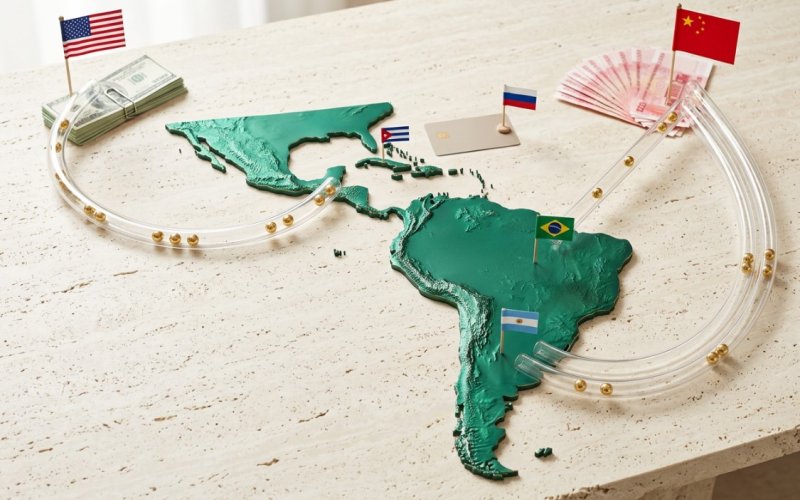
For the economy and diplomacy, the implications run through the United States. Washington backed the winning right-wing candidates in Chile and Colombia, and governments across the region gain new opportunities to ally with the administration. For Russia, this means a shrinking field: left-wing leaders remain only in Mexico, Nicaragua, Cuba, Uruguay and Guatemala, and most of those are small countries.
The reverse also holds. Apart from Bukele, the right-wing presidents' ratings are modest: Milei stands at 36.1%, Mulino at 36.5% and Kast at 38.8%. Looking back across the cycle that began in 1998, the most durable force has been not ideology but the ability to hold on to public support after election day.