

HSBC's chief executive says the Strait of Hormuz could become "unnecessary" within five years. We tested that idea against the facts of this year. What did the September drones show? Why is a pipeline not the same as security? And what does a fair order for all parties have to do with any of it?
What the Banker Said
On October 20, at the HSBC Future Forum in Dubai, group chief executive Georges Elhedery said that Gulf states' investment in alternative routes could make the Strait of Hormuz "unnecessary" in roughly five years. His phrasing was cautious. He said "potentially," and he added at once that the bank hopes the conflict will be resolved. In his telling, the region will recover and keep growing, but that will take heavy investment. This is his second trip to the region since the war began.
The sums are large. An HSBC report issued Monday cites MEED data valuing separate packages of projects across the Middle East, North Africa and Turkey at $872 billion. They form part of a $1.4 trillion pipeline of infrastructure projects for which contractors have yet to be chosen. Last week the World Bank forecast that the economy of the Middle East, North Africa and Pakistan region would shrink by 1.3% this year, after growing 3.3% in 2025.
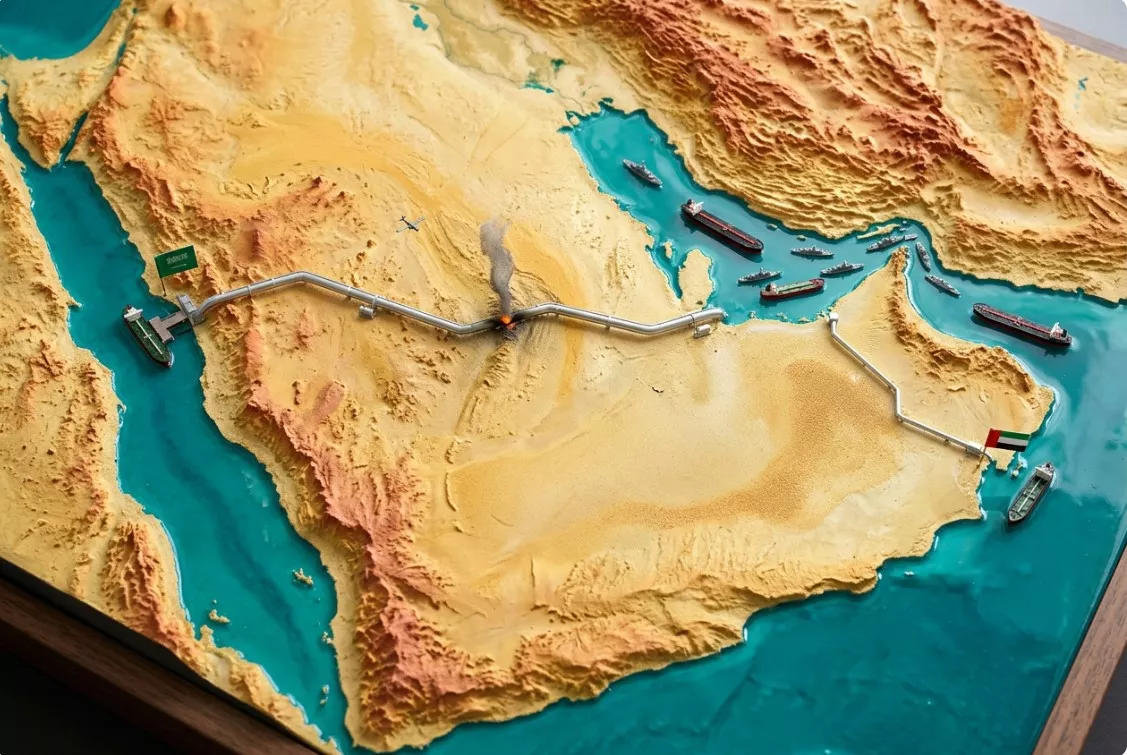
Before the war, roughly a fifth of the world's trade in oil and liquefied natural gas passed through Hormuz. According to Kpler, about 40% of Gulf oil exports now bypass the strait, up from 17%. Most of that flow runs through Saudi Arabia's East-West pipeline to the port of Yanbu and through the Emirati pipeline to Fujairah. A new line in the UAE could more than double the country's bypass capacity, to over 3 million barrels a day.
Neighbors are worse off. Kuwait, Bahrain and Qatar have no bypass routes. The Iraq-Turkey pipeline is running well below capacity, and for liquefied gas no working pipeline exists at all. Qatar's exports have fallen from 6-8 million tonnes a month to about 1 million since March. On Monday, Saudi Arabia postponed its flagship investment conference, which Elhedery was due to attend, until 2027 after deadly Houthi strikes on Riyadh.
What Happened to the Pipeline in September
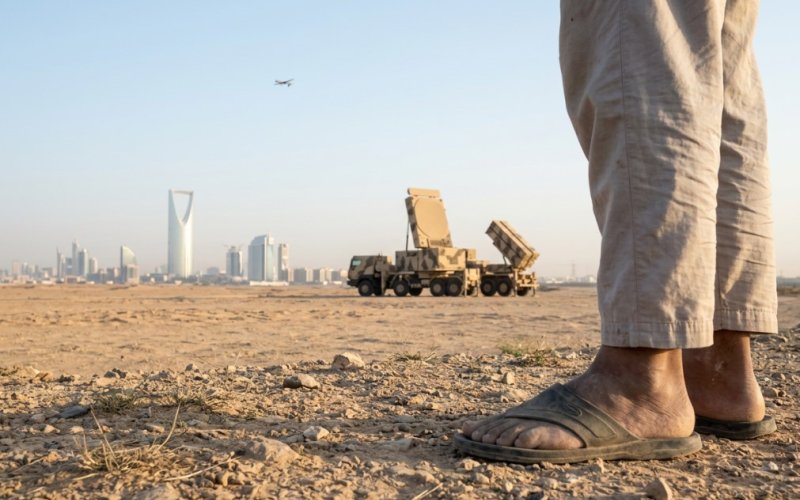
Let us test the thesis against the region's own experience. On September 10-11, a series of drones launched from Iraqi territory struck the East-West pipeline, and Saudi Arabia shut it down. Satellite images showed damage, and analysts warned that an outage could remove about 4% of global oil supply from the market. Riyadh blamed Iran-linked armed groups.
The pipeline matters for another reason: its endpoint, Yanbu, sits on the Red Sea. That is exactly where the Houthis, as the US Maritime Administration (MARAD) warned from September 23, are again attacking commercial vessels and have declared a blockade of ships linked to Saudi Arabia. Kpler adds that the East-West route's throughput is limited not by the pipe itself but by the export terminal at Yanbu. The result is a chain of three links: a closed strait, a pipe across the desert, and a seaside terminal under fire. Any of them can be hit.
The Houthis are also striking farther afield. They are shelling Riyadh, and the coalition reports intercepting a missile headed for Medina. We have written about this separately: Saudi energy infrastructure has become a target for both sides of the conflict.
The Arithmetic of Vulnerability
Compare the two assets. Navies guard a strait. Convoys can be organized, mines swept and patrols run. A pipeline hundreds of kilometers long, with pumping stations, storage tanks and a terminal, is protected by nothing except its own remoteness. A drone costs thousands of dollars, a pipeline costs billions, and an outage lasts weeks.
Analysts at Fazen Markets put the security costs of new bypass pipelines at about $650 million and point to the threat from Iran. The more pipelines there are, the more targets there are. The network does not vanish from the map of vulnerabilities; it is simply spread more widely across it.
Elhedery himself attaches a condition: it all works if the conflict subsides. Yet only the second half of his remark survived in the headlines. "Hormuz may become unnecessary" turned into "Hormuz will become unnecessary." Note, too, that the forecast came while $1.4 trillion in projects still await contractors, and as the bank affirmed its "unwavering" commitment to the region. For a lender, that is an ordinary and honest position: those who build need financing. Turkey, for its part, this week pitched its Development Road project as yet another route around Hormuz.
Security Without Fairness
Our starting point is simple. Any infrastructure, whether a strait, a pipeline or a cable, is protected only to the extent that all parties have a stake in keeping it intact. If some participants consider the rules unjust and their rights violated, they will quickly find the motive and the means to break what others have built. The drones from Iraq and the Houthi missiles did not appear from nowhere. They were born of war and of regional disputes that run far deeper in time.
Equal rights for all participants in the process cost less than any pipeline. They are more reliable than a terminal and require no contractors. The trouble is that this conversation cannot be sold to banks or investors. It promises no $1.4 trillion portfolio and does not fit on a forum slide. So the table discusses five-year horizons, kilometers of pipe and the "redundancy" of a strait, while the question of who will defend those pipelines, and from whom, goes unanswered.
If the logic is "pipelines instead of peace," then in five years the Gulf will have dozens of new targets instead of one. A closed strait is visible at once. A blown-up pipeline is noticed at the gas pump.