

Is the UAE helping the Houthis fight Saudi-backed forces in Yemen? What do events on the front line confirm, and what rests only on anonymous sources? Will Aden hold, with the Houthis about 60 kilometers away? And what does all this mean for the Gulf, the Red Sea and the people living under fire?
By Dr. Hassan, VIGIL Journal's representative for the Middle East and North Africa
On October 27, Drop Site News published a report claiming that the United Arab Emirates is helping the Houthis fight Saudi-backed forces in Yemen. I reread the piece, set it against agency reports and think-tank analysis, and separated what can be verified from what is merely asserted.
What Drop Site News reported
The report, by journalists Ryan Grim and Jonah Craig, relies on four unnamed people familiar with the situation. According to their account, Yemeni formations close to the UAE are helping Ansar Allah, the Houthi movement, choose targets among forces backed by Riyadh, while Abu Dhabi turns a blind eye.
Two of the sources, the authors say, go further and claim that the Emirates is passing intelligence directly to the Houthis. One Yemeni source said: "The UAE has given the government in Sanaa a significant amount of intelligence; the line of communication between the sides remains open." The source added that the Houthis have built their own channels with commanders who remain loyal to Abu Dhabi. The assistance, the article says, is confined to Yemen and does not include data on targets inside Saudi Arabia.
The Houthis rejected the report and said they had received no help from the Emirates. One point is simple: this is a denial by one party, and it proves nothing by itself. The anonymous accounts likewise prove nothing until a document backs them up. Until a third piece of evidence appears, the two claims carry equal weight.
Other outlets, including Al-Istiklal and News18, picked up the story, but they cite the same original source.
Background to the rift
The story found an audience because of what happened last winter. As the House of Commons Library describes it, in early 2026 the Southern Transitional Council, a separatist group founded in 2017 and backed by the UAE, took control of most of the Yemeni territory not held by the Houthis. In January, a counteroffensive by forces of the Presidential Leadership Council, backed by Saudi Arabia, quickly changed the picture. Council ministers were removed from the leadership, and the Transitional Council announced its own dissolution. Some members disputed that decision, and the group re-emerged under the name "Southern Arabia Transitional Council."
According to the Library, the UAE had been part of the Saudi-led coalition. It withdrew most of its forces in 2020 and the remainder in January 2026. These events strained relations between the Gulf's two leading Arab monarchies, which backed opposing sides within the Presidential Leadership Council. Both called for restraint. Analysts cited by the Library consider a complete Emirati exit from Yemen unlikely.
In June 2026, the Houthis announced a "new phase" of their conflict with Saudi Arabia, centered on lifting the blockade of their air and sea ports. Reuters assessed that Yemen's frozen civil war flared up again over the summer against the backdrop of the US-Iran conflict, pulling Riyadh into direct confrontation with the Houthis.
The situation around Aden
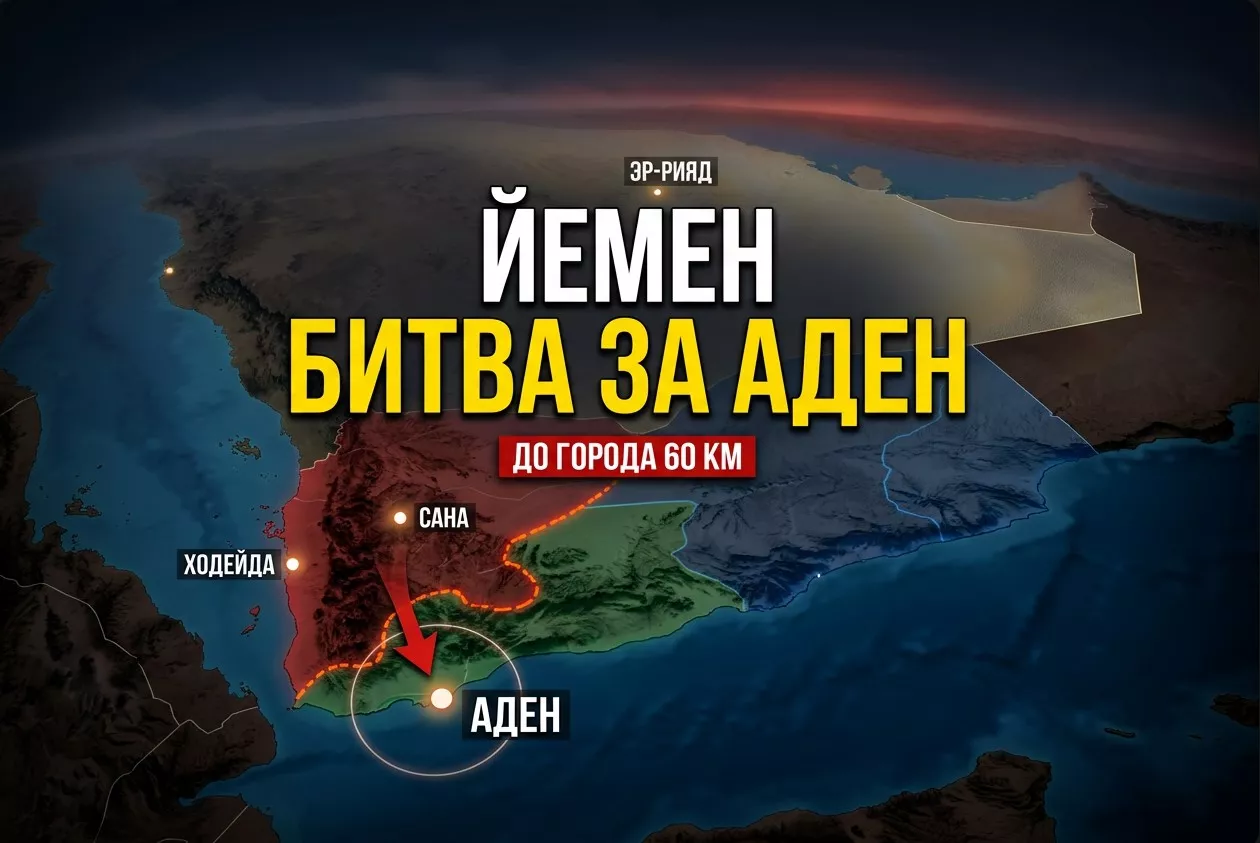
This autumn, government forces launched a counteroffensive but could not build on it. According to Middle East Eye, six weeks of fighting failed to recover what had been lost along the coast, and the priority shifted to the political center of power rather than the maritime corridor. On November 15, the Yemeni government announced it was pulling forces out of areas near the Bab al-Mandab Strait to concentrate on defending Aden.
Military sources say the Houthis have reached the coastal zone of Khor Omeira, roughly 100 kilometers west of Aden, and are 25 kilometers from government positions at Kawa. According to AFP, as relayed by the Times of Israel, the Houthis captured two districts in Lahj province and have settled into the Al-Haraz camp in Al-Madaribah, 60 kilometers from the city. On Sunday, a Houthi missile strike killed eight people near the city, agency sources said.
Riyadh responded with personnel and military decisions. A decree from King Salman named the coalition commander, Lt. Gen. Fahd bin Hamad al-Salman, as an adviser to the defense minister, and gave Chief of the General Staff Fayyad al-Ruwaili the additional post of commander of joint forces. In Aden, residents say, the authorities have set up more checkpoints and tightened document checks.
On November 18, coalition spokesman Turki al-Maliki reported strikes on 60 Houthi targets in the provinces of Sanaa, Hodeidah, Amran and Saada, including tunnels that he said housed ballistic missile workshops and depots. The strikes came on the day of the Houthi advance toward Aden. That same day, the coalition said it had intercepted two cruise missiles fired at Riyadh.
The British risk consultancy Basha Report, cited by the Jerusalem Post, regards the Karish front as the key indicator of Houthi intentions. A breakthrough there would increase pressure on Aden's northern approaches, while positions at Ras al-Arai threaten the western ones.
What the facts can and cannot support
The claim of Emirati help rests on the authors' argument that two precise strikes on a coalition base near Aden required accurate intelligence. Those strikes took place on October 2 and 7, when, according to Reuters, the Houthis had already been advancing for months. A precise strike does not, on its own, reveal where the information came from. The Houthis have fought the coalition for years and have intelligence capabilities of their own.
There is a further point. Events in Aden bear on a question that the article's authors did not address. If the Emirates retains influence over southern forces, and Riyadh needs those forces to defend Aden, then the quarrel between the two capitals has become a military factor regardless of any intelligence sharing. Analysts cited by House of Saud say the alliance is fragile: the Southern Transitional Council seeks independence, not a return to the authority of the recognized government.
Aden's history is also worth remembering. In 2015, the Houthis entered the city alongside units loyal to former president Ali Abdullah Saleh and held significant areas until local resistance and the coalition drove them out in July. Middle East Eye stresses that the city's fall is neither predetermined nor inevitable.
Outlook: weeks, months, years
The coming weeks. My baseline scenario is that the Houthis keep pressing the approaches to Aden and step up their attacks on Saudi Arabia, while the government and the coalition defend the city and offset their losses with heavy air strikes. I put the likelihood of this at about 65%. Indicators include front lines holding at 25 and 60 kilometers from the city, new checkpoints inside Aden, and continued air strikes on Sanaa and Hodeidah provinces. In the alternative scenario, at about 35%, the Houthis break through in the north or west and the city comes under siege. Signs of that would be a strike from Karish and Ras al-Arai, which Basha Report considers pivotal, and the loss of the eastern corridor through Abyan and Shabwa.
Six to twelve months. If Aden holds, the central question will be the cost of its defense. Riyadh will have to either reach terms with the forces the Emirates backed or find replacements for them. That choice will shape the balance of power in the southern provinces. I put the probability that new documents or admissions confirm the Emirati-assistance claim by the end of next year at 20%. That estimate rests on the fact that, in the three weeks since publication, no independent outlet has produced evidence of its own. If confirmation did emerge, it would alter relations within the coalition and raise questions in Washington, since the Emirates is regarded as America's closest partner in the Gulf.
The long term. The fall of Aden, or even a prolonged siege, would cement Houthi control over the entire western coast and strengthen their position on the Red Sea. For Egypt, that means risk to Suez Canal revenue. For the Horn of Africa and the wider region, it means higher food and fuel costs. For ordinary Yemenis, the gravest consequence is humanitarian: the House of Commons Library assesses that needs remain very high. For Saudi Arabia, a drawn-out war means a constant threat to airports and oil facilities, and therefore a rethink of plans tied to investment and economic reform.
What readers should take away
I suggest three rules for reading material of this kind. First, distinguish a claim about a state from a claim about its allies, because they are different assertions. Second, count reprints as one source, not several. Third, watch the map, not the headlines: the front line at Aden will show how the autumn ends.
I began by asking whether the Emirates is helping the Houthis. The answer depends on documents that are not currently in the public domain. The answer on Aden's fate will come sooner.