


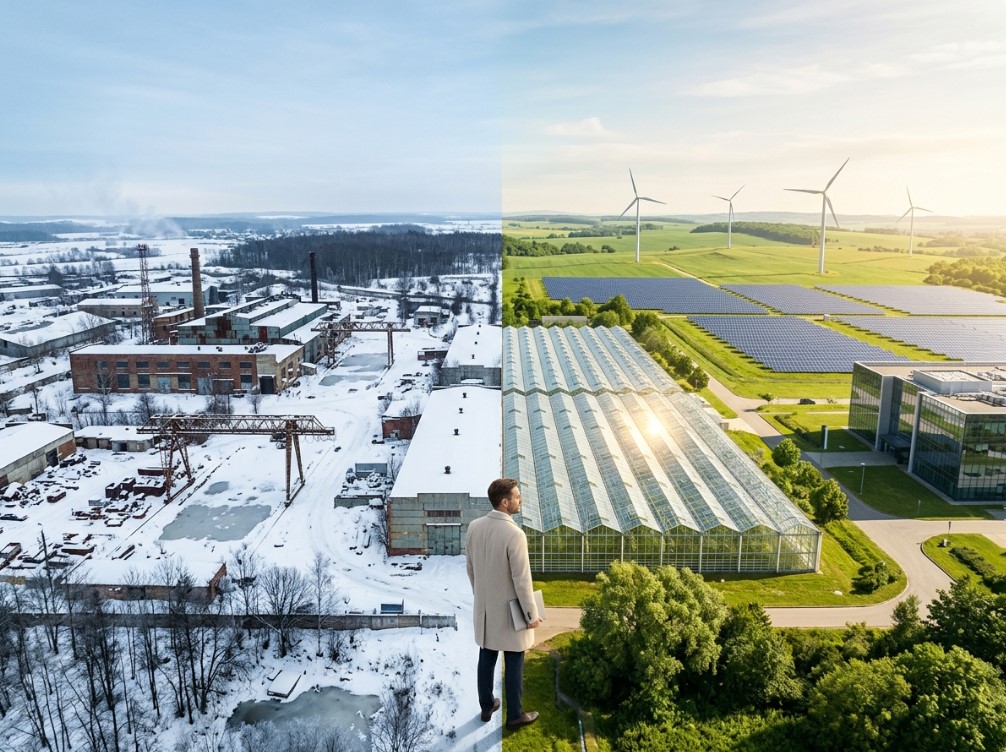
We are not "on the brink of a new crisis." We are already inside a rare convergence of several long-term economic cycles. This is less a catastrophe than a change in the rules of the game, one that most portfolios are not prepared for. The key question is not "when will it blow up," but who will manage to reposition before the old maps stop working.
The Winter Everyone Was Expecting
Followers of Kondratiev theory argue over dates with the tenacity of astronomers, but they agree on one thing: we are in the "winter" phase of the fifth cycle, when the old technological paradigm is running out of steam and the new one has not yet gained momentum. By some estimates, the depressive phase began around 2020 and, given a historical length of 8–11 years, will end somewhere between 2028 and 2031. Notably, this is not "the end of the world" but a structural shift: the old economy (real estate, heavy industry, offline retail) is contracting, while the new one (AI, semiconductors, the energy transition) is attracting capital. The main question is whether the new wave will have enough strength to pull the world out of a K-shaped split, in which some regions and industries grow while others quietly slide down. The irony is that "winter" is not when everything freezes, but when some people freeze while others build greenhouses.
Debt That Costs More Than It Seems
Global debt has stopped being an abstract figure from a textbook. In the first half of 2026, total global debt exceeded 365 trillion dollars, rising by 10 trillion in just six months. At the same time, a third of developed-country sovereign bonds mature by 2028, and new securities are being issued at rates that are on average two percentage points higher than the old ones. In other words, debt is not just growing; it is getting more expensive. In France, debt servicing in 2026 will reach about 59 billion euros, and Italy is heading toward a point where, by 2028, interest payments will consume almost 9% of all government revenue. This is no longer a "manageable level" but a sword of Damocles hanging over fiscal policy. Notably, developed countries' interest payments on government bonds last year exceeded 3.3 trillion dollars, more than total global spending on AI (2.6 trillion), defense (3.1 trillion), or clean energy (2.3 trillion). Debt is no longer the backdrop; it has become the main protagonist.
Rates Caught in a Trap
The market was expecting easing and got a "hawkish turn." The Fed is holding its rate in a range of 3.75–4.00%, and futures are pricing in the probability of another hike in December 2026. Goldman Sachs even forecasts that the Federal Reserve will "freeze" the rate until the end of the year and begin cutting only in 2027. This is not just a technical detail: when the cost of money is not falling and debt is rising, governments find themselves between two fires: cut spending (and lose growth) or increase debt (and lose market confidence). Jeffrey Gundlach of DoubleLine Capital calls it a "waterbed": press down on inflation and interest costs pop up; let inflation go and debt spirals out of control. He forecasts that 10-year US Treasury yields could reach 6%, and 30-year yields 6.5%. For now, markets are remarkably calm: corporate spreads are close to historic lows, but this calm is more a technical breather than fundamental stability.
Demography Is No Longer an Ally
For a long time, population growth was a free driver of the economy. In 2026, humanity fell below the replacement level for the first time in history: there are fewer than 2.2 children per woman. Moreover, the decline in fertility has affected not only wealthy countries but also middle- and low-income states, which is the most unpleasant discovery. In Thailand, the total fertility rate is 0.87 children per woman, in Colombia 1.01, in Iran 1.35, and in Brazil and Mexico about 1.5. Notably, fertility in Mexico turned out to be lower than among non-Hispanic white women in the United States, even though GDP per capita there is only 28% of the American level. South Korea, where fertility fell to a historic low of 0.72, has spent two years in a row trying to push off the bottom: in 2025 the figure rose to 0.8, but that is still catastrophically low. Economies are passing one after another through a "demographic turn," when the share of the working-age population begins to shrink and the "demographic dividend" gives way to a "demographic brake." This means fewer workers, a heavier burden on pension systems, and slower potential GDP growth, and no technology will compensate for it within a single decade.
What Lies Ahead
The main thing to understand is that the convergence of cycles is not a synonym for a crash, but a synonym for uncertainty with a high price of error. The Kondratiev "winter" will end not because we want it to, but when AI and new technologies begin to deliver measurable productivity gains and debts are restructured. And the first signs are already here. Citigroup will direct 5 billion dollars to technology and AI in 2026, and this is already yielding results: generative AI has cut the average support call time by 60 seconds, and the rate of customers resolving their requests on their own has risen by roughly 50%. At its largest North American plant, Lenovo has cut order lead time by 85% and logistics costs by 42%, while productivity has risen by 58% thanks to AI solutions. Korea's Posco has shortened its research and development cycle from 32 weeks to 6, and analysis time by 95%. This is not futurology; it is accounting. But before these stories become mainstream, markets will live in a regime of K-shaped split: some assets (infrastructure, energy, defense, AI infrastructure) will feel fine, while others will tread water for years. The irony is that "diversification" in the usual sense is ceasing to work: correlations are breaking down, and the old 60/40 formula looks less and less convincing. The winner will not be the one who guesses the date of the turnaround, but the one who builds a portfolio able to survive a change of phases without forced asset sales. This is boring, but boredom is currently the most underrated investment strategy.














.png)
.png)

.png)
.png)