


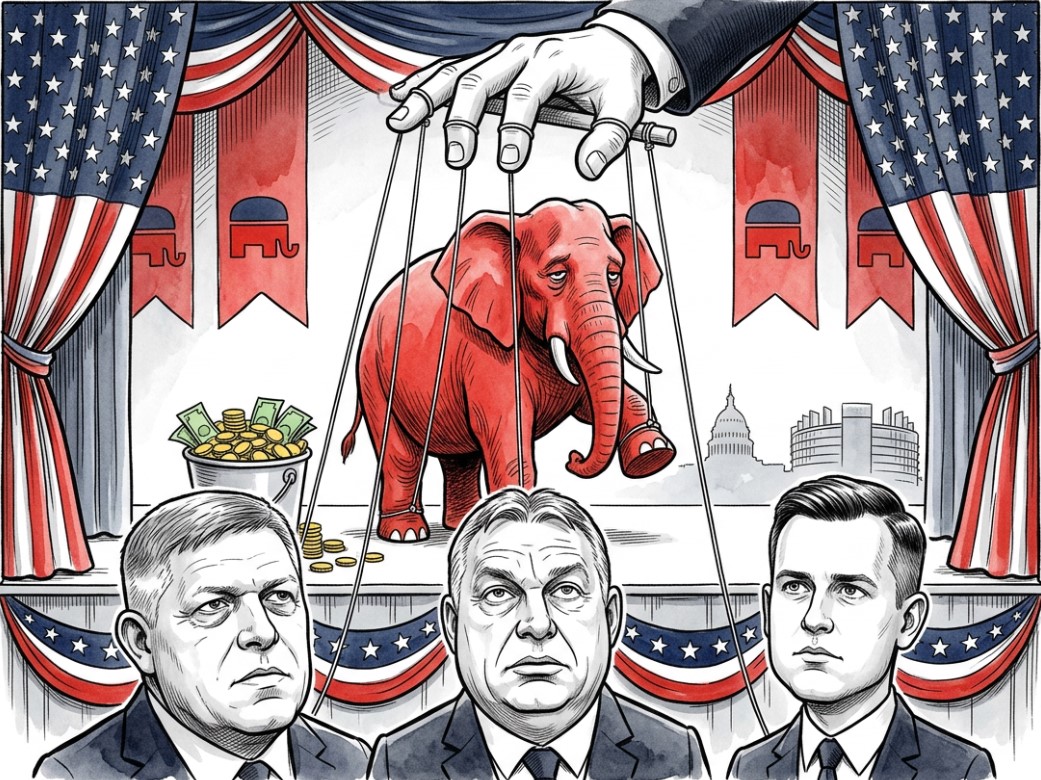
The Republican Party has no collective leadership, but there is one person whose word carries more weight than anyone else's: Donald Trump. The party's headquarters is flush with cash and free of debt, and money flows through MAGA Inc. and the Senate fund. Where are decisions made? How are the limits circumvented? Is it true that the fight against the Democrats is moving to Europe?
The Charter and the Reality
American parties are built differently from European ones. There are no membership cards, and there is no mandatory program for legislators. A Republican is a voter who has registered as one. Once every four years, a convention nominates the presidential candidate and adopts the platform. Between conventions, the Republican National Committee (RNC) operates, but it cannot give orders to a senator.
What it does have is a war chest and voter databases. According to Federal Election Commission filings, the party's accounts held about $125.6 million as of August 31, 2026, with no debt. At the beginning of 2025, the figure was about $38 million. Chairman Joe Gruters likes to compare this with the Democrats, who carry about $18 million in debt. He also believes that the Supreme Court's recent decision to lift the cap on parties' coordinated spending doubles or triples the value of every dollar.
I assess the role of the chairman himself modestly. The committee has long functioned as an appendage of the president: Trump influences the choice of the RNC chair, the nomination of candidates, and whom the party backs in primaries. None of this is in the party rules, but it is evident in practice. In 2016, the party apparatus resisted Trump; today it answers to him.
Where the Money Sits
Democratic money gathers around Schumer and Jeffries. For Republicans, everything rests on two structures: MAGA Inc., which is tied to Trump, and the Senate Leadership Fund, the main Senate super PAC. MAGA Inc. holds more than $400 million. In September, Trump promised to put $400–500 million into the midterm elections. Politico reports that the bulk of spending is planned for the final three weeks before the November 3 election.
Texas shows clearly how the arrangement works. Trump backs Attorney General Ken Paxton, and MAGA Inc. and its partners have spent almost $45 million on him. Polls show him trailing the Democrat James Talarico, so the Senate Leadership Fund added another $60 million, bringing spending in the state to $131 million. In Ohio, the same fund spent about $100 million. A White House spokesperson described the money of these two structures as "one big bucket." Trump picks the candidate, while the party establishment pays for his defense.
The three Republican national committees entered September with $233.4 million; their Democratic counterparts, by CNBC's count, had about $130.4 million. The gap is roughly $103 million.
A Two-Link Scheme
The technique is the same as the Democrats' use. A super PAC raises unlimited sums but must name its donors. So a nonprofit under Section 501(c)(4), which does not have to disclose its contributors, is placed alongside it. According to data on large contributions, the Republican organization One Nation transferred $70.74 million to the Senate Leadership Fund. This is an exact copy of the Democratic pairing of Majority Forward and Senate Majority PAC. Karl Rove was the first to perfect this scheme, with Crossroads GPS, after the Citizens United decision in 2010.
The largest private donor of the cycle is a Republican. Elon Musk reportedly gave about $276 million, of which $158 million went to the Senate Leadership Fund. One person with that much money weighs more in the party than dozens of funds.
Alongside them operates a network of ideological organizations: Americans for Prosperity, Club for Growth, the Susan B. Anthony List, and think tanks remade for Trump. Politico describes a restructuring of the entire conservative world around him: old organizations moved closer to him, and new ones were created for his agenda. Previously, the party was held together by business and religious conservatives. Now the president sits at the top, the donors beneath him, and the organizations lower still.
Europe: A New Front
The struggle between the parties is moving to Europe, where Trump is striking at the Democrats' positions and the "deep state."
The National Security Strategy, published in December 2025, speaks of the "civilizational erasure" of Europe, praises "patriotic parties," and proposes to "cultivate resistance" to the current course inside European countries themselves. CSIS reads this as an invitation to interfere in the domestic politics of allies. Two days later, Deputy Secretary of State Christopher Landau named "censorship, climate fanaticism, and open borders" as the causes.
Then came action. On December 23, the State Department barred five Europeans from entering the country, among them former European Commissioner Thierry Breton, the heads of Germany's HateAid, Imran Ahmed of the Center for Countering Digital Hate, and Clare Melford of the Global Disinformation Index. The European Parliament called this an unacceptable personalization of EU policy. In July, a federal judge suspended the policy itself over a likely violation of the First Amendment.
Then came money. According to Reuters, the State Department is preparing a package of at least $25 million for conservative civil society groups in Europe, of which $4 million is for right-leaning media and $3 million for a project on "democratic backsliding" caused by migration and supranational regulation. Congress was notified on August 21. Some of the competitions are open to those who reject "gender ideology," and organizations in Poland, Slovakia, the Czech Republic, Hungary, and the Balkans are named among possible recipients. The department insists that it does not fund parties.
There were also open gestures. Trump repeated his "full support" for Viktor Orbán, and Vance traveled to Budapest on April 7 to campaign for him. At CPAC events in Poland and Hungary, there were calls to vote for the right.
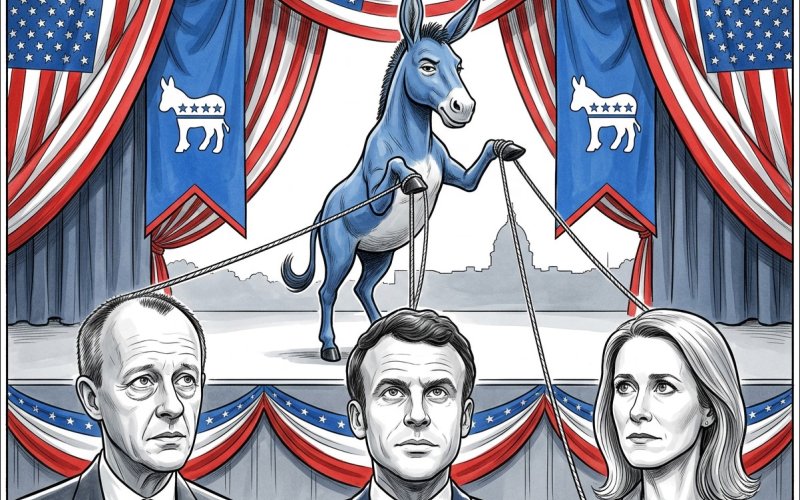
The goal is to "hit the Democrats." The administration names as its targets the European Union, internet regulators, and the structures it assigns to the "censorship complex"; this is a battle over ideology. Because of the overlap with Democratic funders, it can be read as a blow to their European allies. As I have written before, elites closely tied to the US Democratic Party carefully control the EU's political establishment, and here Trump is trying to knock the ground out from under them.
This applies first of all to the "deep state" and the American intelligence services as a single governing force. We are talking about specific agencies, grants, and closed programs.
So far, the result is awkward for the Republicans. On April 12, Orbán lost the election after 16 years in power: Péter Magyar's Tisza took about 53% of the vote and two-thirds of the seats, 138 of 199, while Fidesz took about 38%. Reuters called it a blow to Trump's allies. The US ambassador denied that Vance's visit was interference, but the visit itself did not help.
Europe has become a venue for ideological struggle, and the Trump administration is participating in it openly: pressuring regulators, providing grants, and supporting conservatives. The Democrats use similar tools, previously through USAID and the National Endowment for Democracy and now through workaround instruments, so it is the sign that changes, not the method. The payoff is not yet obvious, and Hungary shows this better than anything.









.png)
.png)

.png)
.png)