Companies have spent hundreds of billions of dollars on the AI race, only to find that the physical world doesn't accept virtual payment. Power plants, transformers and water can't be bought faster than they can be built. The question is whether the race will end before the first socket appears that can feed a trillion-dollar "mind."
Dark GPUs: A New Asset Class
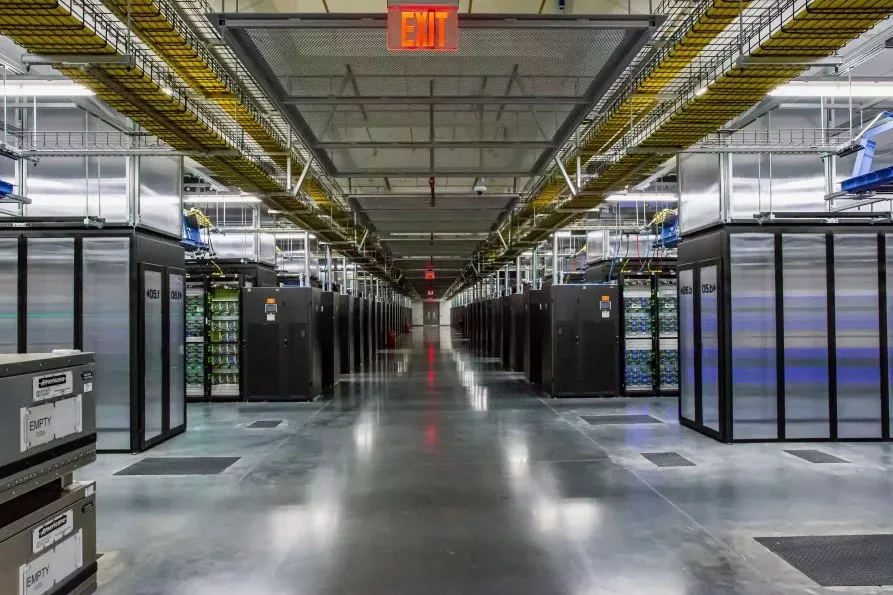
In 2025, the industry picked up a term you won't find in any corporate finance textbook: "dark GPUs." It refers to graphics processors that have been bought but never switched on. They sit in warehouses because there is nothing to power them. The scale is considerable. In August 2025, Amazon Web Services was awaiting Nvidia GB300 racks worth $5 billion, followed by roughly $3 billion more every month, and some of the hardware had to be stored while it waited for energy infrastructure. Morgan Stanley estimated the net power shortfall for US data center builders at 34% through 2028. Liquidity has nothing to do with it; the problem is the calendar. Chips arrive in months, while grid connections in the US now take more than four years on average.
The Energy Wall
Combined capital expenditure at the four largest hyperscalers (Microsoft, Alphabet, Meta and Amazon) exceeded $500 billion across 2025 and 2026. Almost all of it went on silicon, integration and buildings. None of those line items generates a single electron. Demand for data center capacity in 2025 came to 21.1 GW, yet only 8.9 GW was delivered. That leaves a gap of about 12 GW, and it keeps widening: between 2021 and 2025, the cumulative undersupply reached 20.4 GW. Electricity is no longer a utility expense. It has become the slowest asset in the AI stack, and it determines when capex begins turning into revenue.
Chips: A Queue Longer Than the Budget
There is plenty of money for chips; what is missing is the physical capacity to make them. The bottleneck today is not 3-nanometer logic. It is advanced packaging, known as CoWoS, and high-bandwidth memory (HBM). In 2025, Nvidia, Google, AMD and Amazon claimed more than 90% of the world's CoWoS and HBM output by value, but only about 12% of advanced logic die output. TSMC controls roughly 90% of advanced production. The company has warned that its capacity will fall short of demand for several more years, and that its current advanced-node capacity trails customers' plans by about a factor of three. Money can't buy a place at the front of the line. It only confirms that the line will stay long.
Water That Never Reaches the Balance Sheet
Cooling can't be treated as an ordinary cost item. It is a physical limit, and it collides with local communities before it collides with investors. North American data centers consumed nearly a trillion liters of water in 2025, about what New York City uses in a year. Two-thirds of the new US data centers built since 2022 are in water-stressed regions. More than 230 environmental groups have called for a national moratorium on new data centers, blaming the industry for rising electricity bills and heavy water use. At least 16 projects worth $64 billion have been frozen or delayed because of resident protests. This is no longer ESG rhetoric; it is financial risk. Water and permitting are pushing transformers down the list of the biggest constraints.
Cash Flow Under Strain
The physical limits hit not only schedules but also the quality of earnings. Over the past year, Amazon posted negative free cash flow of $42.4 billion, as AI infrastructure capex consumed everything. A market that until recently forgave hyperscalers any level of spending has started to sell. After earnings, Amazon, Microsoft and Alphabet lost a combined $900 billion or so in market capitalization. The question has shifted from "how much are you spending?" to "when will that money start earning a return instead of simply absorbing megawatts?" Analysts increasingly note that the capex cycle depends on borrowed money. This is no longer a story about bottomless cash piles; it is a story about the price of capital.
Orbital Optimism
Against the backdrop of earthly constraints, SpaceX's idea of moving data centers into orbit looks like a financial hack. No water is needed, no grid is needed, the sun shines around the clock, and heat supposedly just radiates away into the vacuum. At the unveiling of the first satellite, AI1, Elon Musk said no nonexistent magic was required and that the technology grew out of proven Starlink designs. The specifications of AI1 are modest, almost terrestrial: 150 kW of peak and 120 kW of sustained compute power, a 70-meter wingspan and a 110 m² radiator. From there, the presentation parts ways with thermodynamics. In space there is no air or water for convection. Every watt of heat from a GPU must be radiated away through a radiator, and the limit is set by the Stefan-Boltzmann law, not by the R&D budget. On Earth, 1 MW of compute capacity requires, in an optimistic scenario, 2,000–3,300 m² of solar panels and 1,900–2,500 m² of radiators. A satellite with a load of just 120 kW has to haul tons of panels and radiators, and its mass can reach 3.5–7.5 tons.
Musk calls the goal "very achievable." But what stands in the way is not engineering ingenuity; it is surface area. Replacing even one gigawatt of ground-based capacity would take square kilometers of panels and radiators in orbit. For the stated target of a million satellites and 120 GW, the system might need to be sustained by as many as 42 Starship launches per day. Orbital data centers are not impossible. As a niche solution for processing data in space itself, they make sense. They will not become a universal replacement for terrestrial infrastructure, and there is no way to get around physics by saving on launch costs.
What Comes Next
An extra trillion dollars won't make physics any cheaper, on Earth or in orbit. The winner will not be whoever has the most GPUs, but whoever can deliver a megawatt to the right place in the right year: through a transformer in Virginia or a football-field-sized radiator in low Earth orbit. Money will flow out of silicon and into infrastructure: gas turbines, long-term power purchase agreements (PPAs), closed-loop cooling and, possibly, small modular reactors, which a decade from now promise what was needed yesterday. For the financial analyst, the conclusion is simple. AI capital now carries a new line item, the "physical lag," and another funding round won't close it. The advantage will go to those who learn to count not only model parameters but also grid-connection timelines, radiator area and launch schedules. And the payoff will be quite tangible: at long last, they will be able to switch on what has already been paid for.