


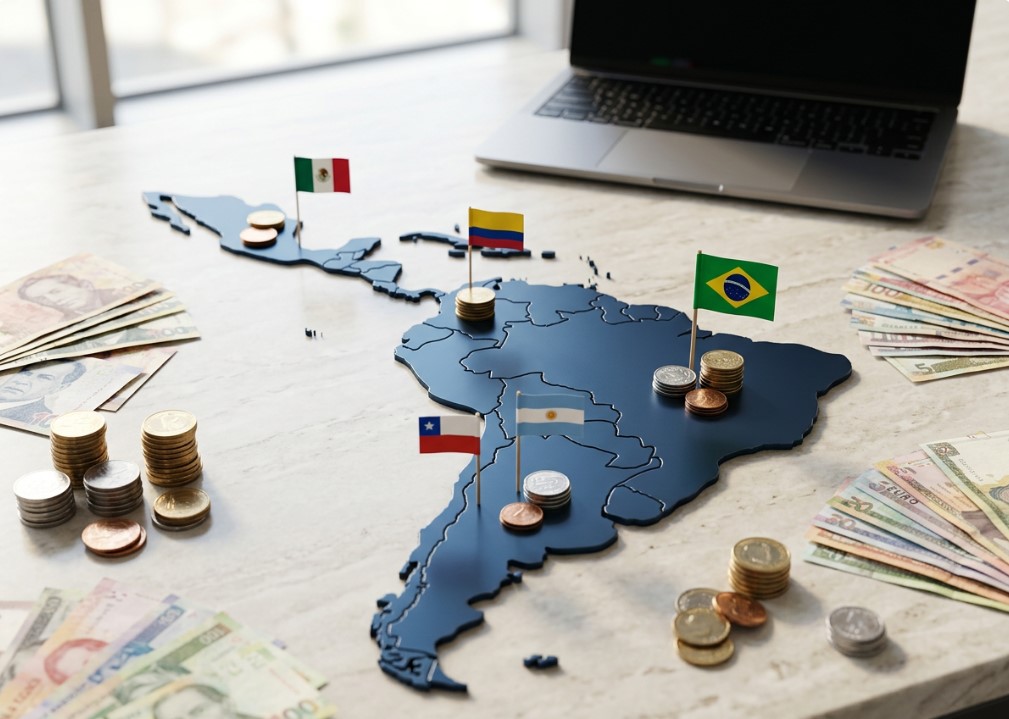
The region is growing slowly, and inflation is diverging across countries: Colombia and Argentina are fighting rising prices, Brazil has broken through the ceiling of its target range, and Mexico is staying within its band. What do the latest data from the IMF and central banks show? Which currencies are under pressure? And where is the region headed?
The Big Picture
On October 13, the IMF lowered its 2026 growth forecast for Latin America and the Caribbean to 2.3%, from 2.4% in July. Growth in 2025 was 2.5%. The 2027 forecast was also cut, to 2.5% from 2.7%. Analysts cite the slowdown in Brazil as one of the reasons. ECLAC estimates regional growth at 2.2% and stresses that the economy is operating in a difficult international context.
Oil sets the general backdrop. In its June report, Chile's central bank says outright that inflation rose quickly because of higher costs following the conflict in the Middle East. In its assessment, the economy has by and large coped with the oil shock. However, the projections were finalized before the US-Iran agreement, and the bank acknowledges high uncertainty. For fuel importers in the region this means pressure on prices. For commodity exporters it means higher revenues, though not for all of them.
Regional averages mask different trajectories. The IMF cut its Argentina forecast particularly sharply: from 3.5% to 2.1% for 2026. Brazil is growing more slowly than expected, with inflation above target. Mexico is holding steadier than the others. Prices are weighing on Colombia, and Chile received a new downward revision in September. Next, we go through the countries one by one.
Brazil
In Brazil, inflation has moved outside the target band. According to IBGE, prices rose 0.82% month on month in September and 4.58% year on year. The upper limit of the target is 4.5%, so the official ceiling has been breached. The monthly figure of 0.82% is also high: if it becomes the norm, annual inflation will keep rising.
Such inflation ties the central bank's hands. Easing policy sharply with inflation above the ceiling is difficult, while expensive credit slows the economy, and this is why the IMF is lowering its forecasts for the country.
The real has been calm in recent weeks. The PTAX fixing on Friday, October 9, was 4.9892 reais per dollar, and there were no notable swings during the week. Market participants were waiting for domestic data and for US inflation. A calm exchange rate alongside high inflation looks ambiguous: it helps contain import prices, but makes Brazilian exports less competitive.
Mexico
Mexico currently looks like the steadiest of the large economies. On September 24, Banxico unanimously kept its rate at 6.50%. According to INEGI, annual inflation in the first half of September was 3.42%, compared with 3.10% in the first half of July. The increase stems from non-core components, while core inflation continued to fall, from 3.95% to 3.79%. Banxico's target is 3% plus or minus one percentage point, so the figure remains within the band.
Tomatoes, onions and school fees rose the most in September. Prices rose 0.33% over the period versus the 0.28% analysts had expected, but this does not push inflation out of the band. The minutes of the meeting are more interesting: three of the five board members allowed for a rate cut if the inflation outlook improves, and one explicitly named a targeted cut at upcoming meetings as possible. At the same time, the board unanimously considers the balance of risks to be tilted to the upside and stresses that policy does not react mechanically to Fed decisions.
Argentina and Colombia
Argentina is the most worrying case in terms of price dynamics. According to INDEC, prices rose 1.9% month on month in September and 33.4% year on year. Cumulative inflation since the start of the year is 23.6%. The main pressure came from utility tariffs and seasonal goods. Perfil writes that the figure casts doubt on the disinflation process the government is counting on.
Growth is also weaker than expected: the IMF cut its 2026 estimate from 3.5% to 2.1%. BBVA Research, in its October review, describes a fork in the road. Cutting rates too quickly could put pressure on the exchange rate, which remains the anchor of the anti-inflation strategy. Keeping rates too high would aggravate problems with loan defaults. The Rio Times review puts the risk simply: if monthly inflation gets stuck above 2%, the stabilization plan will stop looking convincing, and the peso may come under pressure. September's 1.9% sits right at that threshold.
Colombia, in my view, is the hardest case for a central bank. Annual inflation in September was 6.29% versus 6.24% in August, against the market's expectation of 6.32%. Prices rose 0.37% over the month. At the end of 2025 the figure was 5.1%, while the Banco de la República's target is 3%. The rate has reached 12.25% after a 25-basis-point hike. Former finance minister Miguel Villar warns that the country could go seven years in a row without meeting the target. This is his assessment, not the bank's position.
Colombia's exchange rate, meanwhile, is fluctuating moderately. The official representative market rate on October 14 was 3,181.74 pesos per dollar, and on October 7, the day inflation was published, the peso fell as low as 3,239.
Chile and Peru
Chile weakened noticeably over the summer. In June, the central bank lowered its 2026 growth forecast to 1.0-1.75% from 1.5-2.5% in March, mainly because of an unexpectedly weak first quarter and a contraction in mining. In September, the bank revised its estimate once more: it now expects 0.25-0.75%. Three reasons are given: weaker domestic demand, unfavorable weather in several sectors, and lower output in mining.
Chile is handling prices better. The bank expects inflation to return to 3% in the second quarter of 2027. The rate has stood at 4.5% since June, and Santander Chile considers stability in the near term the most likely path. Earlier, the bank raised its year-end inflation projection from 4.0% to 4.2% because of a higher oil price assumption, and for 2027 it returned its growth forecast to the 2.0-3.0% range. The result is a picture of "prices under control, growth not."
Trends and Risks
Three lines run through the region. The first is inflation: Colombia and Argentina show acceleration, Brazil has broken through the ceiling, and Mexico remains within the band, while central banks are in no hurry to ease policy. The second is divergence between countries: each has its own problem, from tariffs in Argentina to weak mining in Chile. The third is the external backdrop: oil, the Middle East and the trajectory of Fed rates affect everyone.
For investors and travelers, the takeaway is practical. Exchange rates and interest rates change quickly here, especially in countries with high inflation. They should be checked not once a year but before every major transaction or trip, and the data should be verified against the official websites of central banks.















.png)
.png)

.png)
.png)