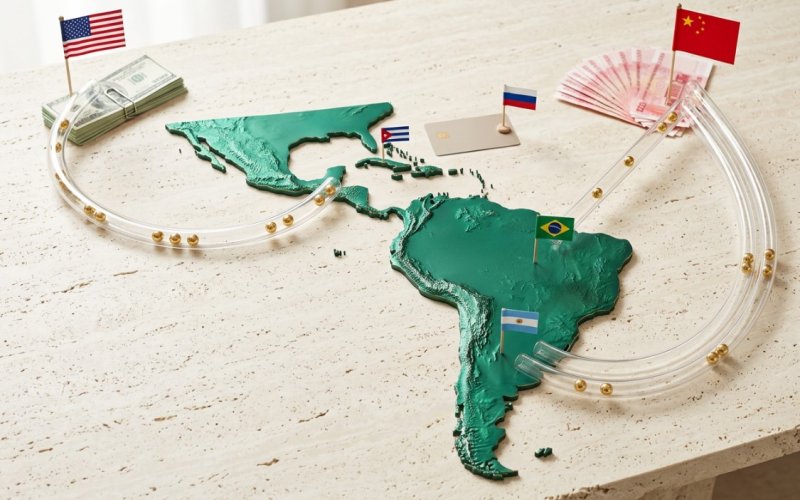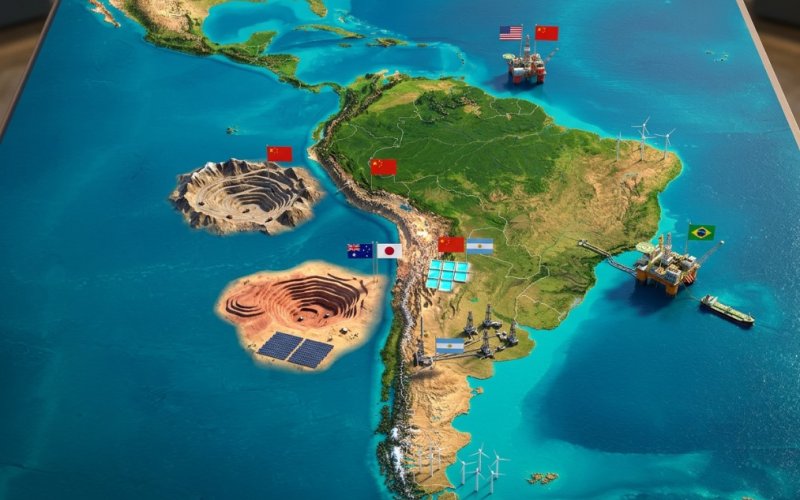


Latin America's freight map is being redrawn. China has gained its own gateway in Peru, Brazil is shifting grain to the north, and the Panama Canal is setting records while cutting slots. Which corridors are already running? Which are still being built? And what should shippers know?
Why the Map Is Changing
Three forces have shifted trade routes at the same time. The first is Asia. The nearest markets for the region's soy, copper and fruit lie across the Pacific, yet most of its ports still face the Atlantic. The second is the bottleneck problem. By its administration's estimate, the Panama Canal handles about 5% of global maritime trade, so any disruption there ripples through freight rates. The third is Hormuz. The closure of the strait has pushed some flows toward the Americas, and in the last fiscal year the canal reportedly handled a record 521 million tonnes of cargo on almost 14,000 vessels.
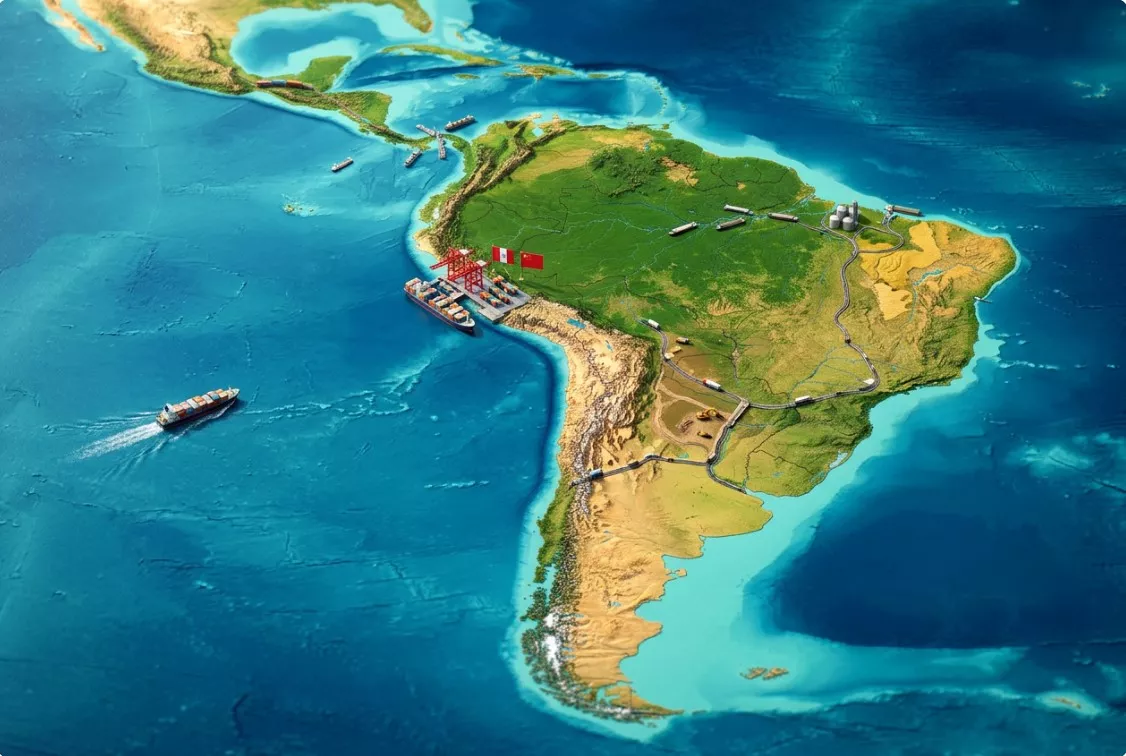
That is the logic behind the new projects. Peru is building a port for direct sailings to China. Four Southern Cone countries are laying a road from Brazil to the Chilean coast. Mexico is developing a rail link between two oceans. And Brazilian farmers are exporting ever more grain through northern ports.
The Corridor Map
The main routes, laid out as chains of nodes:
- Chancay–Shanghai: Andean and Peruvian plantations → Chancay port (Peru) → direct sailings to Shanghai, 22-25 days instead of 35-40.
- Capricorn (Bioceanic Corridor): Port of Santos and Mato Grosso do Sul → Porto Murtinho (Brazil) → 1,294 m bridge → Carmelo Peralta (Paraguay) → the Chaco via Route 15 → Pozo Hondo → Salta and Jujuy (Argentina) → Jama and Sico passes → Antofagasta, Mejillones and Iquique (Chile) → Pacific Ocean.
- Arco Norte: Mato Grosso and Matopiba → northern ports of Itaqui, Barcarena, Santarém and Itacoatiara → Atlantic and on to Europe, the Middle East and Asia via Suez or Panama.
- Mexico's Interoceanic Corridor (CIIT): Coatzacoalcos (Gulf of Mexico) → Line Z railway, 308.5 km → Salina Cruz (Pacific Ocean).
- Panama Canal: Atlantic ↔ Pacific, 36-41 slots a day depending on water levels and operating mode.
Chancay: China Opens Its Window
Chancay, north of Lima, has become the clearest example of the pivot toward the Pacific. In its first year it handled 286,255 TEU. From opening through July 2026, according to Chinese sources, it handled 584,900 TEU and about $4.29 billion in trade. In January-July container throughput rose 60.6% year on year to 247,800 TEU. For January-August, COSCO reported 295,000 TEU, up 51.6%. About 45.5% of volume is transshipment, so the port also works as a hub for the continent's west coast.
Speed is the main advantage. The direct Chancay–Shanghai service cut transit time from 35-40 days to 22-25, and the claimed logistics savings exceed 20%. From January to August, 170 voyages ran on the route, carrying 141,000 tonnes of cargo worth 4.04 billion yuan, up 13.7% and 33.3% respectively year on year. In the first half of 2026, Chancay's share of Peru's seaborne agricultural exports to Asia was about 17%. Blueberry shipments to Shanghai through the port arrived roughly ten days faster than on previous routes. COSCO expects 19,000 Chinese vehicles to pass through the terminal in 2026.
Land and Water: Capricorn, Arco Norte, Tehuantepec and Panama
Capricorn is regarded as the continent's most ambitious overland project. According to the US Department of Agriculture, the corridor runs 2,300-2,400 km from Santos to the Chilean ports of Antofagasta, Mejillones and Iquique. MercoPress reports more than 3,200 km, because the two count from different starting points. In July 2026, builders physically joined the Paraguayan and Brazilian sections of the bridge over the Paraguay River. But a bridge is not a corridor: access roads, border facilities and customs systems still have to be completed. The authorities of the four countries expect to open the route in the second half of the year, and USDA puts the estimated completion at the end of 2026.
Expectations are high. Government estimates say cargo from Brazil's and Paraguay's interiors will reach Asia 10-15 days faster than via Atlantic ports, by some calculations 17 days, with the sea leg shortened by about 9,700 km. At launch, Brazilian customs expects around 250 trucks a day. Studies cite potential of more than 8.6 million tonnes a year and an economic impact above $3 billion.
Arco Norte is already running at full capacity. According to an industry review, northern ports handled 39.5% of Brazil's soy and corn exports in 2025, up from 29.7% in 2021. Volume rose from 36.56 to 58.06 million tonnes, and Itaqui grew its throughput by 74%, from 11.55 to 20.14 million tonnes. In the first quarter of 2026, the north took 39% of soy and 34.9% of corn. By Conab's figures, the share of corn reaches 48%. The next step is the 933 km Ferrogrão railway between Sinop and Miritituba. Brazil Stock Guide, however, calls this route a "risky shortcut" for agribusiness.
Mexico's Tehuantepec corridor links the oceans by way of the Line Z railway. Operations began in December 2023, and more than 316,000 tonnes have been moved. Industry blogs describe the transfer from one ocean to the other as taking about 72 hours and saving five days compared with Panama. The scale, though, is not comparable: a train carries several hundred containers, while a single vessel transiting the Panama Canal carries 12,000-15,000. Planners expect 300,000 containers a year by 2028 and about 1.4 million by 2033, while the canal handles more than 8 million containers. Tehuantepec's advantage is its independence from water levels.
Panama, meanwhile, is both at record levels and constrained. The canal administration reported that 6,288 vessels transited in the first half of fiscal 2026, 224 more than a year earlier. In peak months the canal handled 40-41 vessels a day against a norm of 36. But in early October, a shortage of rainfall forced the number of slots down to 32, and from October 15 it was restored to 33. The Neopanamax draft limit was raised to 14.94 m (49 ft) on September 28. Vessels without a booking have no guaranteed transit date and may wait indefinitely. The rerouting of flows after Hormuz has pushed up freight rates for American LNG.
A Logistician's Commentary
Taken together, the data point to a practical picture.
First, paper timelines and real-world timelines diverge. The Capricorn bridge is built, but customs, access roads and border procedures are still work in progress. Shippers should not plan bulk movements for the end of 2026 before a real pilot run has taken place. Good practice is to send a trial consignment, record border time and cost, and only then shift volumes.
Second, Panama remains the main node but depends on rainfall. Book slots in advance. The long-term slot allocation system (LoTSA) and separate bookings for LNG tankers make it possible to secure a window. Waiting at the entrance is, in current conditions, the most expensive option. For small consignments, the Tehuantepec route is already an alternative, though without the guaranteed capacity of an ocean vessel.
Third, diversifying ports pays off more than betting on one. Brazilian grain exporters already see Arco Norte as a real way to relieve Santos and Paranaguá, especially at peak season. Peruvian growers split shipments between Chancay and Callao. For cargo bound for Asia, Chancay saves ten days or more, but transshipment makes up 45.5% of its throughput, so hub congestion will grow, and in high season windows will need to be booked well ahead.
Fourth, insurance and customs terms change quickly. The new corridors cross several jurisdictions, so every crossing point is a separate risk of delay, documentation problems and fees. Before launch, agree on a single set of documents in advance and check how electronic seals and transit declarations work.