

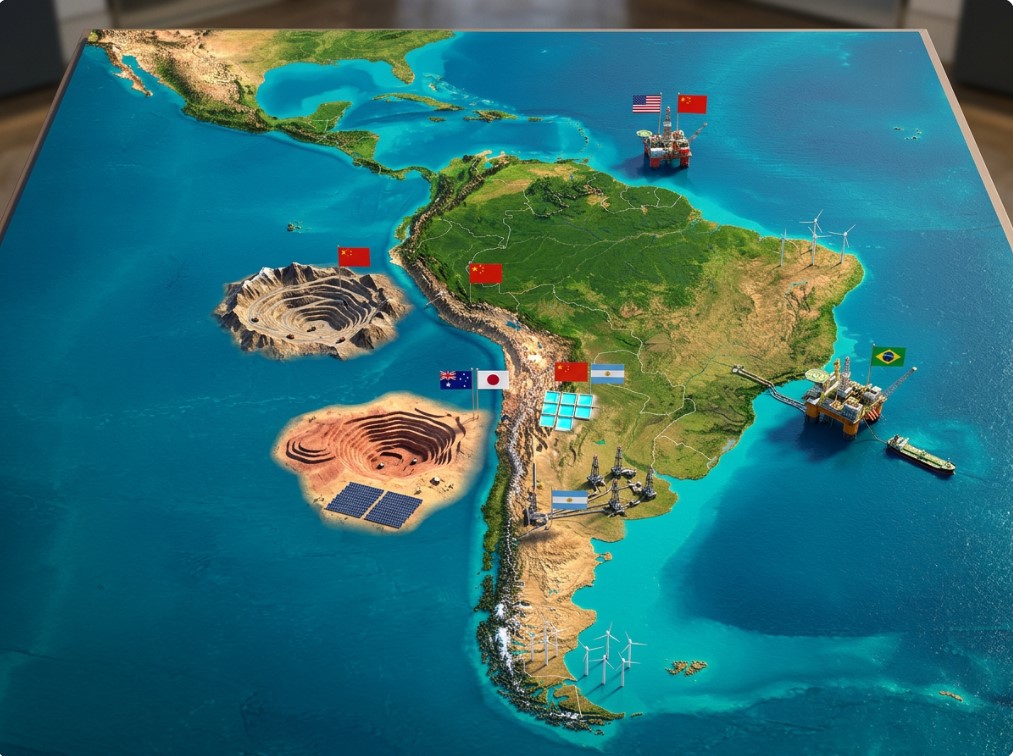
In 2026, Latin America became more than a raw-materials region. It is now a place where oil, sun, wind and critical minerals converge. Who is building, who is selling, and who is buying? Let's break it down by country and by player.
The Big Picture
The region has come through four years of weak growth, yet energy continues to attract capital. According to ECLAC, between 2005 and 2024, 1,152 minerals and metals projects worth 230.07 billion dollars were announced in Latin America and the Caribbean. Critical minerals accounted for 23.5% of projects but 41.6% of their value. That is the essence of the shift: raw materials have stopped being mere commodities and have become strategic assets.
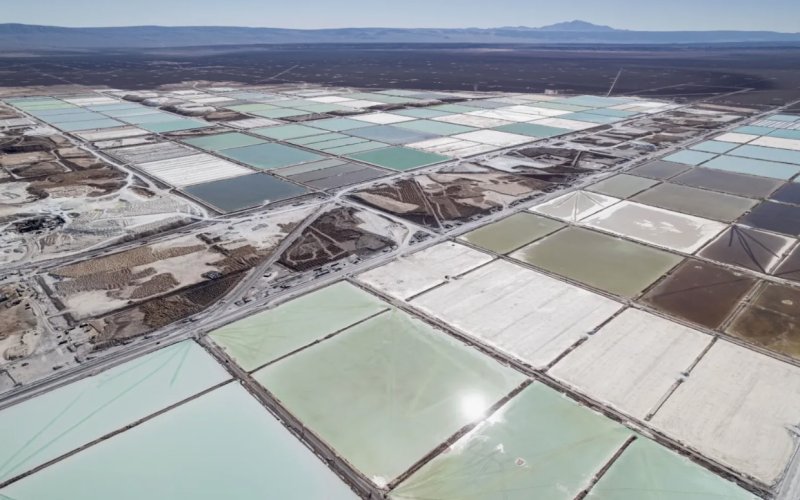
There are several drivers. The first is rising demand for lithium, copper and rare earths from electric vehicles, batteries and artificial intelligence. The second is the fragmentation of global supply chains caused by the US-China trade conflict. The third is the effort by the US, the EU, Japan, South Korea and India to diversify supply away from China, which controls 60-80% of global processing of lithium, cobalt, graphite and rare earths, and up to 92% in the case of rare earths. The region holds about 40% of the world's copper reserves and 60% of its lithium brine resources, according to Moody's.
Oil and Gas: The Old Money
Oil remains the region's main source of revenue. Rystad forecasts that Latin American output will exceed 8.8 million barrels per day in 2026, with Brazil remaining the leader. Argentina, Guyana and Brazil will deliver most of the growth, while a possible return of Venezuelan barrels adds uncertainty but will not change the pecking order.
Brazil holds the lead thanks to its pre-salt fields. Petrobras plans to invest 109 billion dollars in 2026-2030, of which more than 78 billion will go to exploration and production, primarily deepwater pre-salt fields. The company expects oil output of 2.7 million barrels per day by 2028 and combined oil and gas output of 3.4 million barrels of oil equivalent per day by 2028-2029. In May, Petrobras brought on stream the P-79 platform at the Búzios field, with a capacity of 180,000 barrels per day, and in the second quarter production rose 14% to a record 3.34 million barrels of oil equivalent per day. Lifting costs at mature pre-salt areas run 2.5-4 dollars per barrel, and the breakeven for new projects is around 30-35 dollars. This makes Brazil one of the most competitive deepwater regions in the world.
Guyana has become the biggest surprise of the decade. In September 2026, ExxonMobil reported that production on the Stabroek block had surpassed one billion barrels in seven years. Installed capacity of the four FPSOs has reached 900,000 barrels per day, and the resource base is estimated at nearly 11 billion barrels of oil equivalent. In October, Exxon took a final investment decision on the Hammerhead field, adding 6.8 billion dollars and planning a seventh project with a capacity of 150,000 barrels per day by 2029. By 2030, the combined capacity of eight projects is expected to reach 1.7 million barrels per day. For a small country, this is a transformation into a major exporter.
Argentina is betting on shale. Shale investment in the region will rise from 9.4 billion dollars in 2025 to almost 11 billion in 2026, and nearly all of it will go to Vaca Muerta. YPF is developing a floating LNG terminal, and ADNOC XRG is in talks over a stake in the project, which also involves Shell and Eni. The project envisions several vessels with a combined capacity of 28 million tonnes. Investment decisions have not yet been made, but the interest of Middle Eastern and European players shows that Argentine gas is seen as an export asset, not just a domestic one.
Renewable Energy
At the other pole, solar and wind are growing. According to an EMIS report, Brazil, Chile and Mexico will remain the leaders in renewable energy investment. In Brazil, the Novo PAC program has channeled 87.1 billion reais of private investment into 458 energy projects, including 252 solar projects worth 52.8 billion reais and 160 wind projects worth 29 billion. Overall, 666.3 billion reais has been earmarked for the "energy transition and security" axis, of which 446.5 billion is due to be executed by 2026.
Mexico is adding capacity through the state utility CFE: by 2027-2028 it plans 2.47 GW of onshore wind across seven projects worth 3.25 billion dollars, and 4.67 GW of solar photovoltaic capacity. Chile and Peru have exceptional solar resources, while Brazil, Chile, Argentina and Colombia have strong wind corridors. Brazil also positions itself as a future leader in offshore wind: projects totaling 247 GW are under assessment.
The next stage, according to DWF Group, will be defined not by generation but by grids, storage, hybrid projects and green industrialization. The problem is that solar and wind output does not match demand peaks, and without storage and transmission lines, new generation runs into grid constraints.
Hydrogen and Green Feedstock
Hydrogen remains a promise rather than a business. The H2 Global report of August 2026 names Argentina, Bolivia, Brazil, Chile and Colombia as the leaders in national commitments and project pipelines. But none of these countries yet has an operating LNG export terminal, although Argentina, Brazil, Chile, Colombia and Costa Rica have coastal ammonia storage, and Chile, Brazil and Colombia have methanol terminals. This means that exports of hydrogen derivatives are constrained by infrastructure, not just by sun and wind.
Chile and Brazil are competing for the role of hydrogen hub. Chile is betting on cheap solar power in the Atacama and proximity to Pacific markets; Brazil on hydropower and port infrastructure. For now, it is a race of ambitions, not of revenues.
Critical Minerals and Geopolitics
This is where the real competition begins. China remains the dominant foreign investor in Latin America's mining sector, ahead of the US, according to S&P Global. In 2025, Argentina produced 8.4% of the world's lithium, or 138.1 thousand tonnes; Chile 23.1% of the world's copper, or 5.4 million tonnes; Peru 11.6%, or 2.7 million tonnes; and Mexico 2.9%, or 703 thousand tonnes. China will buy 57.6% of the world's refined copper in 2026, according to a Cochilco forecast.
The US is trying to catch up. On March 12, 2026, Chile and the US signed a joint declaration on consultations on critical minerals and rare earths. But the processing gap remains enormous: China refines up to 92% of rare earths, while Latin America, with its 40% of copper reserves and 60% of lithium, barely participates in that stage of the chain. According to FIU, Beijing's control over processing limits the region's geopolitical leverage and cements its role as a raw-materials supplier.
For Russia, this means limited opportunities. Russian companies are not among the main players in either the oil or the minerals sector of the region, and sanctions pressure and logistical barriers narrow the room for maneuver. But there are niches: equipment supply, technical services, and participation in joint ventures through third countries.
Conclusions
In 2026, Latin America lives in two eras at once. In one, Brazil and Guyana pump oil at full tilt, Argentina builds a shale export industry, and Venezuela tries to make a comeback. In the other, Chile, Brazil and Mexico bet on sun and wind, while China and the US divide up lithium and copper. The winner will not be whoever has the most resources, but whoever builds processing, grids and export infrastructure. For now, China holds that title, and it is the main challenge for Washington.












.png)
.png)

.png)
.png)