


Japan has not ranked among the world's three largest economies by GDP for some time, yet its interest rate can still topple markets on other continents. This is not a paradox. It is the arithmetic of the global carry trade, compounded by two decades of nearly free money. Japan, long seen as the quiet pensioner of the world economy, has suddenly become the coach who rewrites the rules for everyone else, and the size of its GDP has little to do with it.
The Creditor Nobody Noticed
The key argument is not Japan's share of global output but its role in the global balance of capital. According to Japan's Ministry of Finance, the country's net external assets hit a record 561.8 trillion yen at the end of 2025, or roughly $3.5 trillion. Japan has slipped to third place among creditor nations, behind Germany and China, but its accumulated stockpile remains enormous. It is not just "one of many" countries. It is a patient, long-term and, above all, predictable buyer of the world's bonds, and for years it kept yields from soaring. When a creditor like that begins to change the math at home, everyone who has grown used to living off its money feels it.
The Arithmetic of Cheap Yen
The logic at the core is simple, almost insulting to financial theory. If you can borrow yen at zero percent and put the money into an asset yielding four or five percent, you borrow as much as your margin allows and repeat the trade for as long as the music plays. That is how Japan spent decades as a "factory of cheap funding." Estimates of cross-border yen borrowing vary widely, from several hundred billion dollars to $1–2 trillion, and some estimates put the accumulated carry trade as high as 360 trillion yen. It was not Japanese exports or Japanese equities as such, but this quiet river of cheap money that fed global capital markets, including US technology stocks and emerging markets.
How It Breaks in Practice
The central question is what happens when the river runs low. In December 2025, the Bank of Japan raised its policy rate to 0.75%. By the Federal Reserve's standards that is laughably low, yet it is the highest level since 1995, and by mid-2026 markets were already pricing in 1%.
There is no shortage of precedents:
- In August 2024, a relatively modest hike to 0.25% coincided with disappointing US labor market data. The yen gained almost 3% against the dollar in a single day, the Nikkei 225 plunged more than 12%, its worst drop since Black Monday in 1987, and the VIX spiked to 65.
- In January 2025, a hike to 0.5% landed on top of the DeepSeek shock in the tech sector. The S&P 500 lost nearly 21% over 73 days, tipping into a full technical bear market.
This is not a sign of Japan's fragility. It is a sign of the fragility of a system that lived on Japanese fuel for too long.
Dominoes in the Bond Market
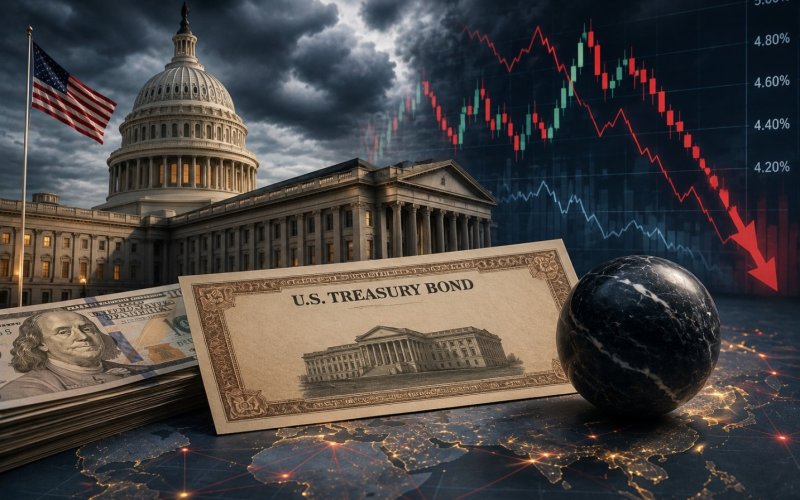
Ironically, Japan's normalization hits not only speculators but also thoroughly conservative borrowers. In 2025, the yield on 10-year Japanese government bonds (JGBs) topped 2% for the first time since 2006, and by the end of 2026 it was edging toward 2.8–2.9%. Not long ago, Japanese paper was a byword for zero yield.
Japanese insurers and pension funds, which for decades were "price-insensitive" buyers of US debt, now earn a positive real return at home and are starting to bring money back. This is not a passing tactical twitch but a structural shift. As the spread between JGBs and US Treasuries narrows, the US Treasury has to offer a higher term premium. That in turn feeds through to the cost of mortgages, corporate loans and budget deficits.
Home Sweet Home
Political pressure for repatriation is a story in itself. Finance Minister Satsuki Katayama has publicly urged the Government Pension Investment Fund (GPIF), the world's largest pension fund, with a portfolio of about 293.6 trillion yen (roughly $1.8 trillion), to increase its holdings of domestic assets. The market reacted instantly: the yen strengthened and JGB yields fell, a move traders dubbed "stealth intervention."
Notably, even a potential shift in allocation of up to 8 percentage points could require repatriating or hedging assets worth 23 trillion yen, about $146 billion. This is not "the end of Japanese capital abroad," but it is a clear signal. The era of unconditional yield-chasing overseas is ending, and the largest pools of institutional money are starting to look back toward Tokyo.
What Comes Next
What happens next will depend less on the absolute level of the BOJ's rate than on the pace and the narrative. If markets come to believe that normalization will be fast, the unwinding of the carry trade will accelerate. If Japan moves gradually, the pressure will be spread out over time.
The Fed is a separate trigger. In earlier episodes it either cut rates or paused, cushioning the markets. In 2026, however, markets were pricing in the possibility of a hike rather than easing, and that cushion is disappearing.
The big question is whether the world will keep its habit of borrowing in yen once that habit stops being nearly free. Markets have no answer yet, only a position. A rate of 0.75% or 1% looks like small change, but it is exactly such small things that break big structures.