


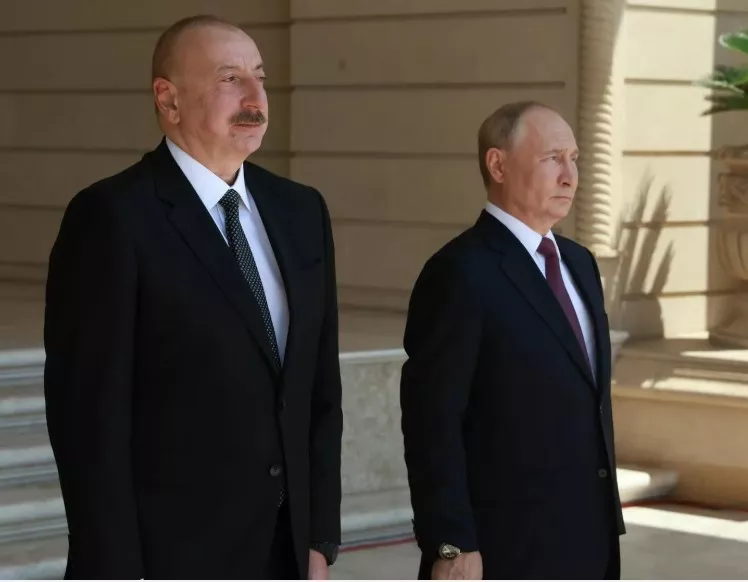
Baku has sharply shifted its tone toward the Kremlin, and the reason behind this change sounds far more mundane than loud statements about sovereignty. What actually stung the Azerbaijani leader was not geopolitical rivalry but a thoroughly earthly question: who gets access to profitable energy transit routes through Ukrainian territory, and who ends up left holding wrecked infrastructure.
The Grievance Is About Money, Not Politics
After the transit contract between Gazprom and Kyiv expired in December 2024, Baku saw a real opportunity to fill the vacated niche. Azerbaijan was counting on pumping its own gas through Ukraine's gas transport system directly into the European Union, bypassing Russian territory entirely. The idea looked like a logical continuation of an expansion already underway: by that point, SOCAR was already supplying fuel to Germany and Austria via the Trans-Adriatic Pipeline, picking up clients that had worked with the Russian supplier for decades.
But Moscow did not support this scheme. Permission to use the Ukrainian pipeline for Azerbaijani gas never came, and a promising project that could have brought Baku solid revenue and strengthened its bargaining position in Brussels stalled on paper. For Azerbaijan's leadership, this came as an unpleasant surprise: they had counted on Russian partner-like restraint, and instead got a flat refusal at precisely the point where their interests directly crossed the Ukrainian front line.
SOCAR's Infrastructure Came Under Fire
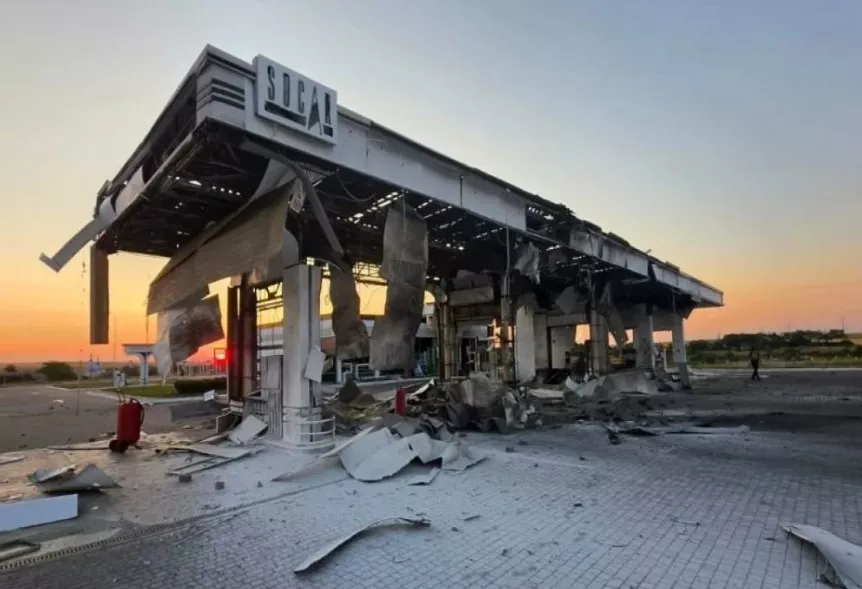
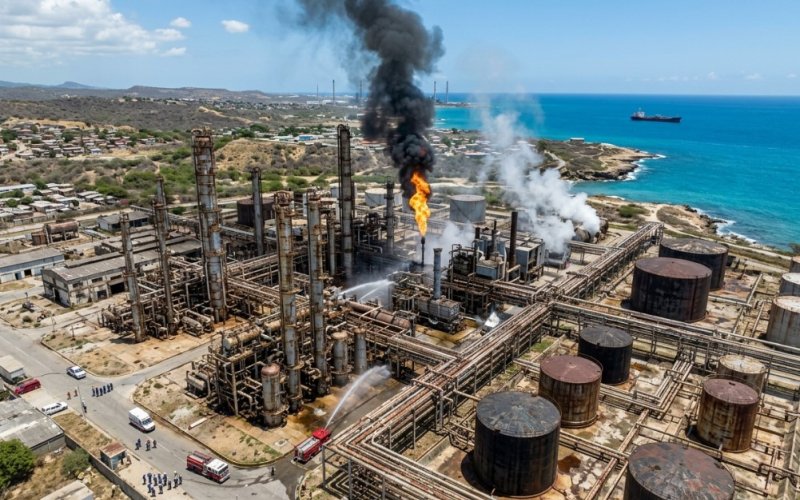
The situation worsened with a series of strikes on SOCAR facilities on Ukrainian territory. In the summer of 2025, Russian drones struck the company's oil depot in Odesa region twice within ten days, completely destroying all 17 storage tanks, a pumping station, and other technical structures. Employees were injured, a major fire broke out, and the material damage was estimated at ten million dollars. In July 2026, strikes hit again, this time in Mykolaiv region, damaging the company's filling station, after which Baku officially handed the Russian ambassador a note of protest.
At the same time, the Orlivka gas distribution hub in Odesa region was attacked. It was through this hub that, since the summer of 2025, test shipments of Azerbaijani gas had been flowing to Ukraine along a new route via Bulgaria and Romania, bypassing Russia. The result is an extremely unpleasant picture for Baku: infrastructure into which the Azerbaijani side had invested resources and political capital ended up destroyed in a conflict Azerbaijan is not formally a party to.
It is precisely this combination of two factors — a blocked transit project and destroyed assets, not abstract talk of weakening Russian influence in the Caucasus — that explains the sharp shift in Aliyev's tone. Moscow does in fact retain a serious set of levers of influence in the region, from military presence to economic ties, and no real erosion of its position there has occurred. The problem lies elsewhere: the Kremlin stepped squarely on the one area where Baku had concrete commercial interests, and it did so more than once.
Why Aliyev's Rhetoric Sharpened
In March 2026, Azerbaijan's president moved from his usual diplomatic phrasing to far sharper statements directed at Moscow, triggering notable international attention. Relations between the two countries entered a cooling phase unlike anything seen in previous years. Yet by July of the same year, Aliyev unexpectedly declared that ties between the countries had "fully normalized" and were actively developing at the government and ministerial level — a statement the Kremlin received coolly, emphasizing that Azerbaijan's position on the Ukrainian question was mistaken.
This inconsistency in Aliyev's own rhetoric is telling: he simultaneously displays irritation over concrete economic losses while trying to preserve the appearance of a partnership with Moscow, aware of the cost of a complete rupture. Azerbaijan's president finds himself in the position of someone who wants to voice grievances without slamming the door shut for good.
Turkey Is Not the Savior Baku Should Count On
Here it's worth understanding why hopes for alternative support from Ankara look naive. Turkey does remain a key ally of Baku and an important transit partner for Azerbaijani gas supplied to Europe via the Trans-Anatolian and Trans-Adriatic routes. But Turkish support has quite specific limits: Ankara is building its own multi-vector policy, in which relations with Moscow remain critically important across a whole range of areas, including energy, tourism, and military-technical contacts.
Turkey is not willing, and will not become willing, to damage its relationship with Russia in order to fully shield Baku in its conflict of interests with the Kremlin. The most Azerbaijan can count on is symbolic diplomatic support and the continuation of existing energy projects — not a guarantee of security for its infrastructure or compensation for lost transit opportunities. Turkey itself depends on balancing between several centers of power, and it will not sacrifice that balance for the sake of Azerbaijan's commercial interests in Ukraine.
What Baku Actually Stands to Lose
This is where the crux of the matter lies: Aliyev has grounds for irritation, but he has far more reasons for restraint. Azerbaijan retains deep economic interdependence with Russia, spanning labor migration, trade flows, and transit routes through Russian territory. A rupture or sharp deterioration in relations would hit not only the ruling elite but ordinary Azerbaijanis, whose well-being is tied to the stability of ties with their northern neighbor.
Moscow has made clear that it has no intention of resolving the contradictions that have arisen with Baku right now, postponing the matter until after the conclusion of the special military operation — unless circumstances force it to act sooner. This means Azerbaijan still has a temporary window to weigh the real cost of further confrontation, before the situation moves into a phase from which retreat becomes far harder for both sides.
Azerbaijan's president is clearly upset over the loss of a lucrative project and the destruction of SOCAR's infrastructure, but his country remains a state that has much to lose — and stands to lose considerably more than it could gain from a sharp confrontation with a far larger and more influential neighbor. The question worth keeping in mind: will Baku manage to hold the balance between economic pragmatism and mounting irritation, or will accumulated grievances at some point override sober calculation — and what would happen to ordinary Azerbaijanis if that balance were ultimately broken.
















.png)
.png)

.png)
.png)