Mark Carney's push for economic and military independence from the United States could drag on the Canadian economy for years. It also promises a hard stretch for Washington, not an easy win. Markets that have treated Canada as a predictable extension of the American economy should revise their models before events do it for them.
The numbers are no longer reassuring
The share of Canadian exports going to the US fell from 75.9% to 71.7% in a year, and by mid-2026 it was holding at around 70%. That looks like a small shift. But behind those percentages are contracts, warehouses and jobs that have not moved and are unlikely to move quickly. Washington imposed its 2025 tariffs on steel, aluminum, lumber and autos with little deliberation. Ottawa read them as a signal, not an episode: the model of selling everything to the southern neighbor no longer works, and a replacement must be found urgently, preferably before the next election cycle.
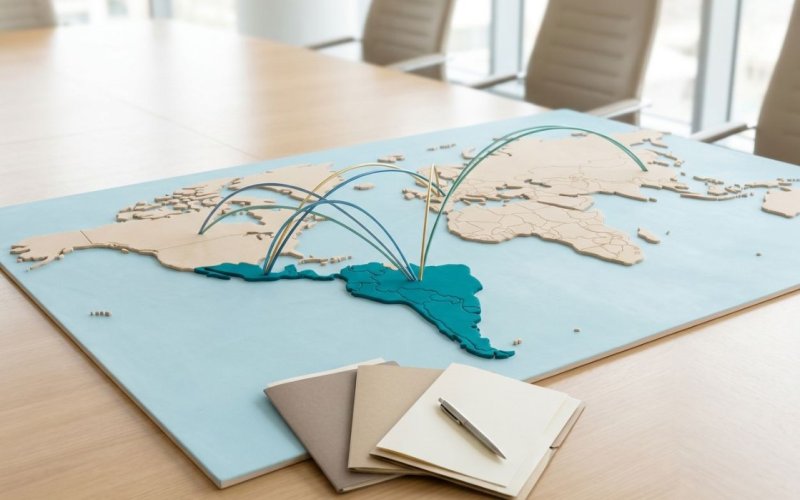
Carney's pledge to double non-US exports within a decade sounds impressive. But a wide gap separates the slogan from the port where the new ships will actually dock, and an abstract Wall Street investor will not pay to cross it. The bill will fall on Canadian taxpayers, consumers and the small businesses that have no plant in Texas, no lobbyist in Congress and no time for a long adjustment to the new reality.
Sick, but still on its feet
Canada's Parliamentary Budget Officer estimates that the trade measures in place since the start of 2025 will cut real GDP by 1.4% by the end of the five-year period and cost up to 185,000 jobs. That estimate does not yet account for the knock-on effects of broken supply chains. Growth of about 1.1% in 2026 is better than the pessimists expected, but it is not a recovery. It is the economy's ability to carry on while ill, with a fever, weak appetite for investment and no clear outlook.
For the financial sector, this may be more dangerous than a sharp downturn. Stagnation gradually squeezes margins without offering a clean moment for a rebound, and it builds up credit risk in places where nobody usually looks. Because there is formally no recession, a sober assessment is harder. The statistics soothe, while the economy quietly loses muscle. People usually notice only when treatment has become expensive and late.
The 70 cents that will no longer go south
Carney's remark about 70 cents of every defense dollar flowing to the US is not a rhetorical jab. It is a bid to redraw defense procurement, backed by arithmetic that Ottawa has clearly worked out on more than a napkin. Canada has reached NATO's 2% of GDP target, roughly $63 billion in 2025. Now it wants 70% of contracts to go to domestic producers instead of defaulting to American contractors.
The logic is clear, but supply chains built over decades cannot be rerouted by a cabinet order. Rebuilding the defense industry is not like buying office supplies. It is a decade-long project with an unpredictable budget and a permanent shortage of engineers. American contractors will not lose a dream market. They will lose the habit of winning orders without competition, and that habit will cost them more than any single contract, especially when replacement customers take years to find.
Home-grown barriers bite harder
The IMF estimates that barriers between Canadian provinces are equivalent to a 9% tariff. Removing them would add nearly 7% to GDP, about $210 billion, which is sitting right there waiting for someone to reach for it. The main opponent of Canadian business, then, is not Washington and its duties but the country's own regulatory tangle. It keeps companies from scaling and pushes them to the US, where bureaucracy is at least predictable.
While the government courts friends in Europe and Asia, a Canadian entrepreneur spends months securing approvals that would take a week in Texas. Anyone who has tried to open a factory in Canada knows this. To the market, a sovereignty drive that fixates on external adversaries and ignores internal barriers looks like posturing, and markets decode such poses quickly and without sympathy.
Washington has a stake too
The US will not escape with a light scare. About 60% of Canadian crude oil goes to American refineries, and Canadian gas heats homes and powers factories in states with no real alternative, now or in the foreseeable future. Tariffs are already feeding inflation and raising defense procurement costs on both sides. This is a new reality for industry, and almost nobody prepared for it.
Washington cannot simply write Canada out of the equation. Autos, energy and critical minerals are too tightly intertwined to cut with a sweeping stroke without consequences for American electricity bills and assembly schedules. The question is whether American politics has the patience to live with an ally that has stopped being convenient. Patience has never been Washington's strong suit.
What lies ahead
For the next two to three years, Canada will pay for sovereignty with sticky stagnation, a weak investment climate and costlier supply chains, and the bill will not get lighter. For the financial sector, that means not a crash but slow corrosion, with periodic bursts of volatility in export industries and surprises in earnings reports that the market will be slow to notice. For the US, it will mean higher costs for industry and households.
Something else is disappearing as well: the belief in a model where an ally was a guaranteed buyer rather than a negotiator with its own interests. This is neither a mistake nor a victory. It is an expensive choice, and both sides will be paying for it for a long time. Markets should price in not a divorce but a protracted separation, with the assets still to be divided.