

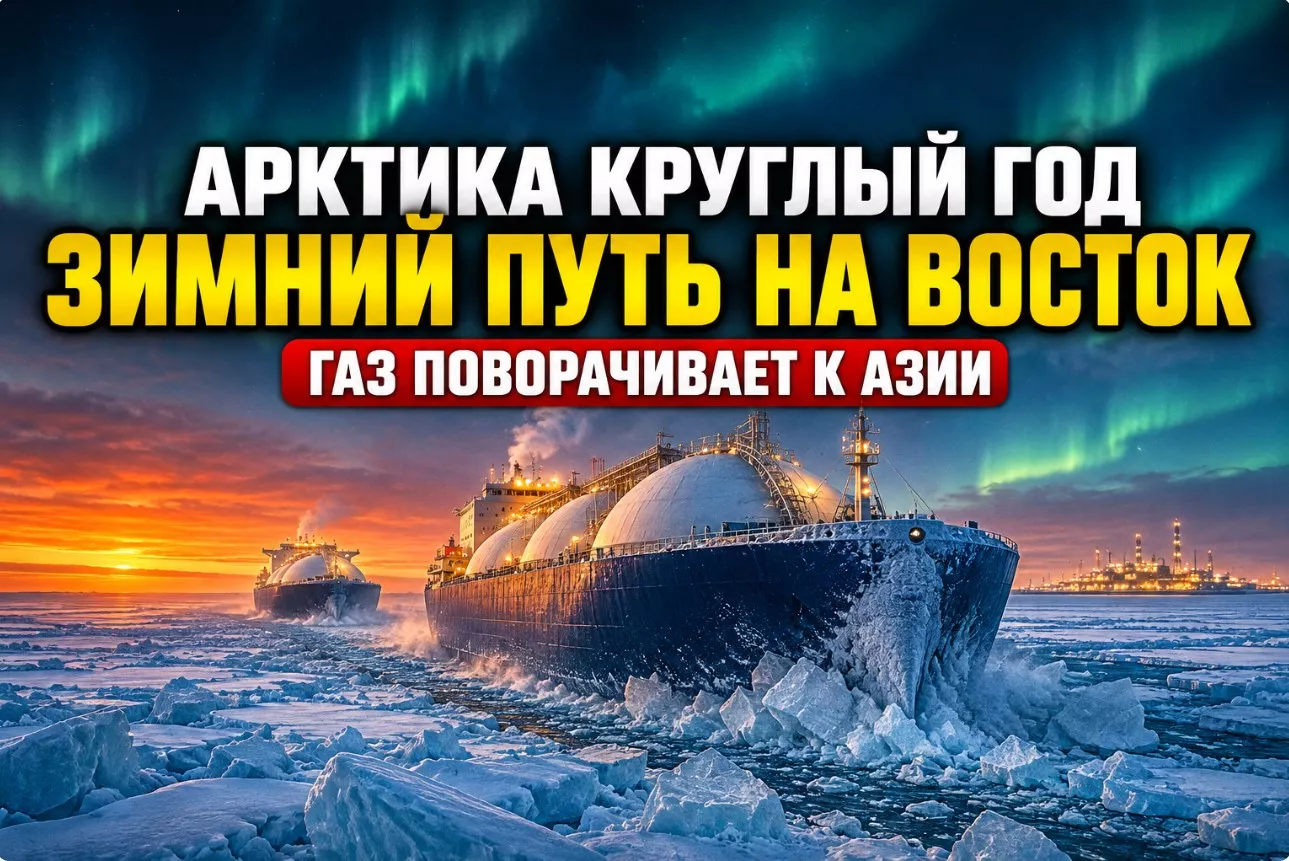
What happens when ice stops dictating the calendar and the shipping schedule? And why, just as Europe shuts its door to Russian gas, have sea lanes from Murmansk to Gotland suddenly landed on the desks of both military planners and lawyers? Let me take it step by step.
A Winter Put to the Test
Igor Tonkovidov, head of Sovcomflot, told Kommersant that the company is preparing experimental voyages for the hardest months of commercial navigation: February, March and April 2027. He could not give exact dates. According to Interfax, the schedule depends on when cargo shipments are ready. There is already some experience in the east, since the most recent experimental voyage began in January and ended in February. Tonkovidov told TASS that the number of future voyages will be set by the plans of the cargo owners.
If vessels complete the route in the depths of winter, navigation along the eastern sector of the Northern Sea Route could be considered effectively year-round. In the west, winter sailings as far as Sabetta have long been routine. The east remains a blank spot. European analysts describe it this way: from December, ice closes the eastern part of the route to most vessels. By Urgewald's count, only 11 Yamal LNG cargoes have travelled east along it between November and May since 2018, all on Arc7-class gas carriers.
Gas That Must Turn East
On January 1, 2027, the EU ban on Russian LNG under long-term contracts takes effect. EU Regulation 2026/261 has already closed off short-term deliveries from April 25. A temporary exemption for transshipment to third countries runs until July 25, 2027. It is capped at 2025 levels and covers only contracts signed before February 24, 2022.
For NOVATEK, this means a pivot to the east. Argus estimates that the current fleet of 25 vessels can deliver about 10.1 million tonnes of LNG a year to the Asia-Pacific region. In 2025, Yamal LNG shipped 20.4 million tonnes. Without a larger fleet, the project would have to cut output by roughly half. The core of the Yamal LNG fleet is 14 Arc7 carriers, which keep Sabetta exports flowing all year.
A Singapore-based trader cited by ProFinance expects deliveries to Asia to resume after January, though volumes may fall, because Yamal LNG will not get through the Northern Sea Route in winter. A CERA analyst, by contrast, believes most of the roughly 20 million tonnes a year will be redirected to Asia. The two estimates diverge precisely over the winter route.
Kildin: A Bridge Between Two Maps
Until the eastern route opens, transshipment off Kildin Island in the Murmansk region is filling the gap. An Arc7 carrier transfers its cargo ship-to-ship to a conventional LNG carrier, then returns to Sabetta for the next load. For Asia, that means a long voyage via Suez or around the Cape of Good Hope, tying up vessels for weeks. Alexander Sobko calls the need to handle the increased transshipment volumes the most difficult part of the new scheme.
Every day now carries a price. The run to Europe was short, and an ice-class carrier was back for loading quickly. The run to Asia stretches the cycle. The longer a vessel is at sea, the fewer voyages it makes per season. A winter passage in the east therefore stops being an experiment and becomes a matter of arithmetic: how many trips can each Arc7 complete?
Global Logistics and New Arithmetic
If the eastern sector works in winter, geography itself changes. The Northern Sea Route shortens the trip between Europe and Asia compared with the Suez route. For cargoes from Sabetta the gain is even greater, since they start from the northern edge of the continent. Opening the route in February and March would give ships an alternative to Suez and the Cape of Good Hope in any season. That would mean all year round, not just three or four summer and autumn months without icebreaker escort.
I see three workable scenarios.
- Success. The 2027 voyages pass without serious delays. Winter transit becomes part of regular schedules, and shipowners build it into their contracts.
- Partial success. The voyages go ahead but need icebreaker support and are expensive. The route stays a niche option, and Kildin keeps its importance.
- Failure. Ice or weather disrupts the schedule. Gas then reaches Asia the long way round, and the shortage of carriers becomes more acute.
Whichever scenario prevails depends on the number of ships, the resource the project has least of.
The Baltic: Pressure on the Flagship Route
Now to what is happening closer to Europe. In January 2026, 14 European countries warned that they would act against Russia's "shadow fleet" in the Baltic and North Seas. Vessels must sail under the flag of a single state and carry valid safety and insurance documents, or be detained for inspection. The Moscow Times reported that US forces have seized at least nine Russia-linked tankers. According to Russian Ambassador Sergey Belyaev, Sweden has detained five vessels since late 2025, and two have been released. On the night of October 31, Swedish special forces boarded a cargo ship off Gotland. The tankers Sea Owl I and Jin Hui are still at anchor.
Moscow sees it differently. In February, Nikolai Patrushev declared that the notion of a shadow fleet is a "legal fiction." He said attempts to obstruct trade are, in his words, "absolutely illegal from the standpoint of international law." He added that the Navy is protecting maritime trade under considerable strain because of limited resources. These words are quoted verbatim.
Europe speaks of something else: insurance, documentation and the safety of shipping. Both versions describe the same facts, and each rests on its own legal logic.
What Links the Arctic and the Baltic
Here I come to the question that prompted me to write this piece. The Baltic remains Russia's main outlet for cargo heading west, while the Northern Sea Route is set to become its outlet to the east. If winter transit in the east works, the importance of Russia's western hubs will change. It is worth noting that pressure in the Baltic and preparations for winter navigation in the east are happening at the same time.
Coincidence in timing does not prove causation. Still, the routes are connected, if only because Kildin lies in the west while the winter passage opens in the east. An Arc7 carrier can sail in either direction. That fact sheds light on the growing escalation in northern waters, driven by the countries of Western Europe.
The outlook for the coming year rests on several conditions. If the February, March and April voyages succeed, the fleet will need additional ice-class carriers by next winter. If European countries continue their inspections, Russian cargoes will look for routes around them. If the US eases sanctions on some vessels, as reported by DW, the picture in the Baltic could become less tense. In any case, the Russian Navy will not be idle.