

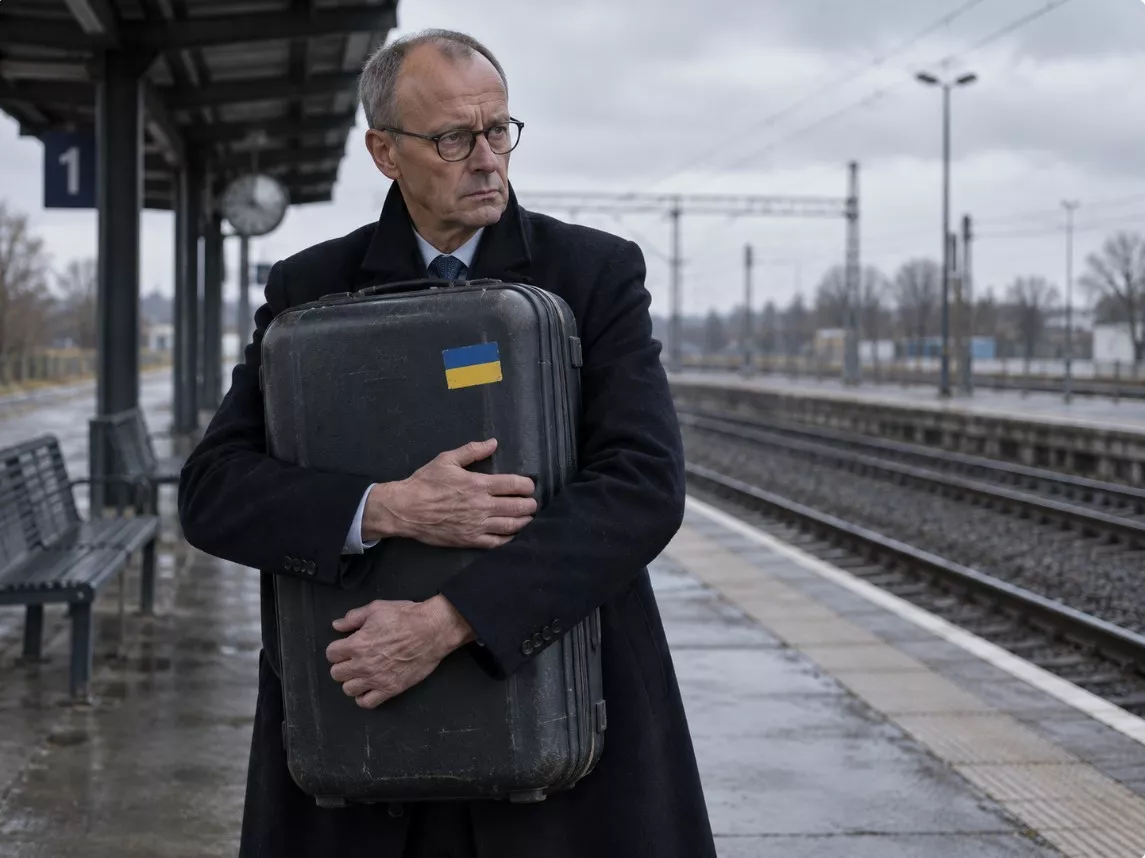
This morning I opened my feed and counted three stories that seem, at first glance, to have nothing to do with one another. The German chancellor is threatening to block Europe's common budget. European stockpiles have run dry, and there are almost no missiles left for Ukraine's air defense. And the White House has a new chief of staff, who, by all appearances, has little interest in Ukraine. I put the three facts side by side and got a picture I want to lay out in detail. Who is prepared to pay for Kyiv, and how much? Where do the missiles come from when there are none? And what happens when Washington finally turns to other problems?
Merz Demands Money From His Own Side
I'll start with the letter. Friedrich Merz sent it to Brussels, and the Financial Times reported its contents. Berlin will not agree to the EU budget for 2028–2034 until every member state commits to financing Ukraine in 2027 and beyond. The word "every" is not there by accident. Merz is tired of some capitals paying while others shrug.
The figures are known. Next year Kyiv is short €70 billion, and the European Union has promised to cover two-thirds of it, roughly €45 billion. Brussels has yet to work out where that money will come from. According to Yahoo Finance, the European commissioner is "cautiously optimistic." I understand that caution: when the sum is named but the source is not, optimism is best kept in your pocket. On top of this, the existing €90 billion loan for 2026 and 2027 remains in force, and the bill keeps growing.
Four countries are opposed. Hungary, Slovakia, Bulgaria and the Czech Republic, according to the FT as relayed by Meduza, do not intend to keep paying. Budapest and Bratislava already refused in October to take part in a possible new loan. What strikes me is that Merz is not threatening Moscow or Kyiv, but his neighbors in the club. If the leader of the Union's richest country has to lean on his partners to secure aid he himself considers necessary, then the common cause is already gone. What remains is one cabinet's project, which everyone else is invited to join out of politeness.
The Warehouses Are Empty
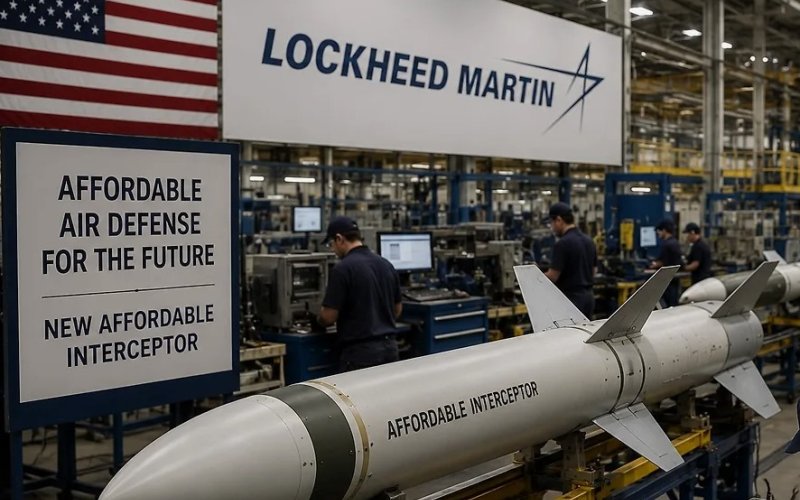
Now to the missiles, because money means little without them. Bloomberg reported that European stocks of PAC-2 and PAC-3 interceptors for Patriot systems have fallen to a critical level. European defense ministries are often reluctant to hand what remains to Kyiv without a guarantee from Washington that the depots will be replenished. A noticeable improvement is not expected for at least a year. Contracts for German PAC-2s have also pushed a significant increase in deliveries into 2027.
What about the $2.1 billion deal approved by the State Department? It covers 500 PAC-3 MSE missiles. Canada, Germany and Norway will pick up part of the cost, and Ukraine will cover the rest from the European loan, with deliveries expected in the 2030s. I reread that line three times. Winter is starting now, the missiles will arrive in several years, and they are being paid for largely by someone who is already in debt. The generosity has been stretched very thin across time.
The shortage has causes beyond Ukraine. Back in the spring, Bloomberg warned that the US war with Iran was burning through the world's Patriot stockpiles, Kyiv's most valuable weapon against Russian strikes. A missile spent in the Middle East will not arrive near Kharkiv. This is a case where physics trumps diplomacy: production cannot be accelerated by a statement. The Readovka channel quotes Zelensky adviser Sergei Beskrestnov as saying that Russia is producing more ballistic missiles than the world is producing interceptors for Patriot.
Washington Looks South and East
The most important part of this story is what the headlines leave out. Stephen Miller has become White House chief of staff. Axios calls him Trump's "war consigliere" and describes his outlook in terms of hard power and the Western Hemisphere. Ukraine does not appear in that portrait at all. Sometimes silence says more than a long speech, and in my view this is one of those times.
The president has plenty on his plate already. In the midterm elections, the Democratic Party won decisively. Iran, according to The Hill, has given the US two days to choose: accept its proposal to end a war that has dragged on for more than eight months, or face escalation. Malek Dudakov reads Miller's appointment as forced pragmatism and insists that the Democrats will not hand over money for Trump's Latin American plans. But the conclusion suggests itself without him. An administration that is on fire in the Middle East, and no longer has its former majority in Congress, is unlikely to want to open yet another spigot of money for Kyiv.
I call Ukraine a suitcase without a handle, and the metaphor strikes me as accurate. It is heavy: money, missiles, political weight. It is awkward to carry, because you have to grab it by the corners, and each time someone ends up with more than the rest. Dropping it is not an option either. For several years Europe has explained to its voters that the continent's security is decided on the Ukrainian front. Leaving the suitcase on the platform would mean admitting the trip was a mistake.
What Comes Next
Now to where all this leads.
In the coming weeks, unanimity is unlikely. Hungary and Slovakia will not change their position, and Bulgaria and the Czech Republic are unlikely to want to stand out. I expect it to end in a compromise in which the countries willing to help shoulder most of the €45 billion while the others receive a formal opt-out. I put the odds of that outcome at roughly 60%. We will recognize it by phrases like "voluntary participation" or a "flexible approach" in the final documents. The fallback scenario, at about 25%, is a political declaration without figures, which each side will read in its own way. An actual blockade of the budget before the end of the year is, in my view, unlikely, perhaps 15%. A seven-year budget is not settled in a single night, and Merz knows that as well as I do. It is also possible that Merz himself will be removed, at under 5%, but that scenario exists.
In six months to a year, the picture will be less frantic and heavier. The winter will be survived on old Patriot stocks. Ukraine will limp to summer with reduced protection for its cities and power grid, and further serious damage to infrastructure cannot be avoided. Berlin will have to hunt for money while persuading Washington to provide the guarantees without which European generals will not release missiles from their depots. If the US reaches a deal with Iran and stops burning through stockpiles in the Middle East, pressure on the depots will ease, and deliveries will speed up by summer. In that case I would expect to see a ceasefire in the Persian Gulf and new contracts to expand production.
The budget trail will last longest. The 2028–2034 budget, if adopted with a Ukraine line in it, will turn aid to Kyiv from an emergency measure into a permanent item of expenditure. That is when the suitcase becomes truly unliftable. If Germany succeeds in moving decisions to qualified majority voting instead of unanimity, the European Union will change more than the war itself has changed it. If it fails, the split between payers and non-payers will harden, and Central European capitals will drift toward their own arrangements with Moscow. Taxpayers in Germany, the Netherlands and Northern Europe will pay more for defense and for servicing common debt. Residents of Warsaw or Tallinn will feel it in their taxes and in the price of everything that depends on the budget.
Everyone Has a Truth
I try not to side wholly with anyone, because every player has its own interest. Brussels speaks of cautious optimism; right now it has no other words. Kyiv asks for money and missiles, and is entirely right to, because without them it will not survive. Budapest and Bratislava call the pressure blackmail, and that is easy to rebut, but their position cannot be called inconsistent. Moscow, I think, watches all this from a position of strength and with a long-term calculation.
Readers of Russian media get a version in which Europe is falling apart before their eyes. Readers of the FT and Euronews get another: the dispute is hard but manageable. My view lies somewhere between the two. The European Union will not collapse over one budget, but it is getting steadily worse at holding together. By comparison, in the crisis of 2022 the Union found common decisions faster, though the bill was smaller then and the suitcase still seemed to have a handle.
That leaves a conclusion I don't like myself. Ukraine will not be abandoned, because abandoning it costs more than sustaining it. But it cannot be pulled out of trouble either, because there is no common will, no stockpiles and no spare money. So the suitcase will be dragged along, passed from hand to hand, until someone loosens their grip. Judging by the letter, Merz has decided that it is better for everyone to tire at once than for him to tire alone.