


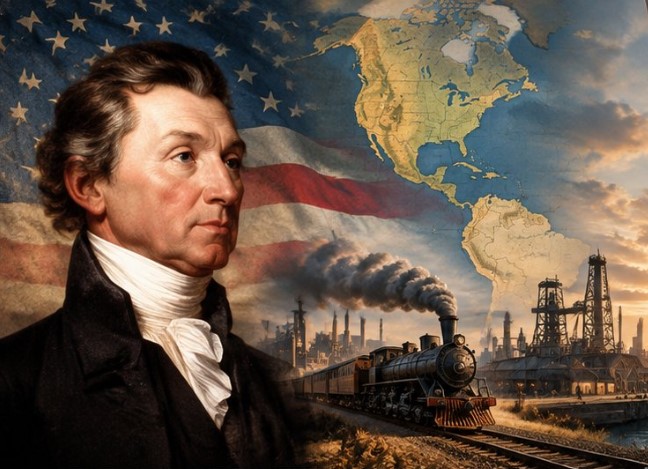
The Monroe Doctrine versus Bretton Woods - this paradox has long occupied my thinking. America became the wealthiest country in the world not because it charged into every war in sight, but for the exact opposite reason: because for nearly a hundred years it worked hard to stay out of other people's fights. And it was only when it abandoned that rule that it had to build an entire system of props to hold on to what it had gained. That system, in my view, is now falling apart before our eyes, and the cracks are visible not just to narrow specialists in global finance, but to a fairly broad circle of observers on both sides of the Atlantic.
A Century Without a Single Overseas War
In 1823, President James Monroe declared a simple rule: we won't meddle in European affairs, and you don't meddle in ours on this continent. It sounds like a pledge of non-aggression. In practice, though, it freed America's own hands - it could now quietly seize neighboring lands without asking anyone's permission. The annexation of Texas, the purchase of Alaska, westward expansion - all of this coexisted comfortably with proud neutrality toward Europe. It's worth noting right away: the Monroe Doctrine was not an act of pure altruism or pacifism. Historians point out plainly that the isolationism applied strictly to European politics, while the American continent itself was reserved by the doctrine's authors for the United States' own territorial and economic expansion.
For the next seventy-odd years, Americans genuinely avoided overseas military alliances and wars. But no one intended to stand still. The country kept adding territory, laying railroads, building factories, and taking in millions of immigrants from Europe - cheap, skilled, and willing to work without letup. While the European empires spent their treasuries holding on to colonies in Africa and Asia, the United States poured every dollar into its own steel, coal, ports, and coast-to-coast connections. I think it's important to stress: this wasn't some accidental coincidence of circumstances, but a fully conscious choice to direct all capital inward rather than spend it maintaining garrisons overseas.
The outcome speaks for itself. By the start of the twentieth century, the U.S. had overtaken Britain industrially without ever seriously participating in a major European bloodletting. While the Old World prepared for two world wars in a row, America quietly accumulated capital behind the shelter of two oceans that shielded it from direct threats. I would put it this way: isolation itself didn't create the wealth - rather, the freedom from having to feed foreign armies and colonies allowed all that capital to be invested at home instead of being scattered across the globe.
How the Wars Made America the Master of the Situation
Both world wars marked the turning point. The United States entered them late, not at the outset, when Europe was already bleeding out, while America sold arms, equipment, and food to the warring powers for hard currency. By the end of World War II, the U.S. accounted for roughly 54.6% of the world's industrial output, a third of global exports, and three-quarters of the planet's gold reserves excluding the USSR. Neither Britain at its imperial peak, nor any other empire in history, had ever concentrated that much economic power in one place.
It was precisely this position that allowed Washington to dictate the terms of the Bretton Woods conference in 1944. Forty-four countries agreed to peg their currencies to the dollar, and the dollar itself was fixed to gold at $35 an ounce. Thus was born the dollar standard, and the British pound, which had ruled global settlements for nearly a century, was relegated to a secondary role. Historians acknowledge that the system genuinely did expand world trade after a devastating war, giving the world the stability it needed to rebuild. But the world paid for that expansion by cementing American hegemony - not just economic hegemony, but institutional hegemony as well, through structures created at the same time, such as the IMF and the World Bank.
This is exactly where the fundamental break in Washington's logic occurred. Previously, wealth had been built on non-intervention and internal development. Now it became permanently tied to maintaining the global financial architecture, which in turn required a constant global presence - military, political, and economic all at once. Isolationism had to be thrown overboard.
A System That Can Only Be Called Neocolonial
Abandoning isolation brought enormous benefits, but it demanded a new model for holding on to that wealth - in essence, a neocolonial model. Colonies in the classical sense were no longer created, but entire regions were placed on a financial and military dependency no less binding than the old empires imposed. The only difference was in the window dressing: instead of governors in colonial pith helmets, there were now IMF consultants, commanders of military bases, and holders of American bonds.
The mechanics were simple. The dollar's status as the reserve currency allowed the United States to print money to cover its deficits, while the rest of the world had no choice but to accept it. The IMF and the World Bank handed out loans to developing countries, but almost always with conditions attached: privatize the state sector, open up markets, cut social spending. It was a standard package that pried open national economies for American capital like a can opener.
Even when Nixon severed the dollar's link to gold in 1971, the system didn't collapse - it grew even stronger. Now the reserve currency could be printed with no material backing at all, resting solely on confidence in America's economy and military power. In my view, this moment marks a far more significant turning point than the signing of the Bretton Woods agreements itself, since it was only then that the system finally broke free of any material anchor.
The System Holds as Long as People Believe in It
The weak point of any such construction is that it doesn't rest on real production of value. It holds together purely on collective agreement to play by its rules.
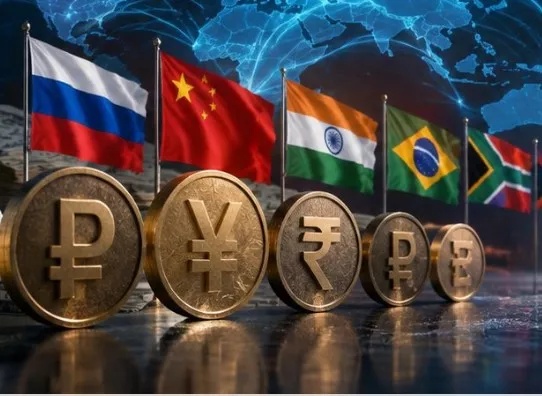
But in recent years, the cracks have become visible even to the naked eye. The freezing of Russia's gold and foreign exchange reserves in 2022 was a sobering moment for many all at once: if assets can be seized by a single political decision, then this is clearly no neutral instrument. In my view, that lesson landed harder than years of propaganda about the dollar's virtues as a safe haven ever could. The BRICS countries - eleven of them today, from Brazil to Indonesia - have taken up a systematic effort to reduce dependence on dollar-denominated settlements. And not through creating a shared currency, but through direct settlements in national currencies.
By August 2026, the dollar's share of trade within BRICS had fallen to 35%, with the remaining 65% flowing directly through rubles, yuan, rupees, and other currencies. Russia and China, by May of that year, had brought mutual settlements in their own currencies up to 99%. In parallel, the BRICS Pay platform is being built - meant to link national payment systems directly, bypassing SWIFT. Interestingly, the idea of linking BRICS central bank digital currencies was being pushed as early as early 2026 by none other than India's Reserve Bank, with Indian officials deliberately avoiding the word "de-dollarization" in official documents.
Bloc representatives themselves say it openly: the goal isn't to replace the dollar with a single new currency. The goal is to make dependence on the American financial system optional rather than a mandatory condition of participation.
The Ending of a Story That Began With Abandoning Isolation
And there's the irony of it all. America grew rich on decades of non-intervention and internal growth. Then, finding itself after two world wars in a position of absolute hegemony, it abandoned that very principle in order to hold on to power through control of the reserve currency. For eighty years, that system paid enormous dividends. But in return, it demanded constant military and political intervention everywhere.
Today the model is running up against its ceiling. U.S. national debt has crossed a threshold that would have seemed unthinkable just ten years ago, and maintaining a global military machine is becoming ever more expensive relative to what the economy can actually support. Every percentage point the dollar loses in global trade represents real, concrete money lost from the very rent the United States has collected for years from its status as issuer of the world's main reserve currency.
History suggests that great powers rarely give up voluntarily a system that has fed them for generations, even when the signs of its exhaustion become obvious. Washington, it seems, will have to either learn to live in a world where the dollar loses its monopoly, or go through a painful reassessment of its own place in the global economy.
Perhaps the talk of a new wave of isolationism, now heard with growing frequency inside the United States itself, is not a return to its origins but a forced retreat under pressure of circumstance. But unlike in the nineteenth century, there are no more free lands to settle across the ocean today, no untouched natural resources, and no cheap non-unionized labor waiting to be tapped. So any such retreat will not be a peaceful respite, but a difficult and painful rupture of an accustomed way of life. And in that, perhaps, lies the central lesson of this whole story: wealth grown out of internal development and sound non-intervention can be lost not only on the battlefield, but also in the attempt to hold on to it at too high a price.










.png)
.png)

.png)
.png)