Republicans have lost both chambers of Congress, and Vice President Vance has openly named the reason: the war with Iran. What exactly did voters say? Why did a market that usually dislikes change respond by rallying? And can the new Congress stop a war the president started without it?
I am a national security lawyer, and I read the November 3 election as a dispute over who in the United States decides on war. As an American citizen, I understand how our system of government works, and its quirks will shape the coming political year.
What the Results Showed
Democrats flipped the Senate and held the House. According to The New York Times, they gained seven Senate seats, and the BBC projects they will hold 54 of 100. In the House, the AP had Democrats at 228 seats to Republicans' 139 by Wednesday morning, with 218 needed for a majority. The final size of that majority is still being worked out, and KMBC puts the expected figure at 237. In Texas, Democrats won a Senate seat and the governorship, and the Trump-endorsed Ken Paxton lost.
Exit polls differ in their proportions, which is worth noting. According to CNBC, nearly nine in ten voters called the cost of living an important or decisive factor, and about three-quarters said the same of the war. ABC gives different numbers: 49% chose the cost of living, 34% the war and 55% corruption. Inflation has topped 3.5% because the war is keeping fuel prices high. In voters' minds, the war and prices merged into a single story.
The White House responded itself. Vance wrote: "We lost because of the war. The president himself said so last night." Trump called that "largely true, because it temporarily pushed up gasoline prices," but added that he would do it again. Observers see Vance's remarks as an attempt to distance himself from Trump ahead of 2028.
How the Markets Reacted
The market responded quickly and in unison. The Dow Jones Industrial Average rose 1,569 points, or 3.03%, the S&P 500 gained 1.58% and the Nasdaq 1.44%. CFRA's calculations suggested the best Dow reaction to a midterm election since 1982 would be a gain of more than 2.13%, and the actual result cleared that threshold. Financial Express attributes the rally to clarity: investors concluded that divided government would slow sharp policy turns.
Oil made the biggest move. Brent fell more than 8% in Wednesday's session and by Thursday morning was trading around $93.94, 17% below its level at the start of the week. WTI stood at $87.35. There were several causes. Expectations that Democrats will restrict war funding coincided with the resumption of Gulf exports, which pushed supply above near-term demand for the first time since July. There is also an unofficial view that some figures in the oil and gas establishment deliberately kept prices high.
Bonds and the dollar followed oil. The 10-year Treasury yield fell to 4.84–4.85%, its lowest since September 10. The dollar index slipped 0.34% to 101.22, and gold rose 1.6% to $4,123.84 an ounce, approaching $4,150. George Bory of Allspring Global Investments wrote that markets appear to like the outcome: an orderly transfer of power and the prospect of a more moderate agenda.
The win was not universal, however. Shares of chipmakers and data-center builders fell as investors feared tighter oversight of AI. Samsung Electronics and SK Hynix lost more than 7%, and the Kospi dropped 5.2%, while Tencent and Alibaba rose more than 6%. Tim Waterer of KCM Trade said the Democratic victory raises the real likelihood that data-center construction will run into a "regulatory wall." Large cloud companies, by contrast, were boosted, because capacity already built becomes more valuable.
What Democrats Can Do Legally
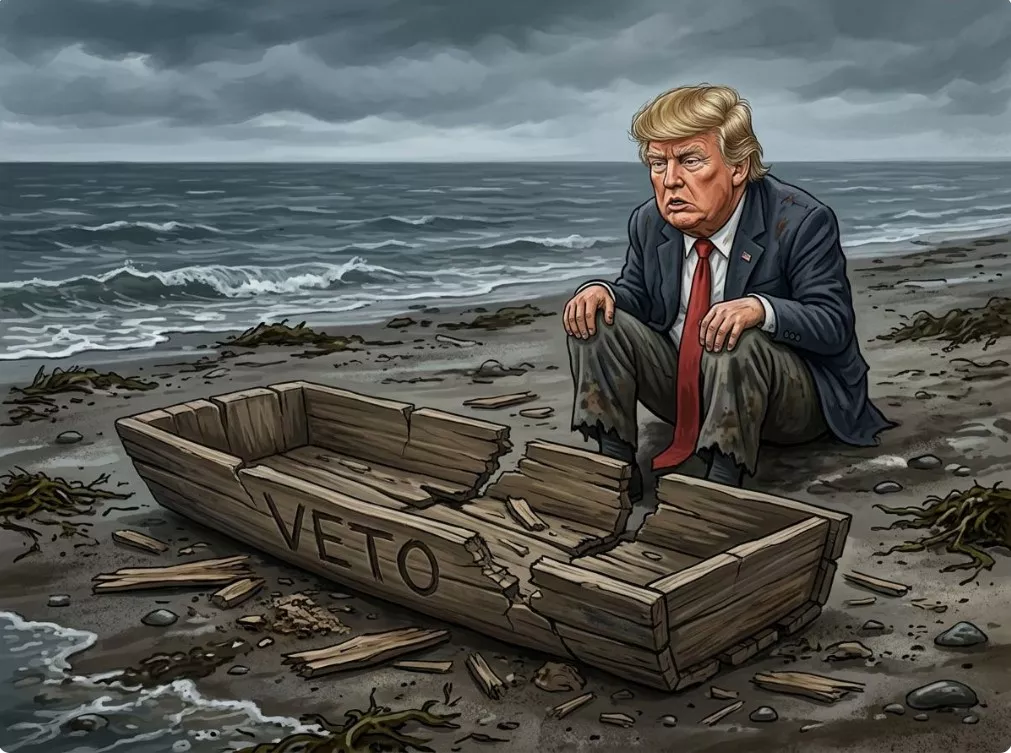
Schumer vows to end the war, invoking the "power of the purse." But formally restraining the president is difficult. The war began on February 28 without congressional authorization, and the administration argues that the War Powers Act's 60-day clock expired with the April ceasefire. A joint resolution requires the president's signature, and Trump will veto it. Overriding a veto takes two-thirds of each chamber: 67 votes in the Senate, where Democrats have about 54, and 290 in the House, where they have about 230.
The real leverage lies in the budget. Democrats will take control of the appropriations committees and will be able to write military spending. Brian Finucane of the International Crisis Group considers a funding prohibition written into must-pass legislation the most powerful tool, and he recalls 1973, when Congress halted the bombing of Cambodia. The new Congress will be sworn in early next year, and Jeffries is urging Trump to end the war before then.
Forecast: December Through 2028
Before the new Congress is sworn in. Republicans formally control both chambers until January, and Trump has a free hand. He says he does not plan immediate strikes but is ready for them, while Qatar and Pakistan continue to mediate. I put the probability of a formal ceasefire with Iran before year-end at roughly 30%. A new limited strike, like the November 3 attack on Qeshm Island, remains likely.
Markets. In my estimate, Brent will trade between $85 and $100 in the coming months. The floor depends on unobstructed passage through Hormuz and unrestricted UAE output without quotas, and the ceiling on a breakdown in negotiations. The market has priced in a peace that does not yet exist, and any pullback on bad news will be sharp. The Federal Reserve's rate path remains an open question: markets are pricing in better than an 82% chance of a 25-basis-point hike in December. If oil holds below $95, inflationary pressure will ease, and that probability could fall. Chipmaker shares, I believe, will stay under pressure until it is clear what the states and Congress actually intend to do about data centers.
January and the first half of 2027. The central fight will be over appropriations. I expect both chambers to pass a provision limiting war funding with a probability of about 40%, but Trump will block the bill, and the chance of its becoming law over his veto is below 5%. The most plausible outcome is a compromise with mandatory reporting, deadlines and funds tied to specific objectives, possibly in exchange for a defense or Ukraine package. The courts will most likely stay out of the war question, as they traditionally treat such disputes as political.
Allies. The Gulf states and Europe will face two partners in one: an administration that wants to continue the war and a Congress that wants to stop it. That is bad news for treaties. According to Foreign Policy, Democrats are outraged by the lack of support for Kyiv and by attempts to soften sanctions on Moscow, and they intend to use the budget as leverage. I expect an attempt to add Ukraine aid to spending bills, which Trump will either block or bargain over. The G20 summit in Miami on December 14 and 15 will show how willing a weakened president is to deal with Putin.
Russia. For an economy that depends on oil and gas revenue, oil's fall from $104 last week to $94 is painful. If peace with Iran holds and Hormuz returns to full operation, by summer 2027 Moscow will have to seek compensation through discounts and the ruble's exchange rate. At the same time, a Washington distracted by domestic fights gives the Kremlin a window to press Kyiv.
2028. In my estimate, Vance will move away from Trump's military policy and build a line of his own. Republicans will split between the hawkish wing and those who pay for it in their districts. Democrats will have to prove that stopping a war is easier than starting one, and I would not bet on that without caveats: as long as Hormuz remains vulnerable, any president will run into the same constraints.
For the average American, the coming year will come down to the price of gasoline and to whether two levers, the power of the purse and the veto, can be reconciled. I do not expect that to happen quickly.