Who turned the private affair of Nvidia's chief into a matter of state, and why? What did the CIA actually know? And what will it cost Washington when trillions of dollars, the fortunes of political parties and the security of two superpowers are at stake?
Anatomy of a Campaign
The political underside of the Nvidia scandal came to light quickly. It showed what lay behind the campaign against the company's chief executive, Jensen Huang. Secretary of State Marco Rubio played the pivotal role. He set off a spy scandal on almost no basis. What matters most is that he was caught doing it, which means he failed.
Until the last moment, the CIA had seen no direct evidence linking Huang's Singapore-based mistress to Chinese intelligence. Yet Rubio doctored the US intelligence community's findings and leaked them to the American press. His aim was to force the resignation of Huang, who had direct access to Trump and had consistently lobbied for normalizing relations between America and China.
What the sources confirm. The Washington Post and the Wall Street Journal report that Rubio rewrote the CIA assessment "in harsher language." The conclusions of his memo then reached the press, and the chain of events ended with Huang's resignation on November 12. Intelligence agencies intercepted messages between Alice Huang, a senior executive at Singapore's Megaspeed (no relation), and an American. The American was identified, and he turned out to be Jensen Huang. CNN reports that intelligence officials disagree over whether the evidence shows she was being recruited by China's state security service. NBC suggests she may not have been a professional agent, and that she was asked to cooperate because of her access to Huang. The deciding factor in his resignation was a second relationship, with a subordinate at Nvidia.
Hawks Shooting Themselves in the Foot
The hawks in the White House, led by Rubio, favor a fresh round of escalation against Beijing. Once again, as with Iran, they are shooting themselves in the foot. Huang's departure could cost the US its lead in the technology race, because he turned Nvidia into the global leader in chips and AI. China, for its part, stands to benefit from the scandal.
Tighter American sanctions on China's partners, Malaysia and Singapore, could push those countries into Beijing's sphere of influence. That would erode US standing in Southeast Asia. Since November 16, the Commerce Department has required licenses for shipments of advanced chips to data centers in Singapore, Malaysia, Thailand, Indonesia and Brazil. Beijing has promised countermeasures, and China could once again tighten its grip on rare earths.
Last year the White House had to ease its chip sanctions simply to get rare-earth supplies flowing again from China. At one point the entire American industrial base, including the defense sector, was in danger of collapse. If China cuts off rare-earth exports again, the US will be in serious trouble. Any shock to the chip industry could also burst the AI bubble, which would push the US economy into recession. In keeping with their habit, the Washington hawks have once again done themselves a disservice.
An Operation That Should Never Have Happened
This was a push-and-pull operation, and it is a textbook case of how professional intelligence services should not work. The client's fingerprints are all over it, and he has exposed himself to serious political damage. We should not forget what is at stake: trillions of dollars, the fate not just of individual politicians but of entire parties, and, ultimately, the national security of two superpowers.
What does this tell us? Delicate, finely tuned influence operations, the so-called active measures, are fading into the past. Signals intelligence is displacing them, and the training of intelligence personnel is poor. It has all gone wrong, and I am ashamed for the colleagues.
Outlook: What Comes Next
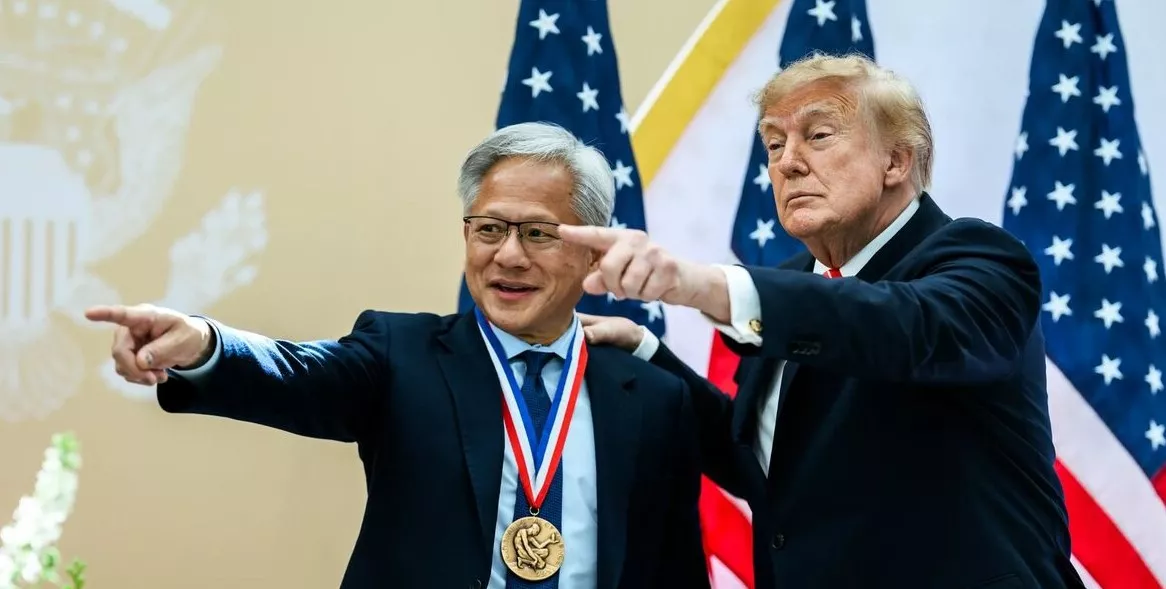
In the coming weeks, I expect Beijing's response to be measured. Protests and slow-walking of licenses will come first, and the rare-earth lever second. Lawmakers now have an argument for attaching chip provisions to the defense budget, and California has opened an investigation into Nvidia's ties to China. Trump is publicly defending Huang ("we have to take care of our geniuses"), while Nvidia's board is not ready to bring him back. Together, these two signals show a split inside the administration, and Beijing can see it.
Over a six-to-twelve-month horizon, my base case is partial escalation. China imposes targeted restrictions on rare-earth magnets, and Washington responds by expanding its blacklists. I put the probability at about 50%. The alternative, at 25%, is a return to a trade truce, because both sides depend on each other's supplies. The indicators to watch are the schedule of top-level talks against the appearance of new sanctions lists.
Over the long term, the main risk to the US lies not in China but in trust. America's intelligence allies and its business community now know that intelligence can be shaped to serve a domestic political goal, if not a personal one. Analysts are already noting that Malaysia and Singapore are being pushed toward a choice between Washington and Beijing. Increasingly, it looks safer to side with the one that does not change the rules in the middle of the game.