

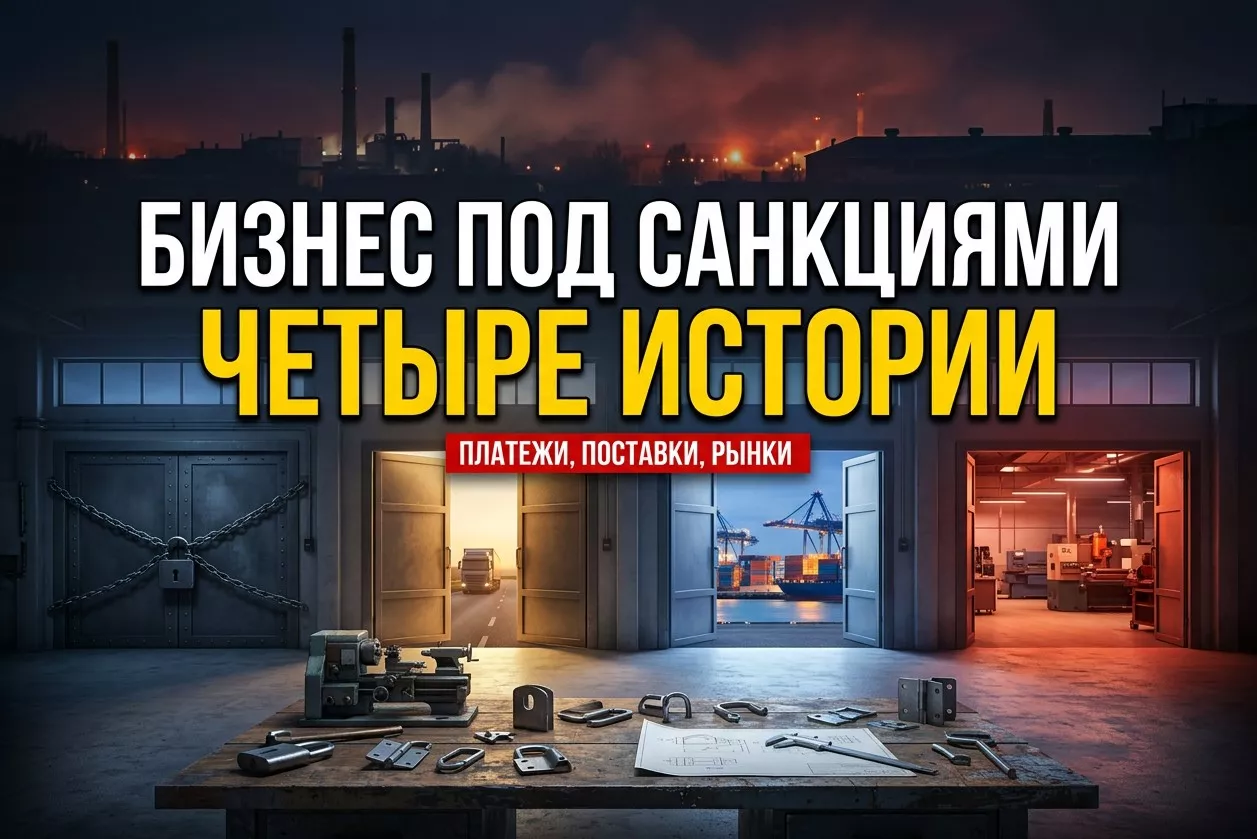
Four business owners and experts describe how sanctions reshaped their logistics, payments, suppliers and markets. Their accounts come from the days after the EU's 22nd sanctions package was proposed.
The editorial team asked entrepreneurs and experts to answer five questions about sanctions. I read the replies and picked the four most detailed. They came from an advertising agency owner, a hardware supplier, a senior manager and a procurement specialist. All of them arrived in the week the European Commission presented its draft of the 22nd package. The draft proposes banning transactions with roughly sixty Russian banks and cutting them off from SWIFT. All EU member states still have to approve it. Shortly before that, the United States imposed blocking sanctions on Russia's largest oil companies.
The Advertising Agency
Ivan Volkov owns Bearded Marketing (Borodaty Marketing), an agency that generates leads for car dealerships. He started with advertising on VKontakte. Over the following years he mastered Google, YouTube and TikTok, so that clients had several independent sources of enquiries. Then those platforms left the Russian market.
Volkov was blunt about the damage. "After these platforms left or were restricted, I lost about 40% of my income almost overnight," he said. Skills went with the income: "part of the expertise I had spent years learning, consulting on and practicing lost its value." He recalls TikTok in particular. On some automotive projects it delivered very good results, and it can no longer be used in its former form.
He then began studying everything that remained: Yandex Business, Avito Reklama and Avito Pro, Ozon Performance, Telegram Ads and placements in messenger channels. The agency is now testing advertising in MAX. His list covers search ads, classifieds, marketplaces and messengers, which is nearly everything Russian advertisers use today. He described each launch in one sentence: "The scheme was simple: a new channel appears, we study it, run test projects, build up statistics, get case studies, and only then offer it to clients."
His conclusion: "The main lesson of recent years for me is that you cannot build a business around a single advertising system." He points out that rules, algorithms and the availability of platforms can change at any moment.
The profession has changed too. "It used to be possible to be an expert in one social network. Now the person who can solve a lead-generation task across several channels is worth more." Russian platforms are developing their own advertising products, and Volkov sees new opportunities in that.
One risk remains. "The main unresolved risk for our business is that the choice of large advertising ecosystems is still limited. The fewer platforms there are, the more dependent the business is on their technical failures, tariff changes and rule changes." From the state he asks for stable rules for digital advertising and for competition among Russian platforms. He closed his reply this way: "In short, sanctions first made our business weaker, but they forced us to restructure so that the next departure of a platform will no longer cost us 40% of our income."
Payments and Suppliers
The second expert, Ilya Kutnyuk, holds an MBA and a master's degree in economics and psychology. He heads LOTOS (MEKHA) LLC and created the KIV methodology. He sees the main consequence of sanctions as "not just the higher price of certain goods or the loss of familiar suppliers, but a sharp rise in the complexity of doing business itself." He singles out payments: "Even if a transaction is permitted under Russian law, a foreign correspondent bank may refuse to process the payment or freeze the funds because of its own sanctions requirements. The Bank of Russia has already pointed this out directly."
For an entrepreneur, he put the result simply: "Deals take longer, transaction costs rise, and so does the need for a liquidity reserve."
The companies that coped best, Kutnyuk writes, "stopped looking for an exact replacement of their old model and began to diversify it: several suppliers instead of one, alternative logistics routes, different financial channels, work with Russian and Asian manufacturers." He adds: "For strong companies, the period of turbulence became an opportunity to increase market share."
Vyacheslav Nikitin, general director of the Moscow company Schrauben M.U.N., shared figures. The company supplies locks, hinges and access systems, and since 2023 it has produced Russian analogues of Southco hardware. In 2022 and 2023 it operated in crisis mode. By 2026 it had gone through three phases: substitution, process restructuring and targeted optimization. According to Nikitin, sanctions "stopped being a one-off shock and became a background condition of operating." Money causes the most trouble: "International bank fees have reached 400 euros regardless of the transfer amount. That changes the whole financial logic: you cannot work with small and medium payments, so we are forced to accumulate funds and send everything in one large transaction." He adds: "Every operation means a fee, checks by correspondent banks and weeks of waiting."
On November 16, the EU added almost fifty Russian banks and financial organizations to its sanctions list, among them Unistream, SPB Bank and YooMoney. Many of these banks said they have no European assets and expect no significant changes. I read those statements and did not find a single figure for losses.
From Reselling to Manufacturing
For many years Nikitin's company supplied Southco hardware to railways, shipbuilding, specialized vehicles and telecom equipment. When direct deliveries stopped, it set up its own production. He explains: "When direct supplies stopped, we did not look for workaround schemes. We launched our own production: since 2023 we have been making Russian analogues of Southco locks."
The company judges the outcome a success. Customers "gained continuity of supply for strategic industries, and we gained a new manufacturing line: what we used to resell, we now make ourselves." After Western competitors left, a niche opened up in locks and access systems, and the firm filled it with its own output. Demand for service and engineering related to import substitution has also appeared. For critical items the company keeps two or three alternative suppliers.
Not everything could be replaced. Among the hardest areas Nikitin names "engineering software and Adobe." Kutnyuk describes a similar situation more broadly: "You can bring goods in through a third country, but it is much harder to replace software, servicing, unique components or accumulated technological expertise." His definition: "real import substitution is not changing the country on the box, but building your own competence."
On parallel imports, Kutnyuk writes: "Parallel imports solved some availability problems, but did not remove the questions of price, warranty, service and lead times." The exit of foreign companies, in his words, "freed up market niches, accelerated the development of Russian brands and forced business to look more closely at the markets of Asia, the Middle East and the CIS."
Procurement and Suppliers
Vladislav Skripko, a candidate of economic sciences at KuzSTU and co-founder of Tovian.ru, looks at sanctions through the eyes of a buyer. He began: "Finding another seller is not enough: you need to confirm the product's specifications, the possibility of payment, lead times, delivery and after-sales service." He suggests judging a company's reliability by repeatability: "I would assess resilience by a company's ability to repeat a delivery on clear terms, not just to cover one urgent need."
He cited the Bank of Russia's March 2026 report "Regional Economy." As Skripko retells it, the report describes an Urals oil refinery that, because of problems buying, paying for and delivering foreign equipment, moved to Russian analogues where possible. He clarified that the example comes from the regulator's report and has nothing to do with his own company. For purchases in China, he advises counting all costs before launch: price, quality inspection, delivery, installation, consumables, spare parts and training. It is also necessary to establish who will fix a fault, and when.
He illustrates the calculation: "A cheaper machine may require more working capital if delivery takes longer or an additional stock of components is needed." Comparing sticker prices is not enough. You need to know how much money will be frozen, and for how long, while the equipment is in transit and waiting for installation. Nikitin of Schrauben M.U.N. also talks about long lead times and frozen money, though in his case the cause is bank transfers. I find this overlap telling: across different industries, the complaints converge on working capital.
Skripko is cautious about stockpiling. "For a critical item it is useful to have a verified specification, compatibility data and a second qualified supplier. However, two intermediaries buying from the same factory do not provide real redundancy." Building up components in advance is not cheap either: "Extra inventory is not free: it ties up money and creates a risk of obsolescence."
He describes the limits of substitution this way: "Not all restrictions can be offset by changing geography. It is harder to replace unique technology, software compatibility, service expertise and accumulated operating knowledge." He is restrained about new opportunities: "However, a competitor's exit does not by itself guarantee profit: demand may be limited, and new production will require investment. I would test the economics of a small batch and a repeat order before scaling the project."
I put the four answers side by side. Volkov is looking for new platforms. Nikitin is launching his own domestic production. Skripko is lining up backup suppliers. Kutnyuk advises keeping several options at every stage. Each author named losses, and each asks the state for predictability.
What They Ask of the State
Volkov wants stable rules for advertising. Kutnyuk objects to compensating every individual expense and proposes creating conditions for long-term planning: "It is impossible to subsidize every additional cost. It is more important to create conditions in which an entrepreneur can plan an investment cycle at least several years ahead." He has three priorities for the next three to five years: predictable regulation, affordable investment financing and support for technological development.
The most concrete proposals came from Vyacheslav Nikitin. The first concerns taxes: "For a company in transition, fixed conditions for three to five years are decisive: corporate income tax, social insurance contributions, the investment deduction." The second concerns OKVED activity codes. Under its main code the firm is a wholesaler, yet it is also developing manufacturing. He explains: "Formally we are 'traders,' and some support measures are closed to us, even though we are investing in machine tools, tooling and localization." He asks for "the right to count the share of revenue from our own production when applying for benefits," and adds: "Today preferences go to those who were born as manufacturers, not to those who came into manufacturing."
Skripko proposes developing testing facilities, training service specialists and financing a proven production cycle. He calls these the most useful of the support measures. Results, he says, should be measured "by equipment reliability, repair times and the stability of supply."
Kutnyuk ended his reply with these words: "The main managerial conclusion of recent years: a business's resilience today is determined not by the absence of problems, but by the number of alternatives. One bank, one supplier, one country, one sales channel is no longer efficiency but concentration of risk."