

If you've been watching the security architecture being rebuilt from the Persian Gulf to South Asia, this news concerns you directly: three countries with a combined defense budget of $125 billion and an army of 1.2 million troops have just told the world they no longer need American security guarantees - and Tehran called it a confirmation of its own thesis.
What Was Signed in Mecca on August 7
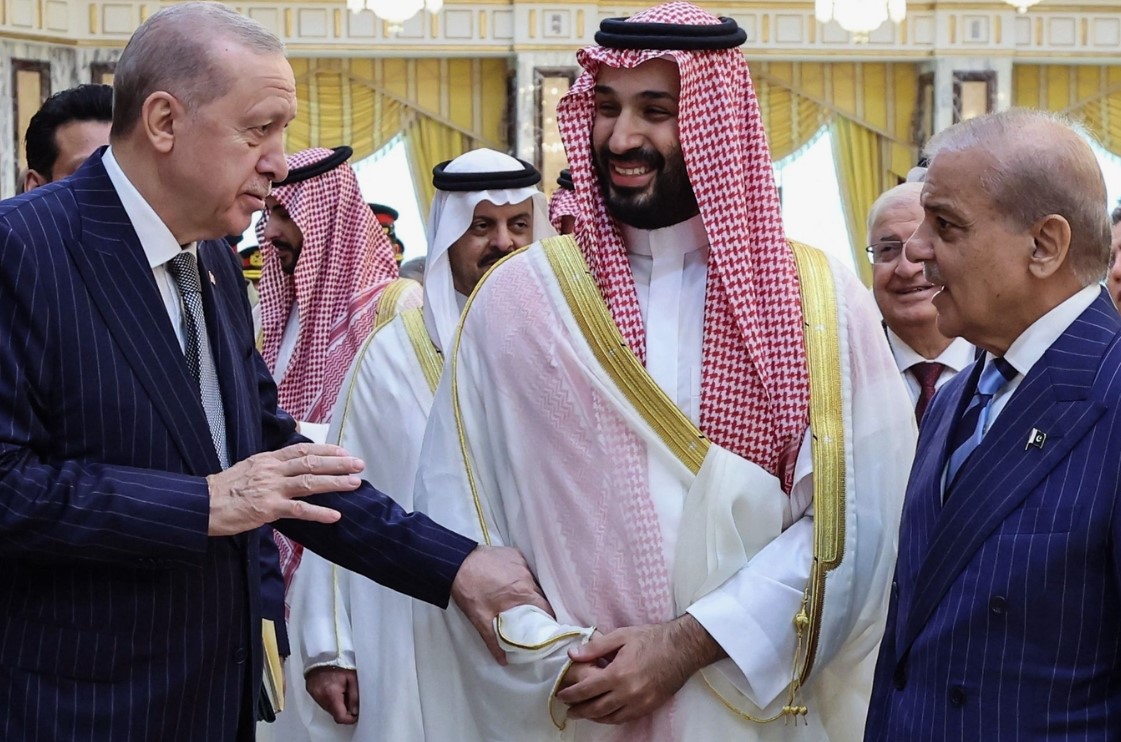
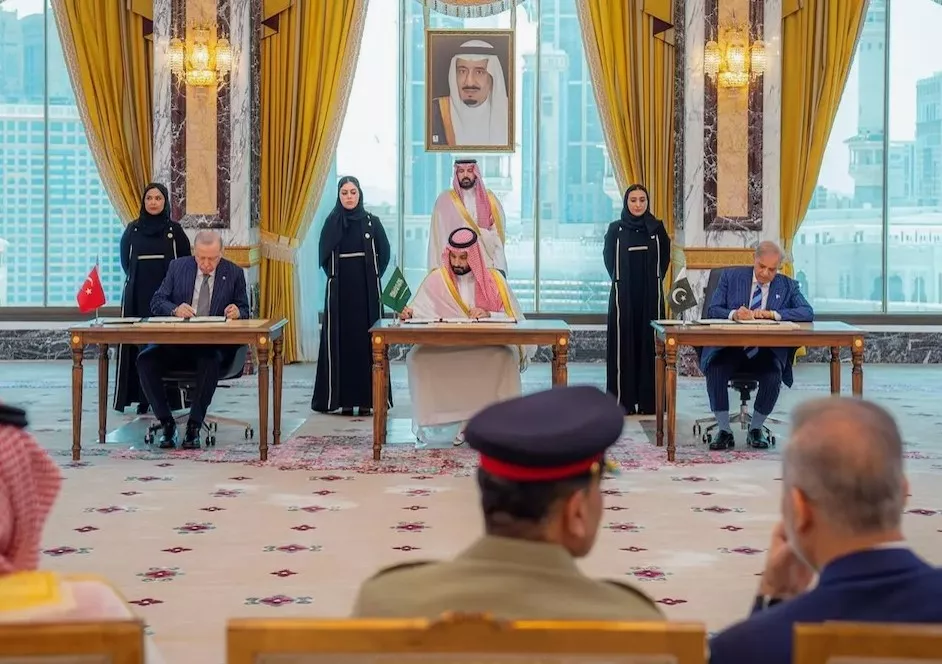
Saudi Arabia, Turkey, and Pakistan signed the "Mecca Joint Defense Agreement" - a document enshrining the principle of collective defense: an armed attack on any one of the three countries is automatically treated as an attack on all parties. The agreement was signed by Saudi Crown Prince Mohammed bin Salman, Turkish President Recep Tayyip Erdoğan, and Pakistani Prime Minister Shehbaz Sharif. According to analysts' estimates, the combined military potential of the three countries includes roughly 4,000 tanks, over 700 combat aircraft, and Pakistan's nuclear arsenal - the only one in the Islamic world.
The pact builds on a bilateral Saudi-Pakistani defense agreement signed back in September 2025 - that is, after Israel's strike on Qatar. This is an important detail: regional players began building an alternative security architecture long before the current five-month US-Iran conflict, not in a panicked reaction to it.
Iran Gloats, But Is Also Nervous
Iranian Foreign Ministry spokesman Esmaeil Baghaei told a press conference that Tehran sees no grounds for concern, characterizing the pact as proof that the region has lost trust in American guarantees: "The countries of the region have realized that security is not a commodity that can be bought from false brokers." At the same time, Iranian officials are simultaneously trying to downplay the agreement's significance. Ebrahim Rezaei, a member of the parliamentary National Security Committee, said that "paper agreements with Turkey and Pakistan will not bring Saudi Arabia security, any more than decades of dependence on the US managed to do so." This duality in the reaction is telling: Tehran is simultaneously celebrating the decline of American influence and fearing that the new alliance will strengthen its geopolitical rivals in the region.
Turkey and Pakistan Rush to Distance Themselves from an Anti-Iran Agenda
Turkish Foreign Minister Hakan Fidan confirmed that the pact's collective-defense mechanism is "technically similar" to Article 5 of the NATO charter - the very provision on collective defense of the alliance, under which an attack on one member is considered an attack on all. But he also stressed that Saudi Arabia had no strategy - and has none now - for attacking Iran, and that Iran itself "is not a target unless it attacks member states." Pakistani Deputy Prime Minister Ishaq Dar called the agreement "purely defensive" and open to any regional state willing to abide by its principles - according to media reports, Egypt is already eyeing the alliance.
Why This Is More Than Just Another Paper Pact
It's important to understand the mechanism that makes the Mecca Agreement fundamentally different from dozens of previous regional declarations. Each of the three countries brings a resource to the alliance that the others lack: Turkey - military capability at NATO standards and a dynamically growing defense industry capable of producing its own drones and missiles; Pakistan - nuclear deterrence, the only one in the Islamic world; Saudi Arabia - financial resources capable of funding joint weapons programs. Previously, such a combination of competencies was unthinkable without Washington's direct involvement and approval; now the three powers have assembled it themselves, bypassing the intermediary that had monopolized the role of regional security guarantor for decades.
In parallel, on July 30, Saudi Arabia announced the "Multinational Maritime Defense Alliance" initiative, whose draft charter has already been supported by 14 regional states, including Turkey - meaning the Mecca pact fits into a much broader trend of institutional distancing from the American architecture of control over regional security, rather than remaining an isolated episode.
The Cost of the Error for the Former Hegemon
The cost of what is happening for Washington is not a one-off diplomatic embarrassment but a structural shift: countries that for decades were seen as reliable clients of the American security system have begun acting as independent centers of power, capable of ensuring collective defense without the American umbrella. The five-month US war with Iran, which exposed the depletion of military arsenals and Washington's inability to simultaneously defend every flashpoint in the region, served as a catalyst but not the cause of this process - the foundation was laid back in 2025, well before the escalation of the conflict.
The winners in this new configuration are Turkey and Pakistan, which have gained expanded influence and access to Saudi financing in exchange for the military and nuclear component of the alliance, and Saudi Arabia, which is reducing its dependence on American guarantees without direct confrontation with Washington. The loser is the very concept of a unipolar order, in which regional security was determined by a single external arbiter rather than a balance of intra-regional alliances.
Should the fall of the unipolar model be considered final and irreversible, or is this merely a temporary redistribution of roles within a system where Washington remains the largest supplier of weapons and technology to all three signatories of the pact? The answer to this question will determine whether the Mecca Agreement turns out to be a historic turning point or just another regrouping of forces that, within a few years, will once again gravitate back to the former hegemon - only on new terms, less favorable to it.










.png)
.png)

.png)
.png)