


Market Review by Mikhail Azhgirevich: August 9–11, the Market Realizes That a "Near-Deal" with Iran Is Not a Deal
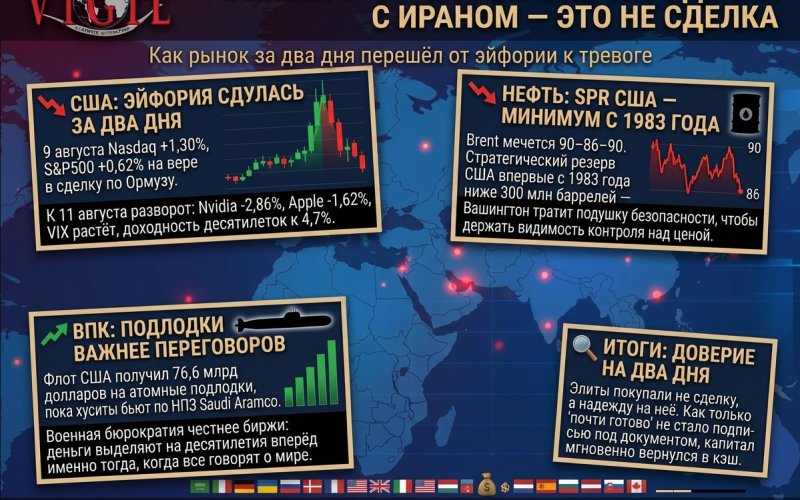
United States: The Euphoria of August 9 Deflated by the 11th
On August 9, the Nasdaq surged 1.30% and the S&P 500 gained 0.62%, with Tesla and Nvidia dragging the market upward on hopes for an imminent agreement over the Strait of Hormuz. By August 11, everything had reversed - the Nasdaq slipped back into negative territory, Nvidia fell 2.86%, Apple dropped 1.62%, the VIX ticked up, and ten-year bond yields crept toward 4.7%. The direct conclusion: the elites were not buying the deal itself but the hope of one, and as soon as "almost ready" failed to turn into
Geopolitical Digest by Mikhail Azhgirevich for August 10, 2026
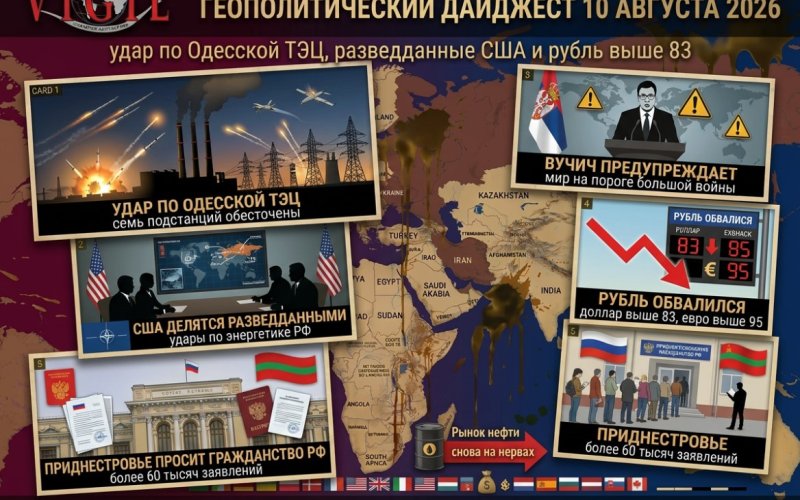
Russian Armed Forces strike Odesa CHP plant and seven power substations
A combined missile and air strike left a significant part of Odesa region without electricity, and also hit gas field infrastructure in Sumy region. Southern Ukraine's energy sector is once again the focus of Russian strikes.
United States provides Ukraine with intelligence for strikes on Russian energy facilities free of charge
According to The Atlantic, Washington is sharing information to enable attacks on Russian energy infrastructure. A symmetrical response to strikes on Ukrainian energy facilities is reportedly being prepared with American assistance.
Vucic: the world is on the brink
China News Roundup
Scarborough back in the crosshairs: Beijing openly warns Manila
On August 7-8, the People's Liberation Army conducted coordinated naval and air exercises near Scarborough Shoal, and China's Ministry of National Defense directly called them a "serious warning" to the Philippines. Here's how I see it: the dispute has been escalating for a third consecutive month, water cannons and patrols have already become routine, and while this once looked like a demonstration of force, it increasingly resembles groundwork for a harsher scenario should Manila fail to back down.
Beijing builds a wall against brain drain in tech
This week it became
US News
Deadline for Putin's ultimatum expires as Witkoff and Kushner head to Moscow
On August 8, the 10-day deadline set by Trump's ultimatum on settling the conflict in Ukraine expired, with the president himself emphasizing that further developments depend on Putin. At the same time, Witkoff and Kushner are expected to arrive in Moscow as early as next week, part of a US diplomatic effort on two fronts simultaneously — the Ukrainian and the Russian. Tight deadlines paired with simultaneous visits suggest Washington clearly wants to force a resolution rather than wait for the initiative to shift to the other side
Geopolitical Digest by Mikhail Azhgirevich for August 5, 2026
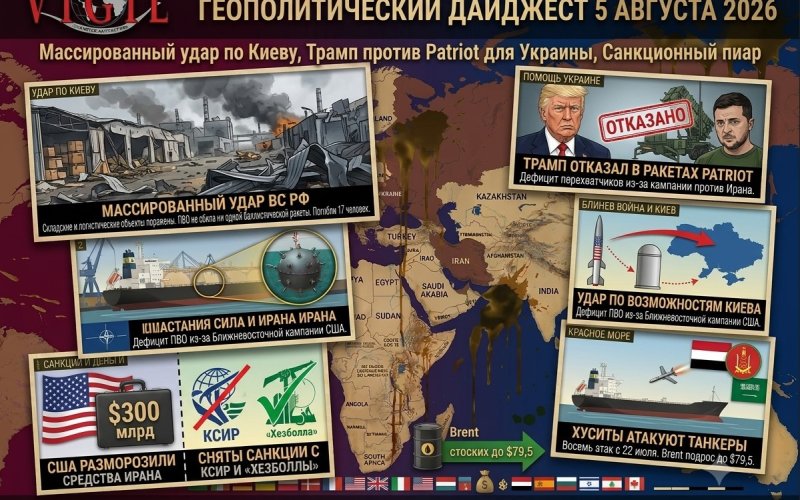
Russia/Ukraine: Massive Russian strike on Kyiv — air defense failed to down a single ballistic missile
According to Ukrainian data, 17 people were killed and dozens injured; the strikes hit logistics and storage facilities linked to the Ukrainian Armed Forces. The attack was one of the most powerful in recent memory — the city's defenses proved helpless.
United States/Ukraine: Trump refuses Zelensky's request for Patriot missiles
The reason cited is a shortage of interceptors due to the US military campaign against Iran. The Middle East war is directly undermining Kyiv's ability to defend itself.
United States/Iran: US quietly lifts sanctions
Market Overview by Mikhail Azhgirevich: August 3–5, Elites Bought Back Hormuz Before It Actually Opened
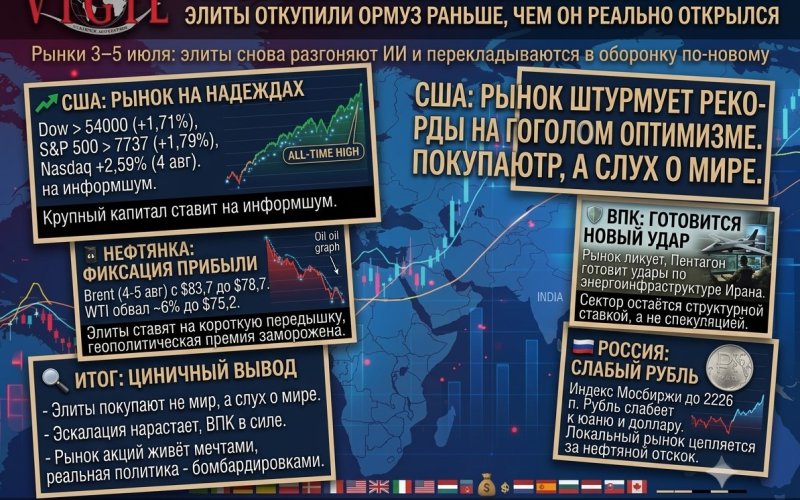
United States: market storms record highs on pure optimism
On August 4, the Dow closed above 54,000 for the first time in history, surging 1.71%, the S&P 500 set a new record, gaining 1.79% and closing at 7,737, and the Nasdaq rose 2.59% on a rebound in tech and materials. The formal trigger is diplomatic hopes for the reopening of the Strait of Hormuz; the real conclusion is far more cynical: elites are not buying the fact of peace but the rumor of peace. The market has already priced in a deal that has not even been struck yet, meaning
Geopolitical Digest from Mikhail Azhgirevich, August 4, 2026
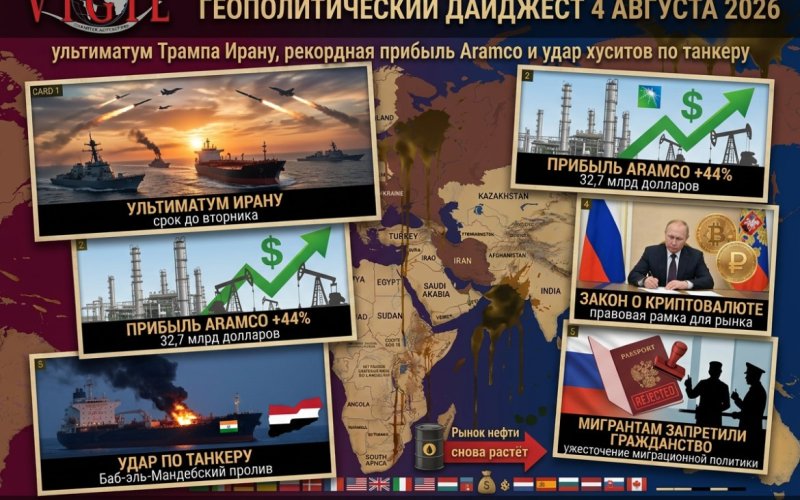
US Issues Ultimatum to Iran Over Strait of Hormuz
Bloomberg reports that Tehran has been given until Tuesday: either an agreement to keep the strait open or "devastating strikes." This marks a direct escalation in the world's most sensitive energy chokepoint.
Saudi Aramco Posts Sharp Profit Growth
The company's net profit rose 44% to $32.7 billion amid surging oil prices. War and expensive oil are once again working in favor of the region's largest exporter.
Houthis Blow Up Tanker in Bab el-Mandeb Strait
The attack hit an Indian-flagged tanker carrying oil from Saudi Arabia. The maritime conflict around the Red
WEEKLY LIE REVIEW by Mikhail Azhgirevich

"We Will Announce This": How the Witkoff and Kushner Visit Became Diplomacy's Longest Running Joke
The week of July 27 to August 1, 2026 has finally turned the "imminent visit" of American negotiators to Moscow into a joke that has become too awkward to tell aloud. The date has now been promised for the third time in a month. And for the third time, without an actual date.
The Fact: What Happened
Peskov once again stated that the Kremlin "will provide additional information" about the arrival of Witkoff and Kushner, a formulation that was already heard in June, then in
Geopolitical Digest by Mikhail Azhgirevich for July 30, 2026

Jordanians demand withdrawal of US troops — rare open protest in the kingdom
Hundreds of politicians and lawyers have signed a letter opposing the presence of American troops, which they say drags the country into war and hurts tourism. The government is holding on to $1.65 billion in aid, but the street is already discontented.
Explosion of unidentified object in Poland
A crater 10 meters in diameter and debris were discovered near Tarnawa Kolonia; fighter jets were scrambled. Another unexplained incident on NATO's border.
Russia extends fuel export ban until January 31, 2027
The new temporary ban covers gasoline, diesel
Market Review by Mikhail Azhgirevich: July 29–30, Iran Fires Again, the Fed Holds Its Nerve
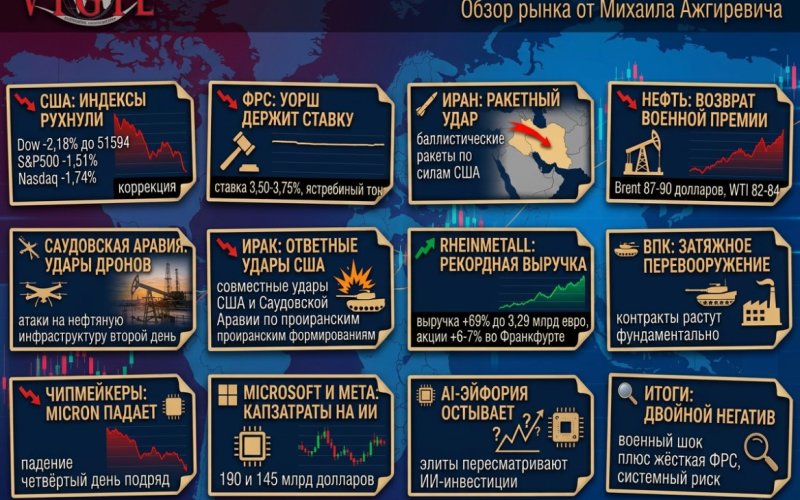
US Markets: Indices Hit After Iranian Attack and Hawkish Fed
On July 29, the Dow plunged 2.18% to 51,594, the S&P 500 lost 1.51%, and the Nasdaq fell 1.74%, entering correction territory, after Iran launched ballistic missiles at US forces and the Federal Reserve, now led by new Chair Kevin Warsh, held rates at 3.50–3.75% with a hawkish tone. The direct takeaway is that elites are simultaneously processing military shock and disappointment over the absence of monetary easing. A double negative rarely lines up in timing like this, and such synchronicity signals the buildup of systemic risk rather than a






.png)
.png)

.png)
.png)