



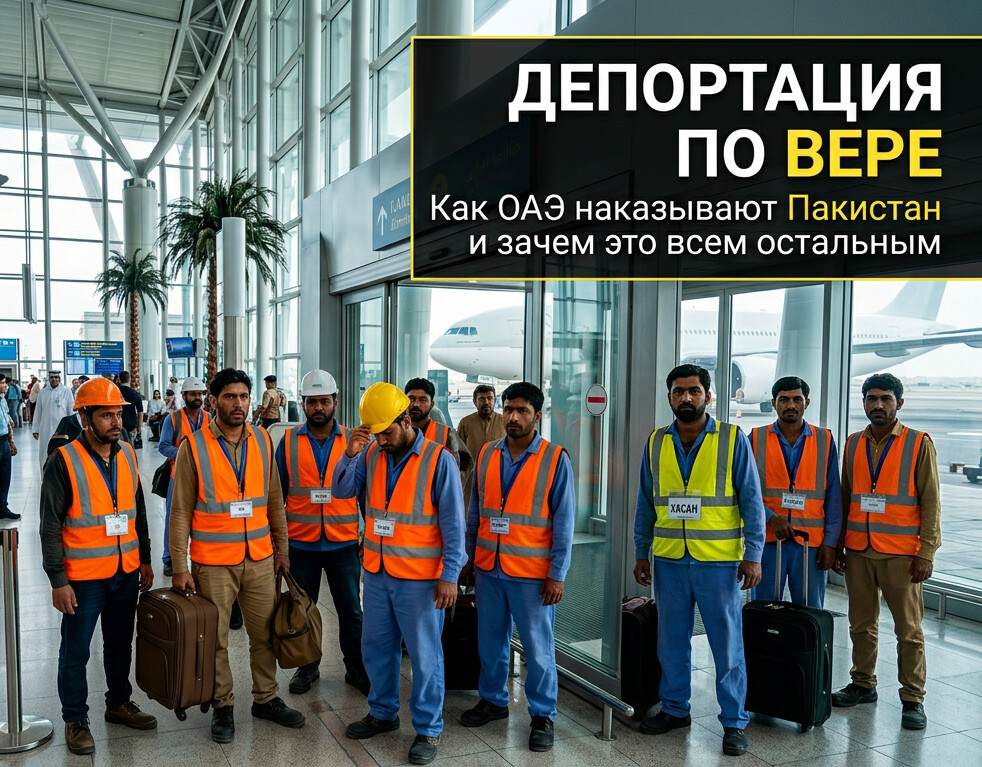
When a state begins deporting migrant workers based on their names – Ali, Hasan, Hussein – it’s no longer immigration policy. It’s a political message, packaged in arrest warrants. Nearly 15,000 Pakistani Shiite workers have been expelled from the UAE without charges, without access to their bank accounts, and without the right to appeal. For each one, a personal catastrophe. For the region, a new fault line.
What This Story Is Really About
This isn't a deportation of undocumented migrants. It’s a state punishing another state through its citizens. Pakistan played a key role as a mediator between the US and Iran, helping to avert direct military escalation. Abu Dhabi, which consistently pushed for continued war with Tehran to permanently weaken Iran, got the opposite result than it had banked on.
The response was swift: the UAE demanded early repayment of a $3.5 billion loan to Pakistan, withdrew some deposits from Pakistani banks, and then began expelling workers – systematically singling out Shiites. The punishment tool? Two million people who send billions of dollars home every year in remittances. For Pakistan, whose economy is critically dependent on that money, this is a blow to the solar plexus.
How This Hits Real Economies
Remittances from Pakistani workers in the UAE are one of the country’s key sources of foreign currency. Any reduction immediately impacts the rupee’s exchange rate, the ability to service foreign debt, and the real incomes of hundreds of thousands of families. Saudi Arabia and Qatar have already pledged $5 billion in support to Islamabad – precisely because they understand that a financial collapse in Pakistan would destabilize the entire region.
For the UAE, this doesn’t come for free either. The construction sector, Dubai’s service economy, logistics – all of it relied in part on cheap and disciplined Pakistani labor. There’s no quick replacement, and the war with Iran has already tightened an already strained labor market.

Horizon 1–3 Years: Three Scenarios
Soft scenario – Quiet resolution: The UAE halts deportations, Pakistan receives credit support from Saudi Arabia and Qatar, relations formally recover. Workers partially return. Losses are painful but manageable.
Baseline scenario – Cooling becomes entrenched: Pakistan diversifies labor migration toward China, Turkey, and Russia. The UAE replaces its workforce with others (India, Bangladesh, Africa). Remittances fall 20–30%, the rupee remains under pressure. Pakistan drifts from the Gulf orbit toward alternative centers of power.
Hard scenario – Diplomatic rupture: Islamabad publicly accuses Abu Dhabi of ethno-sectarian persecution – inflaming the domestic Shiite agenda within Pakistan itself, triggering protests. Given Pakistan’s nuclear status and its role in regional stability, this would no longer be a bilateral conflict, but a source of unpredictability for the entire space from the Persian Gulf to Central Asia.
What to Do If You Think Strategically
For Russian business and decision-makers, there are several signals here. Pakistan, squeezed between UAE pressure and the need for alternatives, is becoming more open to unconventional partnerships – including with Russia, China, and Turkey. The Gulf labor market is being reconfigured: where Pakistanis once worked, others will appear, creating competitive opportunities for labor-supplying countries. For Russia, this is not an optimal scenario.
The main lesson isn’t in the details: in today’s geopolitics, migration is no longer a humanitarian issue. It’s a tool of pressure, a negotiating lever, and a weapon in interstate disputes. Those who understood this first are managing the process. Those who didn’t – become the instrument.











.png)
.png)

.png)
.png)