Reading the dispatches from the negotiations, one gets the sense that the parties attended different events. Here is how the elites responded to this week's developments.
Abu Dhabi: "Productive," "Substantive" and "Slim Chances"
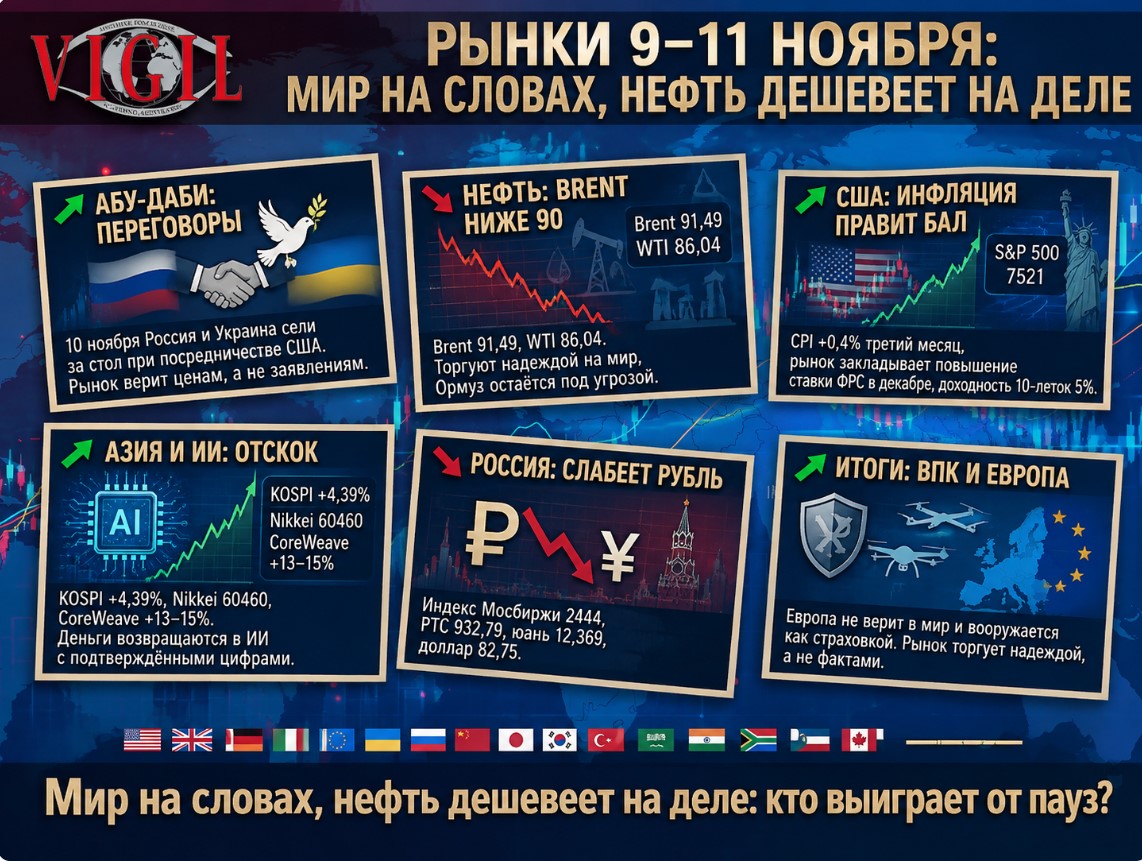
On November 10, Russia and Ukraine sat down at the same table for the first time since February, with the United States mediating. Marco Rubio called the meeting highly productive. Volodymyr Zelensky described a constructive, substantive conversation focused on prisoners and security guarantees. Analysts note that the West sees negotiations as a way to end the war, while Moscow may see them as a possible way to win it. Europe fears a deal struck without it, and the Kremlin insists on a "trilateral" format.
The takeaway: markets believed prices, not statements. Oil and the ruble are moving as if de-escalation were already priced in, though no real agreement exists.
Oil: Brent Falls Below $90 for the First Time Since August
On Monday, Brent dropped 5.85% to $92.57 after Donald Trump said strikes on Iran were "highly unlikely." It closed Tuesday at $91.49 (WTI at $86.04) and at one point slipped to $89–90. The Strait of Hormuz blockade remains in place, but flows are recovering, and Middle Eastern producers are already cutting prices to attract buyers. The EIA, however, still expects Brent at around $100 by year-end.
The takeaway: traders are betting on hope for peace, not on facts. Any attack on a tanker would bring the risk premium straight back, as Wednesday's rise to $92.2 showed.
United States: Elections Forgotten, Inflation Rules
On Monday, with oil getting cheaper, the S&P 500 gained 2.35% to 7,550, its best day since April. The Dow added 2.15% and the Nasdaq 2.74%. Tuesday brought the bill: consumer prices rose 0.4% for the third month in a row, and Fed Governor Christopher Waller left open a 0.5-percentage-point rate hike in December. The S&P lost 0.38% (to 7,521) and the Nasdaq 0.74%. Markets now fully price in a Fed rate increase in December. The two-year yield jumped 19 basis points, and the ten-year returned to 5%. Nvidia fell 5.4% amid a scandal around Jensen Huang and a board investigation.
The takeaway: the elites are pivoting from bets on an AI victory to bets on the Fed.
Asia and AI: A Rebound on Frayed Nerves
South Korea's KOSPI rose 4.39% on Monday. Japan's Nikkei climbed 2.87% to 60,460. On Tuesday, Korea added another 2.6%, with SK Hynix and Samsung up 5.4% and 3.6%. On Wednesday, Nasdaq 100 futures were up almost 2%. CoreWeave gained 13–15% after strong earnings and a raised forecast. OpenAI's quarterly revenue reached $10 billion for the first time, and demand for the Anthropic IPO remains high.
The takeaway: after the November 5 rout, when the S&P lost 4.4%, big money is returning to AI. But it is going only to companies with proven numbers, not to promises.
Russia: Index Mid-Range, Ruble Weakening
The MOEX Index closed Monday at 2,473.14 (+0.37%), then fell 1.17% on Tuesday to 2,444.28. The RTS Index lost 0.92% to 932.79. The yuan on the Moscow Exchange rose to 12.369, its highest since October 20, and the official dollar rate for November 10 was 82.75. Alfa-Investments blames cheaper oil and the Finance Ministry's increased foreign-currency purchases from November 9.
The takeaway: for Russian business, peace news means cheaper raw materials and a weaker ruble. Exporters earn fewer dollars, but those dollars convert at a better rate, while importers will have to recalculate their margins.
Defense Sector: No Data, but the Logic Is Clear
There are no fresh quotes for defense companies for November 9–11. All we know is that Europe is nervous about a possible US–Russia deal without it, while oil prices and rhetoric have shifted toward détente.
The takeaway: the closer the talks get, the more cautiously the market prices defense budgets. European elites, however, do not believe in peace and will insist on rearmament as insurance.