


US News, August 17-19, 2026
Trump Breaks Off Talks With Iran — Shifts to a "Strangulation" Tactic
On August 18-19, Trump announced a shift in strategy: rather than continuing dialogue, Washington is moving to a policy of slow economic pressure on Tehran. According to CNN, the president personally instructed Kushner, Witkoff, and Vance to halt all contact with the Iranian side — the 60-day negotiating window that began in June ended without a deal. Trump confirmed that the naval blockade of Iranian ports remains in force, though he claimed the Strait of Hormuz is "open and functioning" — a version Iran disputes. The shift in
Market Review by Mikhail Azhgirevich: August 17–18, Yields at 5.3% Speak Louder Than Indices
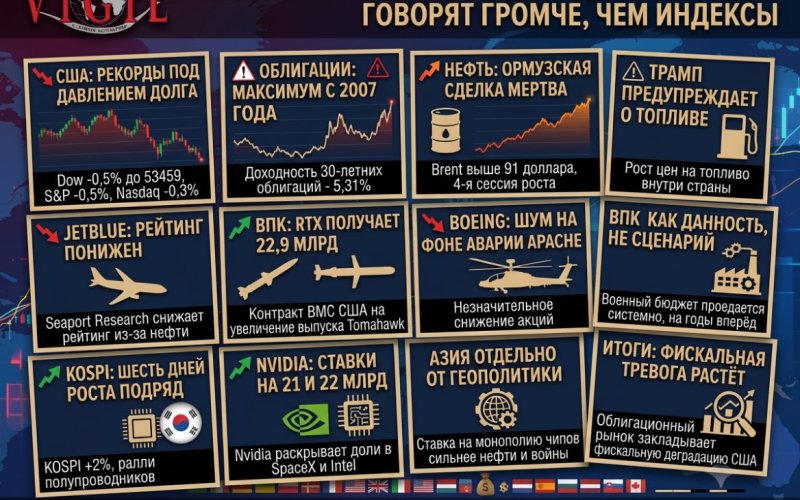
US Market: Losses Concentrate Exactly Where the Budget Hurts
On August 17, the Dow fell 0.5% to 53,459, the S&P 500 lost the same amount, and the Nasdaq slipped 0.3%, while the yield on 30-year bonds surged to 5.31%, the highest level since 2007. The direct takeaway: elites are less afraid of Iran than of America's own national debt and the avalanche of corporate borrowing tied to AI infrastructure projects. The stock market is holding at record highs only because investors still believe in Nvidia, while the bond market is already openly pricing in years of fiscal deterioration.
Oil: The
Geopolitical Digest by Mikhail Azhgirevich for August 17, 2026
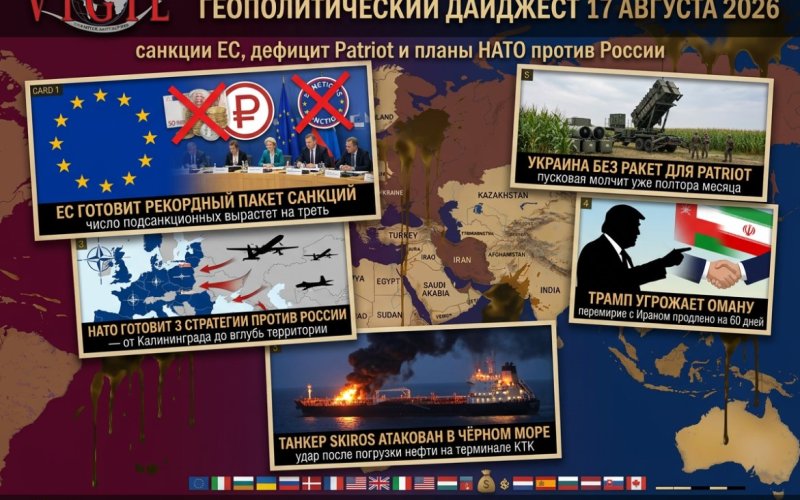
EU prepares its largest sanctions package against Russia since 2022
Kaja Kallas told Die Welt that by autumn the number of sanctioned Russians and companies could grow by roughly a third. Brussels is promising the most extensive tightening of the entire conflict.
Ukraine has nearly exhausted its Patriot interceptor missiles
CNN reports that one of the launchers has not fired for about six weeks — the shortage stems from a global deficit following the US and Israeli war with Iran. Without missiles, the system becomes useless scrap metal.
NATO has prepared three strategies for a potential war with Russia
According
Geopolitical Digest by Mikhail Azhgirevich for August 14, 2026
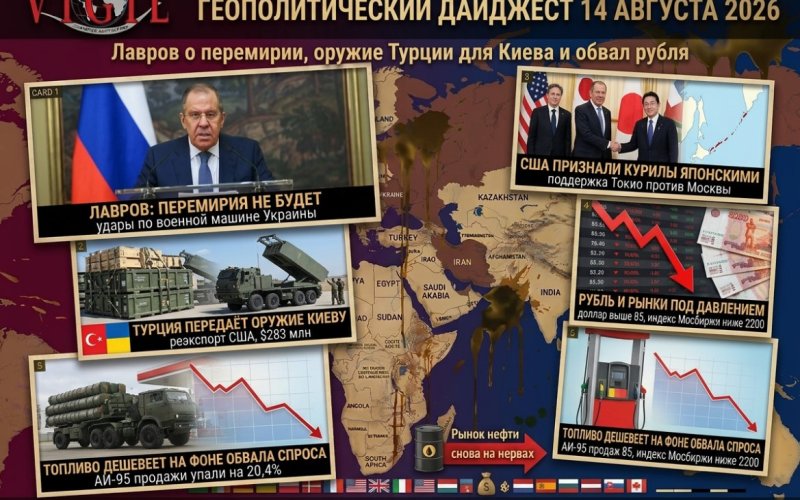
Russia/Ukraine: Lavrov says there will be no ceasefire in Ukraine
Russia's Foreign Minister announced a toughening of strikes on facilities that sustain Ukraine's "war machine" and rejected the idea of stopping at the current line of contact. The rhetoric points to further escalation rather than a freeze of the conflict.
Turkey/Ukraine: Turkey transfers to Ukraine its largest weapons shipment via US re-export
The package includes 70 ATACMS ballistic missiles, 12 M270 multiple rocket launcher systems, 2,524 M26 rockets, and 47,000 cluster munitions, worth approximately $283 million. Ankara is offloading outdated stockpiles, supplying Kyiv with one of the largest shipments since
WEEKLY LIES ROUNDUP: Mikhail Azhgirevich, August 10–14, 2026

"Hellish Sanctions": How the Graham Act Turned Pressure on Russia Into Trump's Bargaining Chip
The week of August 10–14, 2026 unfolded to the drumbeat of triumphant declarations about the "toughest sanctions in history" - the U.S. Senate passed a bill named after the late Lindsey Graham. The phrase "hellish sanctions" spread across headlines instantly. What remains is to determine who actually holds the keys to this hell.
The Fact - What Happened
The Senate approved the bill by a vote of 86 to 11. The legislation provides for tariffs of up to 100% on the five largest buyers of Russian
China News, August 12-14, 2026
Beijing Sends Fleet to Guard Its Tankers in the Middle East
China has announced the deployment of naval vessels to the Middle East to escort its own merchant ships, a direct response to growing risks in the Persian Gulf and the Strait of Hormuz. Here's how I see it: Beijing previously preferred to address energy security through diplomacy and long-term purchasing agreements, but is now shifting toward direct naval protection of its interests far from its own shores. This is a bid for status as a power ready to defend global supply chains by force rather than ask someone else
US News, August 12–14, 2026
Gilman's Release Could Restart Ukraine Talks
The release of American citizen Robert Gilman is being viewed as a potential catalyst for resuming dialogue between Washington and Moscow on a Ukraine settlement. Against this backdrop, the visit by Witkoff and Kushner to Moscow and Kyiv remains announced as taking place "within a week to ten days," though specific dates have still not been named. The humanitarian gesture is being used as a warm-up before difficult negotiations — classic diplomatic mechanics, in which a symbolic step precedes substantive talks.
Karoline Leavitt Steps Down as White House Press Secretary
Karoline Leavitt has announced
Geopolitical Digest by Mikhail Azhgirevich, August 13, 2026
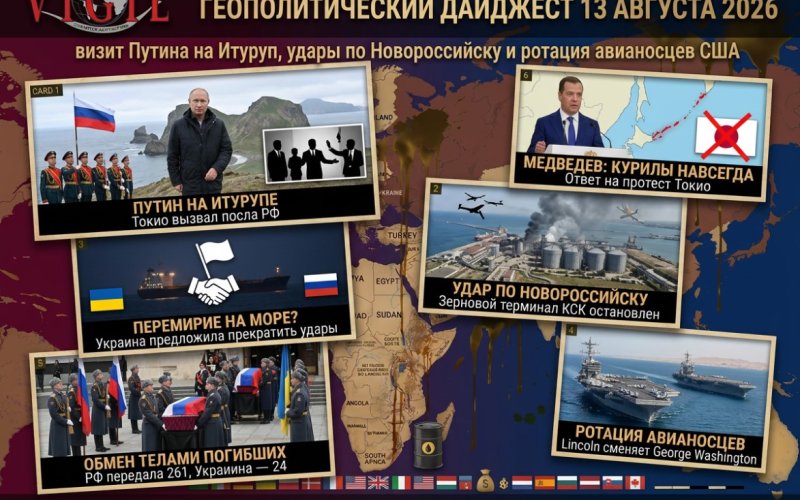
Russia–Japan: Putin makes first visit to Iturup, Japan summons Russian ambassador
Tokyo issued a "resolute protest," calling the visit incompatible with its stance on the "Northern Territories," while Medvedev responded by reaffirming that the Kuril Islands belong to Russia in perpetuity. The symbolic gesture predictably triggered a harsh reaction from Tokyo.
Russia grain: KSK grain terminal in Novorossiysk halts operations
The decision followed a drone attack overnight on August 12 — the third major terminal at the port to suspend operations. Russian grain exports through the key port are once again under threat.
Ukraine–Russia: Ukraine proposes mutual halt to strikes
Market Review by Mikhail Azhgirevich: August 11–13, Oil Is Screaming About War While AI Pretends Not to Hear
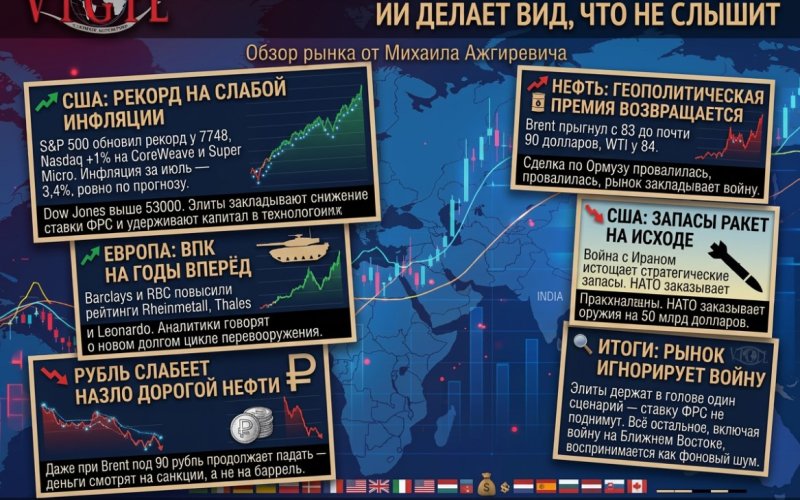
United States: The Market Buys Back Inflation, Ignoring the Oil Shock
On August 12, the S&P 500 set a new record at 7,748, the Nasdaq gained nearly 1% on earnings from CoreWeave and Super Micro, and July inflation came in exactly at forecast - 3.4% year-on-year - allowing the market to exhale. The direct conclusion: the elites are holding only one scenario in mind - the Fed will not raise rates - while everything else, including the war in the Middle East, is treated as background noise as long as it doesn't hit inflation directly.
Oil: The "Geopolitical Premium" Is
China News Digest: August 10–12, 2026
Beijing Warns Washington of Response to Anti-Russian Sanctions
Following the U.S. Senate's passage of a bill sponsored by Senator Graham, which grants the president the authority to impose 100 percent tariffs against the largest buyers of Russian oil, including China, India, and a number of other countries. The Chinese Embassy in Washington openly stated that Beijing "firmly opposes unilateral sanctions" and will take the necessary measures to protect its companies if the law takes effect. This looks to me like a moment of truth—the bill is currently stuck in the House of Representatives until September, but if it passes, we