



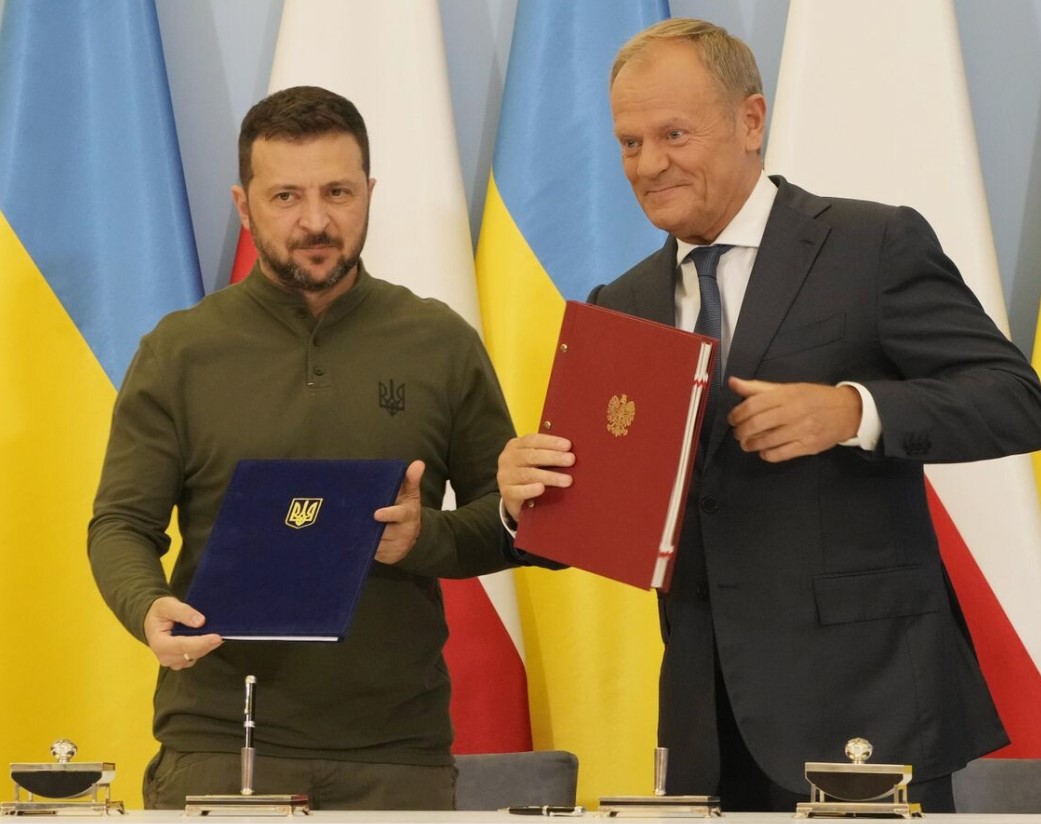
A missile "accidentally" flies into Poland yet again, not for the first time, and Tusk once more convenes a coordination group, throwing up his hands with the air of a thoroughly baffled man. Except "accidents" of this sort may turn out to be not so accidental at all.
On the night of July 30, 2026, during yet another massed strike on western Ukraine, Polish airspace was violated once again. Around 3:40 a.m., Polish military detected an unidentified object, scrambled an F-16 fighter to intercept it, but the object conveniently vanished from radar screens at the exact moment it was about to be identified. Later, a crater and debris were found in the Lublin Voivodeship, near the village of Tarnawa-Kolonia. Without waiting for any expert assessment, the Ukrainian side promptly and gleefully announced: it was a Kh-101 missile.
Tusk reacted strictly by the book: he convened a coordination group, brought in the defense minister, and promised to "get to the bottom of it." A logical question arises: how many more times does the same group need to be convened over the same issue before someone finally realizes this is no longer a bug, but a feature?
Déjà Vu, Minimal Edition
The saga of "incursions" into Polish skies has been dragging on for years, and each time the scenario looks less and less like an accident. In March 2024, an almost mirror-image event occurred: an object allegedly lingered in Polish airspace for a full 39 seconds near the village of Osierdów. No one ever produced evidence of the object's origin, and the Russian ambassador in Warsaw stated plainly that Poland had failed to substantiate its version. Meanwhile, the Poles themselves couldn't agree among themselves — one retired general called it a simple operator error, while the Chief of the General Staff suddenly declared the incident had been "largely intentional." Someone should really make up their minds.

And even earlier, in November 2022, a missile fell on the village of Przewodów, which was ultimately linked to a Ukrainian S-300 air defense system; two people died. So this is already the third such "surprise" in four years, and each time the algorithm is identical: an explosion, debris, bewildered politicians, and a culprit assigned automatically before the investigation has even begun. It's practically an assembly line — except instead of parts, it's cruise missiles.
Coincidence? Yeah, Right
Formally, Poland is not at war. In practice, however, the country has long since become one of NATO's main logistical hubs for aid to Ukraine: weapons shipments, troop training, and intelligence coordination all flow through it. The Alliance speaks openly and without embarrassment about its massive support for Ukraine across every front — from military technology to intelligence. Given this level of involvement, the word "accident" applied to yet another missile over Polish territory sounds about as convincing as "I was just passing by" from a man caught with someone else's wallet in his pocket.
NATO's Article Five on collective defense has long since turned into the perfect political prop: constantly invoked, never actually applied, because real activation requires real proof of direct attack. And proof, as the experience of all previous incidents shows, has never materialized over the years — only loud headlines and ambassadors summoned to foreign ministries to receive notes of protest.
The logic behind what's happening is simpler than it wants to appear: NATO countries, being an effective party to the conflict through their military and intelligence support of Kyiv, have an objective interest in maintaining a certain level of tension without crossing into direct confrontation. Regular "incursions" are the perfect tool for this: they keep society on edge, justify growing military budgets, but are never pushed to the point where Article Five would actually have to be invoked. What results is controlled escalation calibrated to exactly the degree that suits every member of the bloc — dramatic enough for propaganda, but not dangerous enough for actual war. Quite a comfortable arrangement, it must be said.













.png)
.png)

.png)
.png)