

US: Worst Week in More Than a Year
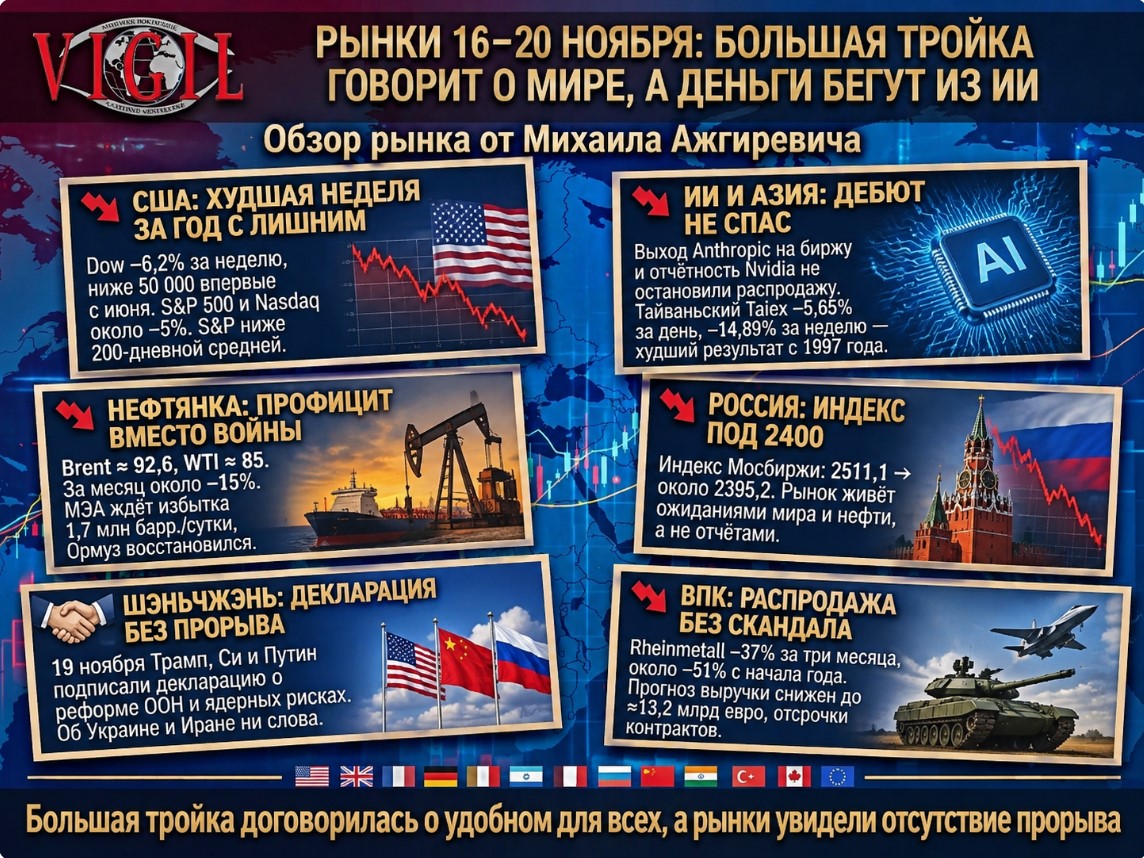
By Thursday's close, the Dow had lost 6.2% since Monday and finished below 50,000 for the first time since June. The S&P 500 and Nasdaq each fell about 5%, the steepest weekly decline in more than a year. The S&P slid for six straight sessions and dipped below its 200-day moving average for the first time since April.
Takeaway: the market is punishing investors not for bad news but for a dream that grew too expensive. The elite are locking in profits on AI, while everyone else still believes in "eternal growth."
AI and Asia: A Loud Debut Didn't Help
Anthropic's blockbuster stock market debut and Nvidia's "solid" earnings failed to halt the selloff. Investors are worried about enormous data-center spending, the need for fresh financing and political pressure. Taiwan's Taiex dropped 5.65% on Friday and 14.89% over the week, its worst result since October 1997.
Takeaway: money no longer believes in endless investment in hardware, and it is looking for shelter far from Taiwan.
Oil: The Market Bets on Surplus, Not War
Brent settled on Wednesday at $91.95 and WTI at $83.26, the lowest levels since August 26. Overnight into Friday, Brent traded around $92.6 and WTI around $85. Oil has shed about 15% over the month, and Brent slipped from $95.84 to roughly $92.6 over the week.
US inventories rose by 3.4 million barrels, and the IEA expects a supply surplus of 1.7 million barrels per day. Flows through Hormuz have returned to roughly prewar levels. Attacks on tankers and Ukrainian strikes on Russian energy infrastructure are, for now, the only things keeping prices from collapsing.
Takeaway: Hormuz is no longer the main risk. The glut is. Importers win, and Russia loses revenue.
Russia: The Index Slips Below 2,400
A week earlier, the MOEX index closed at 2,511.1. On Friday at 10:15 Moscow time it was trading near 2,395.2 (down 0.93%), and at the open on November 19 it was already down 0.17%. The previous week had been propped up by hopes of negotiations and by oil. Now oil is getting cheaper, and hopes for peace have not materialized.
Takeaway: the Russian market lives on expectations, not on earnings reports.
Shenzhen: A "Peace Declaration" Without Peace
On November 19, Trump, Xi and Putin met as a trio for the first time and signed a declaration on UN reform, increased output of petroleum products and dialogue on nuclear risks. The document says nothing about Ukraine or Iran. Peskov said Ukraine was not the main topic, and Putin invited Europeans to come to Moscow. US envoys said Russia is "comfortable" with NATO-like security guarantees for Ukraine.
Takeaway: the Big Three agreed on what suits all three of them, and markets read it correctly, as no breakthrough.
Defense: A Selloff Without a Scandal
Rheinmetall has lost more than 37% in three months and about 51% since the start of the year. The cause is a cut to its 2026 revenue forecast, to about €13.2 billion, along with contract delays. It is not a collapse in demand. Its valuation has compressed to about 17 times annual earnings.
Tikehau analysts describe this as a normalization of valuations after excessive optimism. Baader singles out Rheinmetall, Dassault and Thales.
Takeaway: investors will no longer pay for promised orders. They want signed contracts, and with peace signals, the conflict premium is melting away.