


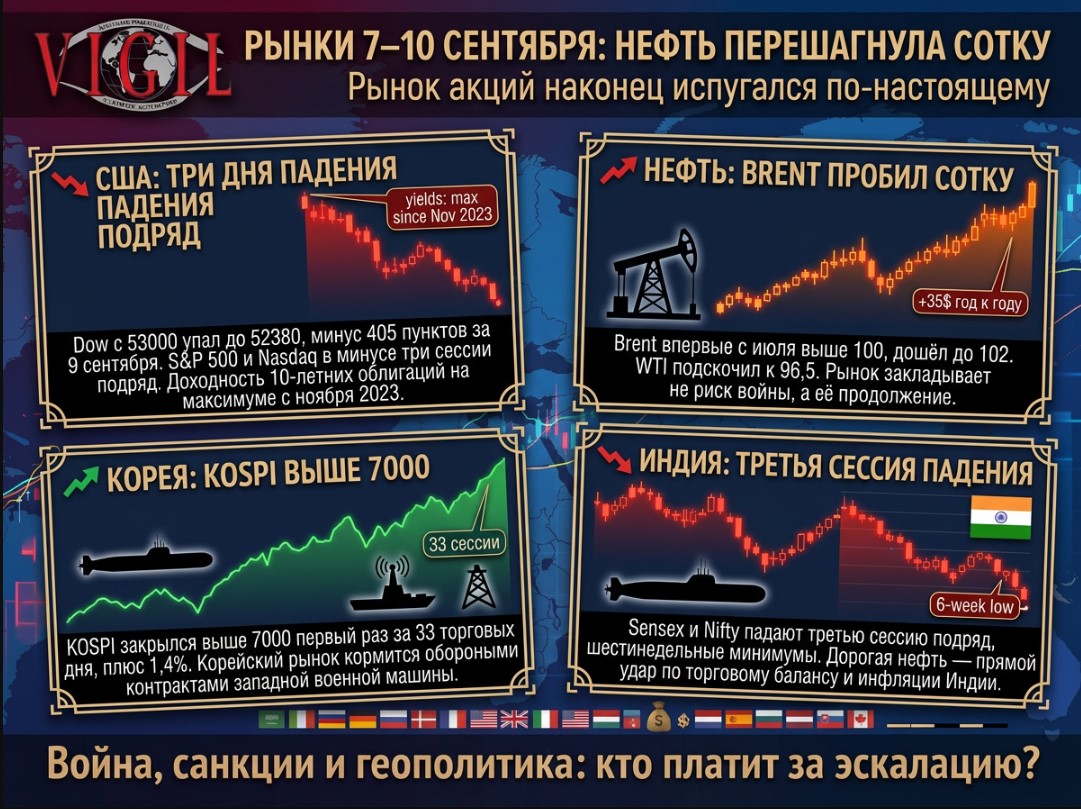
United States: three straight days of decline is not a correction, it is a repricing of risk
From September 7 to 10, the Dow slid from above 53,000 to 52,380, losing 405 points in a single day on September 9. The S&P 500 and Nasdaq moved in sync into negative territory across all three sessions, while the yield on 10-year Treasury bonds surged to its highest level since November 2023. The direct conclusion: the elites no longer treat the Iran-U.S. war as background noise. Three consecutive days of synchronized stock declines and rising yields mean that big capital is simultaneously pricing in both a war premium and an inflationary shock, and that is a combination the market fears more than either factor on its own.
Oil: the hundred-dollar mark is a psychological breakout, not a technical figure
Brent broke through 100 dollars for the first time since July and climbed to 102, while WTI jumped to 96.5, a rise of nearly 35 dollars year over year. This is a direct and blunt signal: the oil market has definitively buried the scenario of an imminent truce. The elites in the commodities sector are trading not the risk of war, but its continuation as a baseline fact for the coming months, and triple-digit oil prices represent their collective vote of no confidence in any negotiating statements coming out of Washington and Tehran.
Defense industry and Korea: KOSPI breaks 7,000 for the first time in 33 sessions precisely amid the war
South Korea's KOSPI closed above 7,000 for the first time in 33 trading sessions, gaining 1.4 percent, while American indexes were falling on that very same news of rising oil prices. The direct connection is obvious and cynical: the Korean market has historically fed on defense and technology contracts that service the Western military machine, so the worse the mood in Washington, the more confident Seoul feels. Money is openly voting for those who supply weapons and components, not for those who use them.

India: a third straight session of decline as a mirror of global nerves
India's Sensex and Nifty fell for three consecutive sessions, hitting six-week lows, precisely on news of oil's race toward 100 dollars. This means Indian elites perceive expensive oil not as someone else's problem in the Middle East, but as a direct blow to their own trade balance and inflation. The panic here is not speculative but fundamental.










.png)
.png)

.png)
.png)