


US Markets: The Market Falls Politely, Because It's Already Used to It
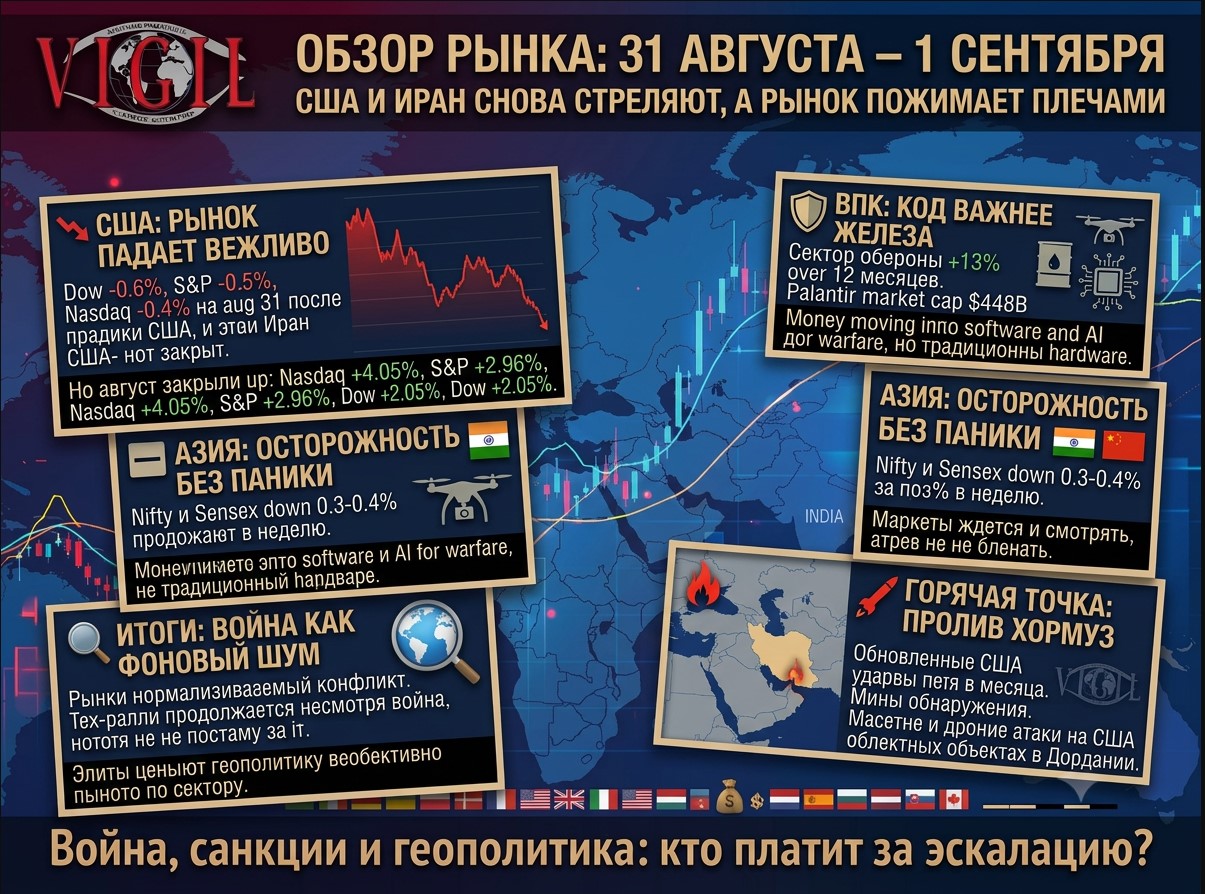
On August 31, the Dow lost 0.6%, the S&P 500 slipped 0.5%, and the Nasdaq fell 0.4% after the United States and Iran exchanged real strikes for the first time in a month. Yet the indices are closing out August firmly in the green: the Nasdaq is up 4.05%, the S&P 2.96%, and the Dow 2.05% for the month. The direct takeaway is this: the elites stopped seeing another exchange of strikes as a reason to panic long ago. Combat operations have become background noise for a market that keeps climbing on the strength of technology despite the war, not because of it. This is the real indicator that the conflict has been normalized in the minds of big capital.
Oil: The One Sector That Reacts Honestly to Gunfire
Amid the broader market decline, energy was the only sector of the S&P 500 in positive territory on August 31, while Brent climbed to 91.3 dollars by September 1 and WTI rose nearly 2.6% to 88 dollars. The connection is direct: while stocks pretend the war is a statistical rounding error, oil trades in real time against actual missile strikes. This confirms that the elites who control capital in commodities have no doubt about the protracted nature of the conflict, unlike those driving the tech index higher.
Defense Industry: The Weapons Market Trades Separately From the Fear Market
The US defense sector has risen 13% as a group over the past 12 months, and Palantir has pushed its market capitalization to 448 billion dollars, a sign that money is flowing not into classic hardware but into software and AI for warfare. The direct conclusion: the elites are betting not on the number of missiles but on who teaches the algorithms to fight more effectively first. This is a fundamentally new stage in the arms race, one where the key asset is not a factory but code.

Asia and Emerging Markets: Caution Without Panic
India's Nifty and Sensex lost about 0.3–0.4% over the week amid global rates and geopolitics, but without any sharp moves. The market there is simply waiting to see how the situation develops rather than running from it. This means that outside the United States, the elites are holding a neutral position, preferring to watch which way the US-Iran conflict rolls before making any sharp bets in either direction.









.png)
.png)

.png)
.png)