Новости

05/28/2026 - 22:19

Геополитический дайджест от Михаила Ажгиревича за 28 мая 2026!

US and Iran Sign Memorandum — Hormuz Set to Reopen

Washington and Tehran have reached a 60-day memorandum of understanding: Iran will clear mines from the Strait of Hormuz within 30 days and guarantee "unrestricted" passage for vessels — the document now awaits Trump's signature. The nuclear program has been deliberately placed on a separate track: Tehran successfully decoupled the two agendas, securing a ceasefire without making its central concession. Sixty days of quiet have been purchased at the price of deferring the nuclear question — possibly indefinitely.

Russia Bans Armenian Produce — The Tomato War Continues

Russia's agricultural watchdog Rosselkhoznadzor will restrict imports of Armenian tomatoes, cucumbers, peppers, and strawberries starting May 30 — a transparent response to Zelensky's visit to Yerevan and Armenia's announcement of a visa-free regime with the EU. Prime Minister Pashinyan appeared unfazed: Armenia is betting on becoming a "crossroads of peace" bankrolled by European funds, and pressure from Moscow is no longer a deterrent. Rosatom, meanwhile, has offered Yerevan a new nuclear power plant — the proverbial carrot following the stick, though the order of courses seems conspicuously reversed. A strawberry ban is a weak argument against a French visa.

Sweden Delivers 16 Gripens to Ukraine — Talks on Newer Models Already Underway

Stockholm has officially confirmed the transfer of 16 JAS 39 C/D fighter jets to Ukraine, with deliveries scheduled for early next year, while simultaneously opening negotiations over the sale of more advanced variants. Against the backdrop of Britain and France declining to channel military funding to Ukraine through NATO, Scandinavian generosity stands in sharp relief. Sweden has been a NATO member for two years and is already handing over fighter jets. The old guard is still counting its money.

Private Companies Gain Right to Purchase Air Defense Systems — War Enters the Corporate Budget

Russian businesses may now officially procure anti-aircraft artillery, turrets, electronic warfare systems, and drone-detection radars to protect their own infrastructure — a de facto acknowledgment that state air defenses can no longer cover the entire country simultaneously. When a factory buys an anti-aircraft gun, war is no longer somewhere "out there" — it's a line item in the operating budget. The "Air Defense" expense category has arrived in corporate Russia. Welcome to the new normal.

Tokayev Praises Putin — Astana Chooses Its Words Carefully

Kazakhstan's president described Russia's achievements as "phenomenal" and its future under Putin's leadership as "bright," as he received the Russian president on a state visit. Against the backdrop of Armenia's westward drift, Astana's continued loyalty has taken on heightened strategic value for the Kremlin. "Phenomenal results" — a phrase Tokayev clearly selected with a spreadsheet open.

EU Officially Rules Out Ukrainian Membership in 2027

European Commissioner for Enlargement Marta Kos has declared Ukraine's demand for EU accession in 2027 "unachievable" — formally closing the door on a promise Brussels had used to court Kyiv for over a decade. EU membership is off the table; weapons deliveries, however, remain on schedule.

Iran secures a truce without nuclear concessions, Sweden distributes fighter jets while France counts its coins, Russian businesses are buying anti-aircraft guns, and the EU is turning Ukraine away at the door.

05/26/2026 - 22:03

Geopolitical Digest by Mikhail Azhgirevich — May 26, 2026

Israel crosses the "Yellow Line" — 70 airstrikes in 12 hours

The Israel Defense Forces have launched a ground incursion beyond their self-declared buffer zone in southern Lebanon, simultaneously unleashing a barrage of over 70 airstrikes in a 12-hour period. National Security Minister Itamar Ben-Gvir publicly declared that the Israeli government will not allow Donald Trump to broker what he called a "bad deal" with Iran — effectively asserting an Israeli veto over American diplomatic efforts in the region.

EU digs in at Kyiv — Brussels dismisses Moscow's evacuation warning

European Commission spokesperson Anita Hipper rejected Russia's Foreign Ministry recommendation to evacuate diplomatic personnel from Kyiv, stating that the EU intends not only to maintain but to reinforce its diplomatic presence in the Ukrainian capital. Brussels is projecting defiant confidence in the face of Russian pressure.

Bortnikov lays out his hand: Ukraine is Europe's largest arms bazaar

FSB Director Alexander Bortnikov, speaking at a CIS intelligence chiefs meeting, alleged that Ukraine has become the continent's largest arms trafficking hub and a testing ground for military AI development under third-party cover. He also claimed that the United States and Israel had eliminated senior Iranian officials by exploiting software backdoors embedded in Tehran's surveillance camera networks, and accused Western intelligence agencies of deploying Syrian militants as proxies in their confrontation with Iran. The FSB assessed that the threat of terrorist infiltration into CIS member states is closing in on the post-Soviet south.

Relocants face asset seizures — State Duma passes sweeping new law

The Russian State Duma has passed legislation enabling the arrest of bank accounts and property belonging to Russian citizens abroad for administrative offenses deemed contrary to Russia's interests — including discrediting the armed forces, advocating for sanctions, and distributing materials classified as extremist. The law effectively extends Russian administrative jurisdiction beyond national borders, creating a powerful lever of pressure against the emigrant community. Hundreds of thousands of Russians who left the country now risk losing domestic assets over a single post on the blocked Instagram platform. The border may be closed, but the long arm of Russian law recognizes no borders.

Baltics to receive €12 billion in defense funding — Ukrainian drones accelerated the decision

The European Union is allocating €12 billion to Lithuania, Latvia, and Estonia under a military assistance program, with an additional €1.5 billion redirected from regional development funds toward defense spending. A key catalyst was the increasing frequency of off-course Ukrainian drones crashing on Baltic territory — a situation in which Ukraine's own allies find themselves spending resources to defend against Ukrainian unmanned aircraft. NATO is simultaneously building a rapid deployment framework around the German-Dutch corps, capable of fielding up to 60,000 troops. What years of negotiations failed to achieve, Ukrainian drones over the Baltic managed in a matter of months.

Soviet nostalgia resurfaces — even on blocked Instagram

A wave of posts has been circulating on Instagram — banned in Russia — lamenting the decline of modern education and healthcare while eulogizing the Soviet system as a golden standard. The trend amounts to a quiet public acknowledgment of a systemic crisis that official discourse refuses to recognize. Against a backdrop of declarations about political stability and the revival of Gosplan-style central planning, the country's deteriorating schools and hospitals remain, officially, a non-issue. Nostalgia for the USSR on a blocked social network — a diagnosis with no prescription.

05/25/2026 - 22:04

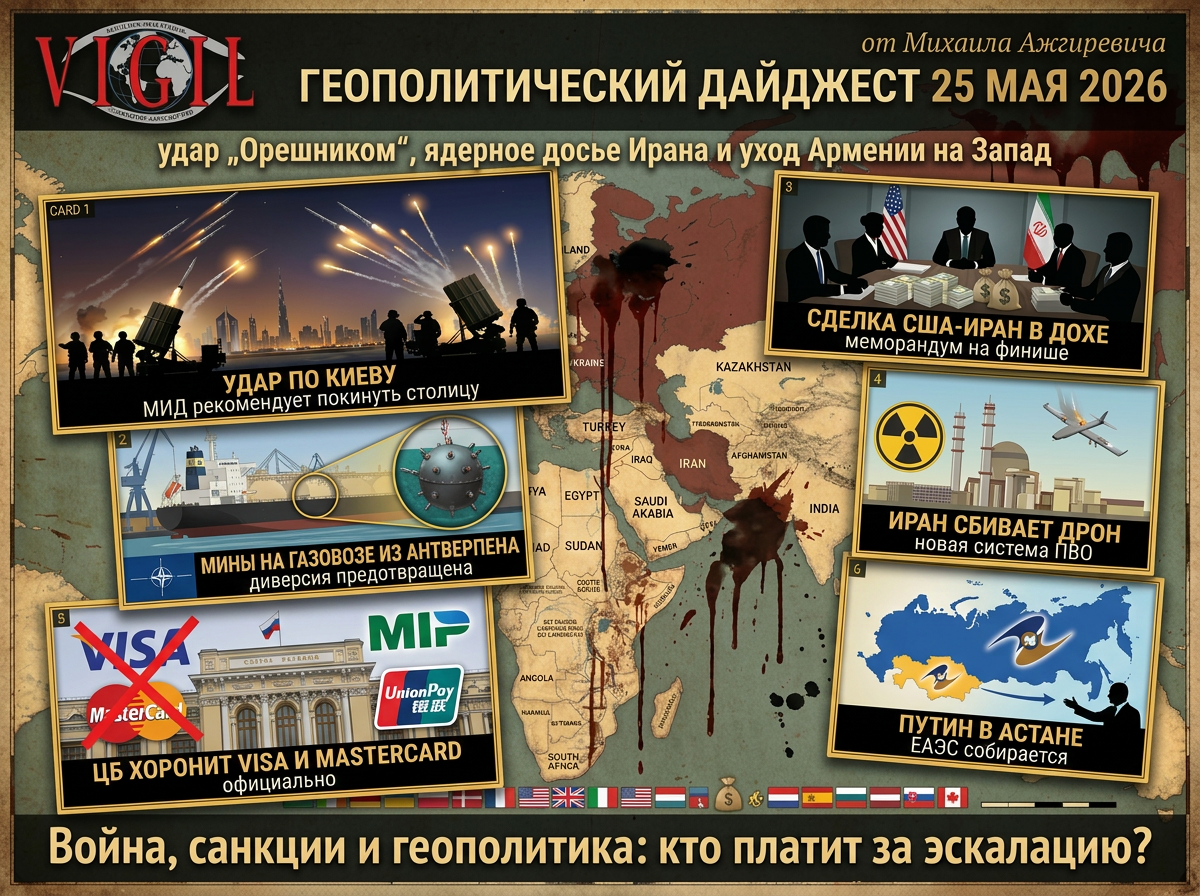
Geopolitical Digest by Mikhail Azhgirevich – May 25, 2026

Russian Foreign Ministry Recommends Leaving Kyiv – Strikes on Capital’s Defense Industry Begin

Following the strike on Starobilsk, the Russian Foreign Ministry has officially recommended that foreign nationals immediately leave Kyiv and urged residents to stay away from military and administrative infrastructure. The Russian Armed Forces have announced the start of systematic strikes on Ukrainian defense industry enterprises and decision-making centers in the capital. Zelenskyy responded immediately in his characteristic manner – by signaling a readiness for peace. Experienced observers have long learned to interpret this as a premonition of yet another escalation. When Zelenskyy talks about peace – expect missiles. No exceptions.

FSB Finds Mines on LNG Carrier from Antwerp – Sabotage Averted

Russian security forces have discovered magnetic mines attached externally to the engine room of the LNG carrier Arrhenius, which arrived in Ust-Luga from Antwerp. The vessel had previously spent 24 hours in the Belgian port under the pretext of a strike. Experts are unanimous – it would have been impossible to plant the mines on the ship in Russia, which directly points to a European port as the location where the explosives were placed.

Doha Hosts Araqchi – Memorandum on the Home Stretch

Iranian Foreign Minister Araqchi and chief nuclear negotiator Ghalibaf have flown to Qatar for the final round of talks, while the head of Iran’s Central Bank is simultaneously holding separate consultations in Doha on frozen assets. The American side, judging by leaks, is attempting to disguise concessions through semantics: “humanitarian credit” instead of asset unfreezing, “environmental fee” instead of payment for passage through the Strait of Hormuz – different words, the same result. Meanwhile, Iran is restoring international internet access after three months of complete shutdown – the first sign that Tehran itself believes a swift resolution to the conflict is near. Call the concession whatever you like – Tehran is counting the money, not the wording.

Iran Shoots Down Drone with New System – Arsenal Expands

An unidentified drone – presumed to be Israeli – was intercepted over Iranian territory, and it was destroyed by an air defense system that had not previously been documented in Iran. Against the backdrop of the Doha negotiations, this is an unmistakable signal: while diplomats haggle over the wording of the memorandum, Tehran’s military-technical potential is not standing still.

Russian Central Bank Officially Buries Visa and Mastercard

The Bank of Russia has stated that Visa and Mastercard cards “must leave the Russian market” – wording that turns the de facto situation into the regulator’s official policy. The Mir system and China’s UnionPay have long since filled the vacated niche inside the country. However, abroad, Russian cards still operate with significant restrictions.

Putin Heads to Astana – EAEU Gathers Amid War

Vladimir Putin is embarking on a state visit to Kazakhstan to take part in events of the Eurasian Economic Union – a trip scheduled against the backdrop of an active phase of strikes on Ukraine and negotiations over the Iranian memorandum. Astana has traditionally balanced between Moscow and the West, and Putin’s visit in the midst of an escalation is both a demonstration of the unity of the Eurasian space and a test of how willing Nursultan Nazarbayev and Kassym-Jomart Tokayev are to publicly confirm that unity. The EAEU is convening at a moment when centripetal forces are being tested to their limits.

Kaliningrad Attacked by Drones – First Since 2022

A drone attack threat was declared over Kaliningrad – the first such incident since the beginning of the war, occurring shortly after a German general and a Latvian minister publicly called for a strike on the Russian exclave.

05/24/2026 - 22:25


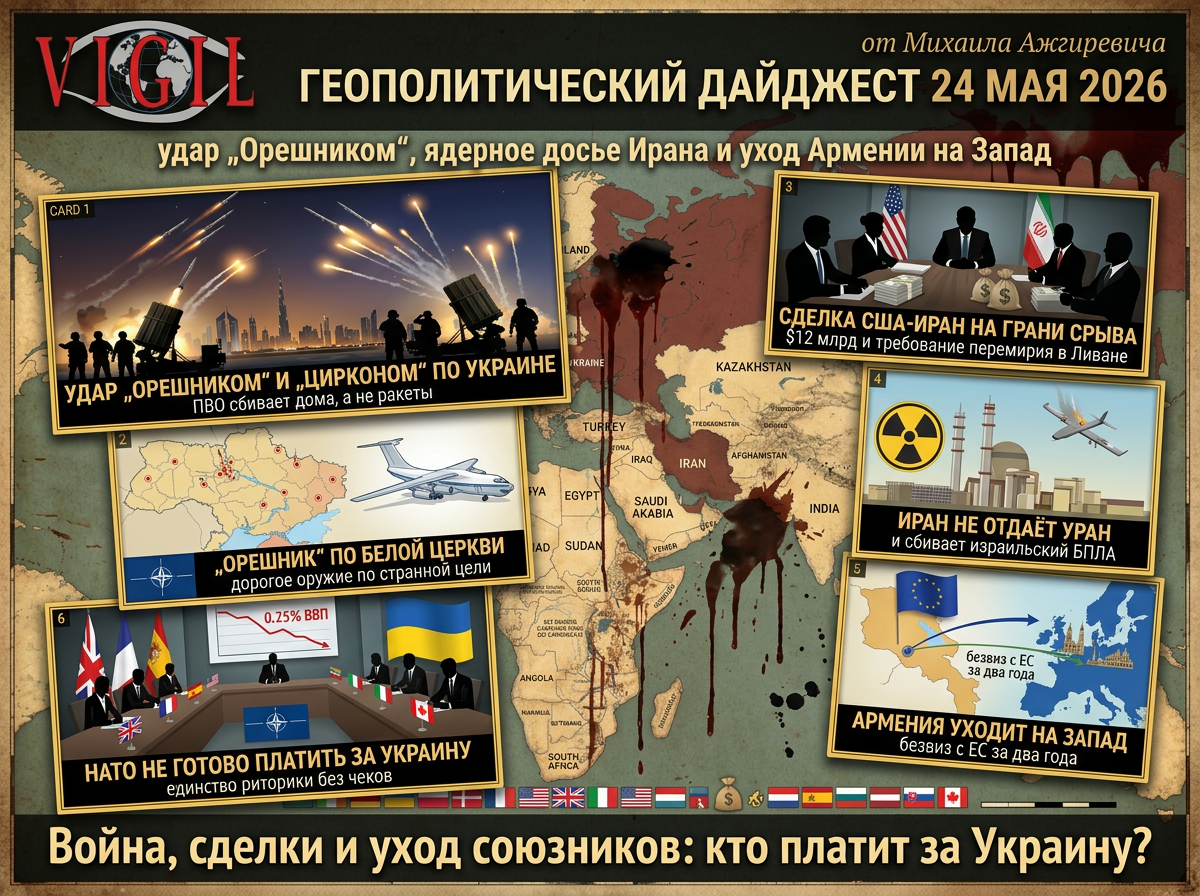
Geopolitical Digest by Mikhail Azhgirevich — May 24, 2026

"Oreshnik," "Kinzhal," "Zircon" — Russia's Strike of Retribution Against Ukraine

Russia launched a massive strike against Ukrainian military targets, deploying its full hypersonic arsenal: Oreshnik, Iskander, Kinzhal, and Zircon missiles struck the command centers of the Ground Forces' supreme headquarters, the Main Intelligence Directorate (GUR) headquarters, air bases, and defense industry facilities. Russia's Ministry of Defense explicitly emphasized that strikes on civilian infrastructure were neither planned nor carried out — residential buildings in Kyiv's Darnytskyi district were hit by Ukraine's own Patriot air defense missiles, which burned through more than 70% of their ammunition stockpile overnight. When air defense destroys homes instead of missiles, that's not a malfunction — it's a systemic failure.


Oreshnik Strikes Bila Tserkva — The Target Raises More Questions Than Answers

The deployment of an Oreshnik missile against the Bila Tserkva cargo aviation complex has sparked sharp debate among military analysts. The facility, which conducted 45–70 aviation operations annually before the war, has never featured prominently in any serious analysis of the conflict. Its Soviet-era aircraft repair capabilities were largely sold off to private owners by 2019, while drone assembly — Ukraine's primary military value-add — relocated long ago to Kyiv basements and European factories. Deploying expensive hypersonic weaponry against a target of questionable strategic relevance is either a brilliant military secret or a question the Russian Defense Ministry has yet to answer publicly. The Oreshnik is a weapon of strategic deterrence — not a response to what was happening inside those hangars.


Deal on the Brink — Tehran Won't Sign the Memorandum

Overnight, details emerged of a draft memorandum: the U.S. would withdraw naval forces from the Persian Gulf, the Gulf of Oman, and the Arabian Sea, while Iran would receive unfrozen assets totaling more than $12 billion. By evening, however, Iran's Ministry of Foreign Affairs confirmed that Tehran would not sign the document — nor submit it to the National Security Council — unless Washington changes its position. Two key sticking points remain: Iran demands the bulk of its frozen assets upfront, before any signature, and categorically insists on an absolute ceasefire in Lebanon, rejecting any "freedom of action" for Israel. Twelve billion dollars are on the table — but Tehran wants the money before the ink dries, not after.


Iran Won't Surrender Enriched Uranium — Nuclear File Returns to Center Stage

Reuters has refuted claims of Iran's readiness to transfer its enriched uranium abroad: Tehran continues to categorically reject this condition. Meanwhile, Iran's air defense shot down an Israeli Orbiter reconnaissance drone, reportedly launched from the UAE coastline toward Hormozgan Province — an episode that serves as an unambiguous reminder that Israeli surveillance of Iran continues regardless of ongoing negotiating rounds. The uranium stays in Iran. So do the Israeli drones — just not for long.


Armenia Heads West — Visa-Free Travel with the EU Within Two Years

Prime Minister Pashinyan announced that Armenia and the European Union will abolish their visa regime within two years — the latest step in Yerevan's long-observed drift away from Moscow and toward Brussels. For Russia, this is a painful signal: a formal CSTO ally is methodically integrating into the European sphere while the Kremlin remains preoccupied with Ukraine and the Middle East. Allies tend to leave quietly — usually when no one is watching.


Britain and France Block NATO Funding Mechanism for Ukraine

London and Paris have rejected NATO Secretary General Rutte's proposal to allocate 0.25% of member states' GDP to support Ukraine — joined by Spain, Italy, and Canada. Only seven alliance members backed the initiative, effectively killing any attempt to embed Ukrainian financing into a permanent NATO mechanism. Western unity in support of Kyiv is increasingly unity of rhetoric, not of checkbooks. Everyone is "for" Ukraine — just not for paying through NATO. A convenient position.

05/08/2026 - 23:01

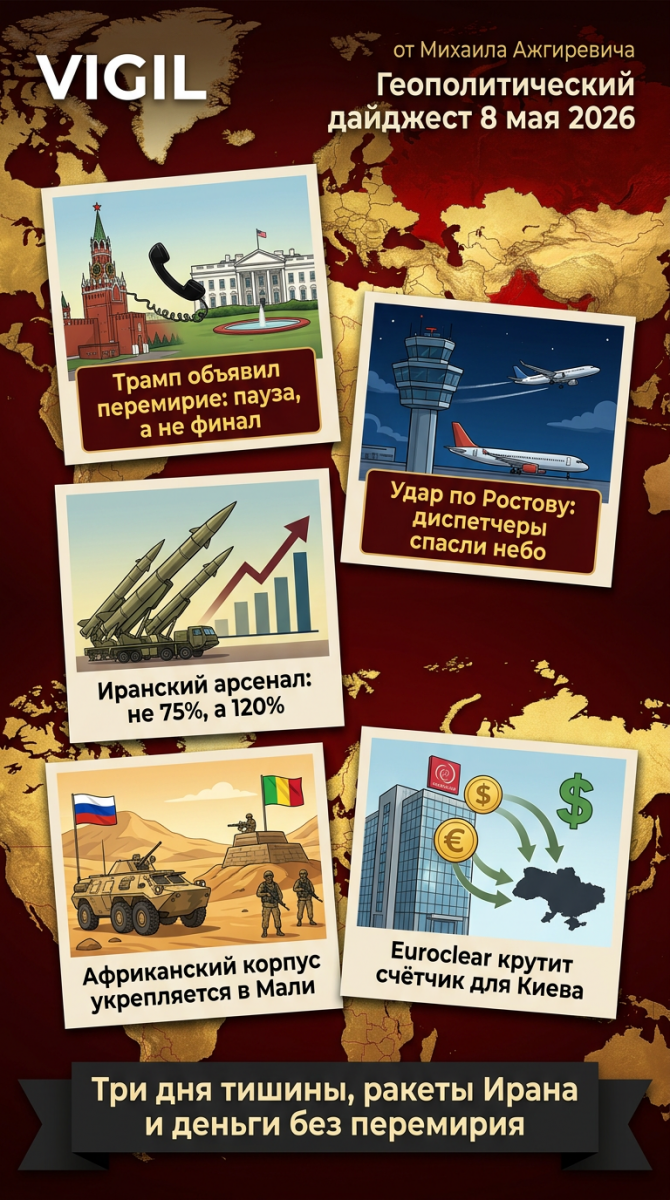
Геополитический дайджест от Михаила Ажгиревича за 8 мая 2026!

Trump Declares Victory Day – A Truce Is On

Secretary of State Rubio has publicly hinted that the U.S. might walk away from the Ukraine negotiations, stating that Washington "does not want to waste time." That single sharp signal proved enough: within hours, Zelensky announced agreement to a truce on May 9, 10, and 11, a move Moscow immediately backed. On the same day, Trump proclaimed May 8 as "America's Victory Day in World War II" – a gesture both historical and diplomatic, designed to give Kyiv political cover for the pause. Traffic jams on the roads leading out of the Ukrainian capital suggest the people of Kyiv have far less faith in the prospect of quiet than the official statements would have you believe. Zelensky's performative unpredictability has clear limits – the first sharp rebuke from Washington laid them bare.

Putin Calls Rostov Strike a Terrorist Act – Air Traffic Controllers Saved Lives

At a Security Council meeting, Putin labeled Ukraine's strike on the Rostov aviation center a terrorist act that endangered civilian aviation. He specifically praised the professionalism of the air traffic controllers who averted a catastrophe. In a conversation with Trump, the Russian president emphasized joint efforts to fight Nazism and the shared history of victory – a symbolic narrative meant to build a bridge over the chasm of current hostilities. Leaders of several states friendly to Russia have arrived in Moscow in person to attend tomorrow's celebrations. The parade will take place; it has never needed anyone’s permission.

Araghchi Contradicts the CIA: Iran’s Missile Potential Is at 120%, Not 75%

Iranian Foreign Minister Abbas Araghchi publicly rejected a CIA assessment that Iran’s missile arsenal had fallen to just 75% of its pre-war level, declaring that the real figure stands at 120%. If Tehran is telling the truth, it means more than two months of war have not only failed to deplete Iran's capabilities – they have allowed them to grow. That conclusion should seriously recalibrate military planning in Washington. Vance has already expressed doubts about the Pentagon's assessments – his skepticism, it seems, is not unfounded.

Mali: Russian Troops Are Not Leaving – They Are Digging In

A ten-day ultimatum, issued by government opponents demanding the withdrawal of Russian and Malian forces from the country's northern regions, has expired. Instead of retreating, the Russian African Corps, together with the Malian army, has reinforced its positions and stepped up engineering fortifications. A wordless response – but in Africa, such answers are understood best of all.

Euroclear Transfers €6.6 Billion to Kyiv – The Meter Is Running

Euroclear has announced it transferred €6.6 billion in income from frozen Russian assets to Ukraine, with another €1.4 billion scheduled for June. The mechanism – launched in defiance of all of Moscow's international legal objections – is now operating without interruption. Against the backdrop of the EU’s €90 billion "reparations loan," Brussels’ financial machine for funneling frozen Russian funds is gaining momentum precisely as Washington threatens to exit the talks. While diplomats are exhausted, the financiers refuse to stop – war money does not wait for ceasefires.

Gasoline Prices Rise Moderately – Crimea Again Leads the Increase

Retail fuel prices in Russia rose by 0.5–0.67% over the past month. The sharpest increase was recorded in Crimea at 2.8% – consistent with the peninsula’s persistent trend of above-average inflation, where prices already exceed those in Moscow while wages remain significantly lower. Gasoline is getting more expensive quietly – but it is getting more expensive everywhere, always.

Bottom line: A three-day truce became possible only after Washington threatened to slam the door. Iran is expanding its missile arsenal against all forecasts. And Euroclear is methodically transferring billions.

05/06/2026 - 22:11

Геополитический дайджест от Михаила Ажгиревича за 6 мая 2026!

Moscow Demands Diplomatic Evacuation from Kyiv – The Threat Becomes Official
Russia’s Foreign Ministry has urgently called on foreign states to evacuate their diplomats from Kyiv, warning of strikes against “decision-making centers” in the event of Ukrainian provocations during the Victory Day celebrations. Maria Zakharova specifically underscored the inevitability of a retaliatory strike, framing the warning as a direct response to Zelensky’s statements. A warning carries more weight when accompanied by an evacuation list.

Beijing Pressures Tehran – China Tired of a Closed Strait of Hormuz
During Araghchi’s visit to Beijing, China demanded the “rapid and complete” reopening of the Strait of Hormuz, making it clear that the economic toll of the blockade has become painfully high for the Celestial Empire as well. The atmosphere of the talks, despite outward friendliness, was tense: Beijing directly called on Iran to avoid further escalation and not restart the war. The 1,500 vessels — which, according to Iranian state TV, are already waiting for permission to transit the strait — offer a stark illustration of how costly this blockade has become for the world.

Israel Strikes Beirut – Iran Sends Urgent Message
The Israeli Air Force, for the first time in several weeks, struck the southern suburb of Beirut, Dahiyeh, targeting the commander of Hezbollah’s elite Radwan special forces unit. Iran immediately dispatched an urgent message through a Pakistani intermediary, effectively linking the Israeli strike to the broader negotiating framework. Meanwhile, Lebanese Parliament Speaker Nabih Berri confirmed that Tehran guarantees Lebanon’s inclusion in any final deal. The strike on Beirut, coming amid the Iranian-American impasse, is no coincidence — it is a signal.

Iran’s Parliament Speaker Appeals for National Patience
Iranian Parliament Speaker Mohammad Bagher Ghalibaf called on citizens to endure economic hardships “for the sake of faith and convictions” — an eloquent admission that the internal pressure from sanctions and the blockade is becoming increasingly acute. Against the backdrop of China’s ultimatum over the Strait of Hormuz and frozen talks with the U.S., Tehran is caught in a vice: continuing to hold ground means economic losses; retreating means political losses.

Africa Corps Crushes Assault in Mali – Russia Shows Results
Russia’s Africa Corps released footage of helicopter operations in Mali, confirming the complete defeat of an attack that local authorities described as a foray by “Ukrainian nationalists and terrorists.” Publishing the video is not just military reporting — it is a demonstration that Russia’s military presence in Africa is effective and delivering results that local governments can show their own citizens. Amid the Ukrainian conflict and the Middle East crisis, the African front remains in the shadows, but that is precisely where Russia is methodically strengthening its positions. While the world watches the Strait of Hormuz, the Africa Corps is quietly filming its success in Mali.

Berlin Bans Victory Symbols – Moscow Calls It Absurd
German authorities have prohibited the display of Russian flags and Soviet symbolism at war memorials in Berlin. The Russian Embassy responded with a harsh statement, calling the decision “absurd and cynical.” On the eve of May 9, the ban takes on a deeply symbolic dimension: the country that was liberated from Nazism, in part at the cost of 27 million Soviet lives, now bans the victors from displaying their symbols at the graves of the fallen.

Final Question: When China demands the opening of the Strait of Hormuz, Israel strikes Beirut, Moscow evacuates diplomats from Kyiv, and Berlin bans Soviet flags — is May 9, 2026, not the most politically overloaded Victory Day in recent decades?

05/04/2026 - 21:51

Геополитический дайджест от Михаила Ажгиревича за 4 мая 2026!

Iran Strikes U.S. Vessel — Hormuz Fires Again
The Iranian Navy launched two missiles at a U.S. patrol ship near Jask Island, while drones simultaneously targeted an oil refinery in Fujairah. UAE air defenses intercepted three Iranian missiles over its territorial waters. Trump responded predictably: Iran “will be wiped off the face of the earth” if it refuses to reopen the strait. Trump threatens annihilation, Iran keeps firing — a dialogue of the deaf, backed by missiles.

Nord Stream — Zelensky Knew: WSJ Book Rewrites the Story
A new book by a Wall Street Journal correspondent claims that Volodymyr Zelensky personally approved the sabotage of the Nord Stream pipelines, with Commander-in-Chief Valerii Zaluzhnyi coordinating the operation alongside political leadership. According to the author, the U.S. quietly supported the perpetrators while publicly denying involvement. Moscow dismissed the book as an attempt to mislead public opinion. Three years on, the truth remains convenient for everyone — except those left freezing without gas.

UAE Exits OAPEC — Gulf Oil Goes Solo
Following its earlier departure from OPEC, the UAE has now withdrawn from the Organization of Arab Petroleum Exporting Countries, severing institutional ties with regional oil structures altogether. The move has had no immediate market impact: the organization was largely consultative, and with Hormuz effectively blocked, the UAE cannot increase exports anyway. Brent crude reached $108.8 per barrel in trading. Leaving every alliance yet unable to ship oil — sovereignty under blockade.

Sakhalin Oil Returns to Japan — Sanctions Bend
For the first time in nearly a year, a tanker carrying Sakhalin oil has reached a Japanese refinery. Mitsui and Mitsubishi remain involved in the project, while the U.S. Treasury continues to grant Tokyo sanctions waivers. The Hormuz crisis is turning Sakhalin supplies from politically inconvenient into strategically essential — and Tokyo understands this perfectly well. A “phased withdrawal” from Russian oil: no rush to count the phases.

Moscow Warns Kyiv — Drones Fly Both Ways
Russia’s Defense Ministry has warned of a potential strike on central Kyiv if attempts are made to disrupt Victory Day celebrations. Meanwhile, drones over Moscow are already hitting residential buildings, and Finland has declined to intercept UAVs over its territory, citing proximity to the Russian border. A May 9 ceasefire reportedly agreed upon by Putin and Trump is beginning under visibly strained conditions. A “holiday truce” — while drones keep flying and neighbors look the other way.

Couriers Taxed, Engineers Saved
Forbes-listed billionaire Sergey Kolesnikov has proposed imposing full taxation on self-employed couriers, redirecting benefits toward design engineers in an effort to revive Russia’s machine-building sector. The idea might sound more convincing if couriers weren’t largely those who failed to find engineering jobs or decent wages in the first place. Saving industry at the expense of couriers — a bold concept from someone who’s never been in the saddle.

Final question: if Iran fires at ships, Finland refuses to shoot down drones, Japan quietly buys Russian oil, and Forbes proposes taxing couriers to rescue aircraft engines — isn’t the current world order a system where everyone pretends to be in control while the process controls everyone?

04/29/2026 - 22:08

Геополитический дайджест от Михаила Ажгиревича за 29 апреля 2026!

Putin Proposes Victory Day Truce – Trump Backs It
During a phone call lasting over an hour and a half, Putin informed Trump of Moscow’s readiness to declare a truce for the Victory Day celebrations on May 9. The U.S. president supported the initiative. However, Ushakov was quick to clarify: Putin told Trump that the goals of the Special Military Operation will be achieved regardless — a tone leaving no doubt that Moscow views the truce as a pause, not an end. Five days of silence do not alter the logic of war.

Brent crude has edged upto120 - Market doubts Hormuz will reopen

Brent crude has edged up to120 per barrel, with spot prices briefly exceeding 122—levelsnotseensincethepeakofthe2022energycrisis.TheWorldBank has warned that energy prices could rise by as much as 24% - levels not seen since the peak of the 2022 energy crisis. Trump is paying for war with other people’s money.

Nabiullina and Siluanov Eye Russians' Savings
Central Bank Governor Elvira Nabiullina admitted what economists have been whispering for some time: Russian savings have become "virtually the only source" of financing for the country’s economy, as Western capital markets remain closed due to sanctions. Meanwhile, Finance Minister Siluanov lamented that half of all Russians keep their money "under the mattress," hinting openly at the state’s desire to "help" citizens use it wisely. Against this backdrop, analysts expect a mass exodus of small businesses into the shadows as the tax burden rises amid a budget deficit nearing 10 trillion rubles. The state is looking for money under the mattress — citizens are looking for a new mattress.

Tuapse in Smoke: Refinery on Fire, Benzene Blankets the City
A fire broke out at an oil refinery in Tuapse, causing benzene concentrations in the air to exceed safe limits — a dangerous carcinogen that attacks the hematopoietic system and increases the risk of leukemia. A burning refinery on the Black Sea coast is both an environmental disaster and a stark symbol of the fragility of wartime oil infrastructure. Sanctions closed the port; fire took the plant. Tuapse gets it all at once.

Poland Turns Ukraine Into a Testing Ground
Polish Deputy Defense Minister Cezary Tomczyk officially announced that Polish drones will undergo combat testing directly in the conflict zone in Ukraine, calling it a "unique proving ground." The statement de facto means the direct involvement of Poland’s defense industry in active combat operations — a step Moscow will inevitably log in its registry of NATO escalatory moves, and one that will cause serious concern.

King Charles Takes a Risk
The British monarch, breaking a long tradition of royal political neutrality, delivered a speech in the U.S. in support of Ukraine, while reminding Trump that without England, America "would be speaking French." The speech — clearly not written by the King himself — represents a direct political statement by the British Crown in support of one side of the conflict. In international legal terms, this is hard to interpret as anything other than official endorsement of war. Moscow will express its concern. The Crown has long been at war — it just hasn’t announced it officially.


Russian savings have become the sole fuel for the economy, oil is breaking records, the King of England is publicly taking sides in the war, and a five-day truce is being passed off as diplomacy — such was this day.

04/27/2026 - 21:51

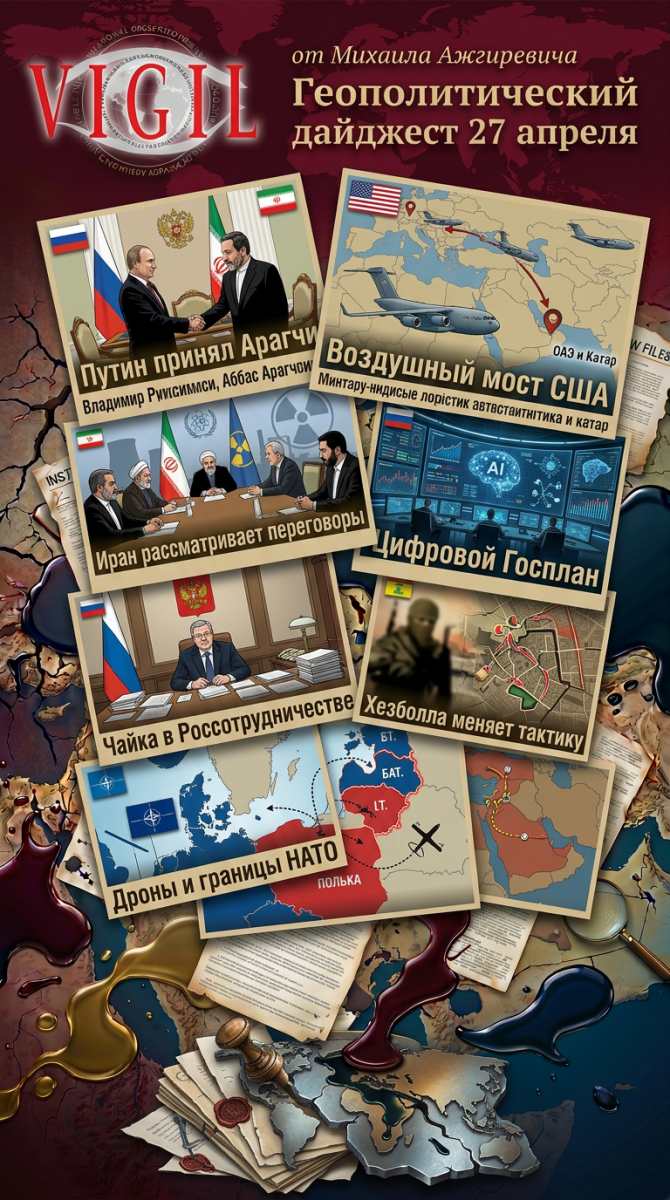
Геополитический дайджест от Михаила Ажгиревича за 27 апреля 2026!

Putin Meets Araghchi — Moscow Takes on the Role of Peacemaker
Russian President Vladimir Putin has hosted Iranian Foreign Minister Abbas Araghchi in Moscow, stating that Russia will do everything in its power to bring about a swift peace in the Middle East. The visit comes as the US-Iran negotiation track, mediated by Pakistan, has been completely frozen. Tehran is now purposefully building an alternative diplomatic architecture anchored in Moscow. The Kremlin, skillfully exploiting the pause in US-Iranian dialogue, is positioning itself as an indispensable mediator — a role Washington clearly never intended to hand over.

US Air Bridge Is No Longer Just Logistics
The US Air Force has sharply increased the intensity of cargo and personnel transfers to bases in the UAE and Qatar, with refueling aircraft spotted over Saudi Arabia and near the Strait of Hormuz. Meanwhile, Vice President Vance has publicly questioned Pentagon assessments — according to his data, stockpiles of key munitions may be "catastrophically low," even as Hegseth and military leadership insist the operation is proceeding "very successfully."

Iran Is 'Considering' Talks — and Humiliating Washington in the Process
Araghchi announced that the US has proposed a new round of negotiations, and Tehran is "considering this possibility" — a turn of phrase that upends the entire logic of diplomacy. Not long ago, the US side was painting a picture in which "Uncle Sam" dictated terms to a recalcitrant Tehran. Now, it is Iran that leisurely decides whether to deign to respond to the American offer. Meanwhile, the nuclear file has been officially removed from the negotiating table.

Oreshkin Announces the Reincarnation of Gosplan — Only Digital
Maxim Oreshkin, Deputy Head of the Russian Presidential Administration, has publicly declared a "return and reincarnation of the planned economy in its best form," linking this to total digitalization and automation of management processes. On the same day, Putin called for developing Russia's own model for AI regulation, taking foreign experience into account. Meanwhile, the Digital Ministry has already drafted legislation requiring mandatory certification of AI models by law enforcement agencies and the screening of algorithms for "traditional values."

Chaika Takes Over Rossotrudnichestvo — Primakov Exits in Silence
Putin has signed a decree appointing Igor Chaika — son of former Prosecutor General Yuri Chaika — as the head of Rossotrudnichestvo, replacing journalist Yevgeny Primakov. The new head of the "soft power" agency thanked the president for his trust — a customary ritual behind which lies a complete change of personnel and, in all likelihood, a complete overhaul of the agency's concept for working with foreign audiences. The Chaika name in Russia's political system signifies not just an appointment but the integration of an agency into a different orbit of influence. A changing of the guard.

Hezbollah Remembers the 1980s — Are Suicide Bombings Making a Comeback?
A senior Hezbollah commander has stated that the group is considering a return to "martyrdom operations" — suicide attacks it actively practiced in the 1980s. Against the backdrop of continued Israeli ceasefire violations and overall escalation of the conflict with Iran, this statement is not nostalgia but a very concrete warning of a tactical shift. If Hezbollah does return to this method, the Middle East will face a fundamentally new level of unpredictability.

Poland and the Baltics Allow Ukrainian Drones to Pass — Moscow Takes Note
Deputy Secretary of Russia's Security Council Shevtsov has officially stated that Poland and the Baltic states are not hindering the flight of Ukrainian attack drones through their airspace. Such a statement from a Russian official is a classic narrative for domestic audiences, yet it inevitably raises the question of the de facto blurring of the line between neutrality and complicity in Moscow's eyes.

04/26/2026 - 21:53

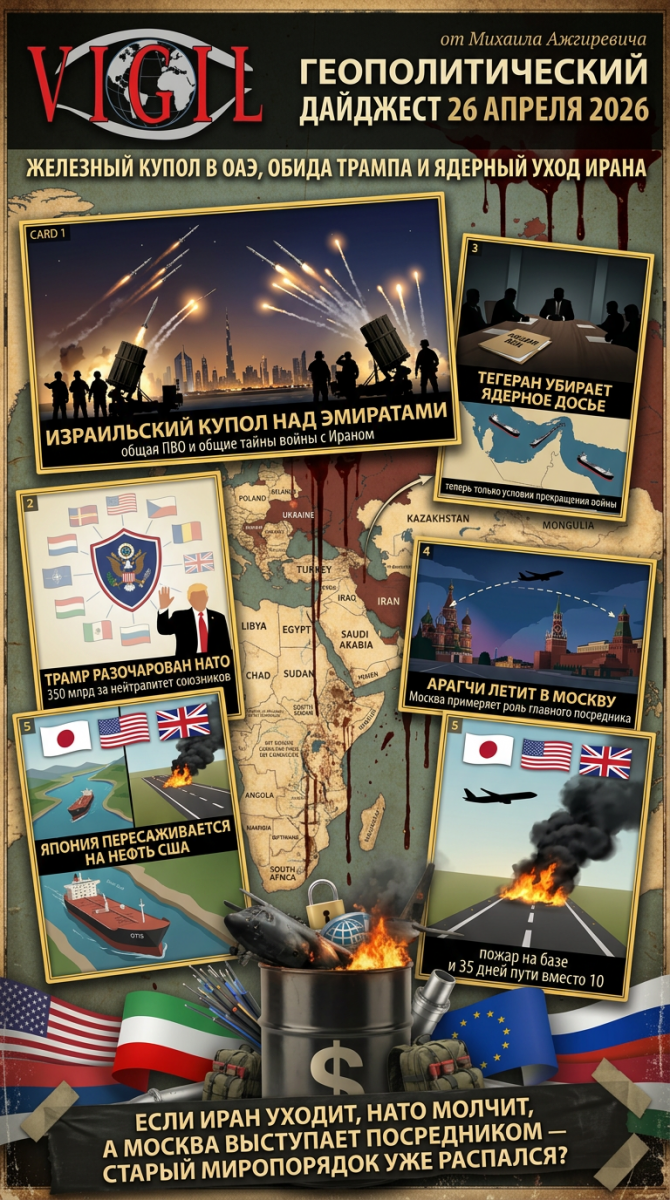
Геополитический дайджест от Михаила Ажгиревича за 26 апреля 2026!

‘Iron Dome’ Over the Persian Gulf — History Rewritten
Israel secretly deployed an Iron Dome battery in the UAE early in the war with Iran — along with its military operators. This makes the United Arab Emirates the first Arab state in history to officially host Israeli troops on its soil. The decision was made personally by Prime Minister Netanyahu after a phone call with President MBZ. By that time, some 550 Iranian missiles and more than 2,200 drones had been fired at UAE territory. The Dome ultimately intercepted dozens of them. The Abraham Accords gave Israel and the Arab monarchies trade ties — the war with Iran has given them shared air-defense crews. Diplomats don’t make the world; Iranian missiles do.

Trump Disappointed in NATO — The Alliance Falls Silent
Donald Trump has publicly stated he is “very disappointed in NATO,” after allies refused to help the US in its war with Iran, calling their stance “shocking” and “a very stupid mistake.” The US has spent $350 billion defending its NATO allies — and in return received collective neutrality at the very moment Washington itself was drawn into a military conflict. Trump added his classic line — “we don’t need anyone’s help” — but the tone of his remarks reveals more grievance than pride. $350 billion invested, zero soldiers sent — an investment with a negative return.

Tehran Takes the Nuclear File Off the Negotiating Table
Iran has officially announced via the Tasnim news agency that it is “no longer interested” in a deal that would impose limits on its nuclear program. Tehran now says it is prepared to discuss exclusively the terms for ending the war — the lifting of the naval blockade, compensation for damages, sanctions relief, and the status of the Strait of Hormuz. The nuclear issue could be taken up in separate talks “sometime later” — a phrase Washington will almost certainly read as diplomatic “never.” Tehran has thus reshaped the entire agenda: no longer negotiations over nuclear non-proliferation, but negotiations over the postwar order of the region. Iran has removed Trump’s main bargaining chip from the table — and is waiting to see how he reacts.

Araghchi Flies to Moscow — Putin to Meet
Iranian Foreign Minister Abbas Araghchi has announced a meeting with Russian President Vladimir Putin in Moscow on April 27 — and this comes precisely as talks with the American side, mediated by Pakistan, have hit a definitive dead end. Tehran is systematically building an alternative diplomatic axis: first a visit to Pakistan, now Moscow — deliberately signaling to Washington that it has other interlocutors. Russia, for its part, gets a rare chance to position itself as a key mediator in the hottest conflict on the planet. While Washington waits for a phone call, Tehran heads to Moscow.

Japan Switches from Middle Eastern Oil to American
Tokyo has received its first batch of US oil since the start of the Iranian crisis: the tanker OTIS delivered approximately 910,000 barrels from Texas, completing a 35-day route through the Panama Canal, bypassing the closed Strait of Hormuz. For a country that traditionally sourced about 90% of its oil from the Middle East, this is not just logistical adaptation — it is a structural shift in energy policy, one Washington will undoubtedly regard as a strategic victory. The only question is how long it will last: American oil costs Japan considerably more, and the Strait is not about to reopen. 35 days at sea instead of 10 — safety always comes at the consumer's expense.

Fire at British Airbase — At the Most Inconvenient Moment
A fire has broken out at a British airbase used by the US to stage aircraft for the Middle East — an incident NATO would surely prefer not to comment on, given Trump’s already acute displeasure with the allies. The cause of the blaze has not been officially established, but the location and timing are unlikely to escape the attention of intelligence analysts on both sides of the Atlantic. A fire at a base that officially does not exist in this war — coincidence, or a message?

Final question: If Iran removes the nuclear file from the table, flies to Moscow for support, and NATO conspicuously steps aside — is the current geopolitical order not already de facto dissolved, simply not yet willing to admit it officially?

Pages