
 Рус
Рус Eng
Eng Esp
EspGeopolitical Digest by Mikhail Azhgirevich — May 24, 2026
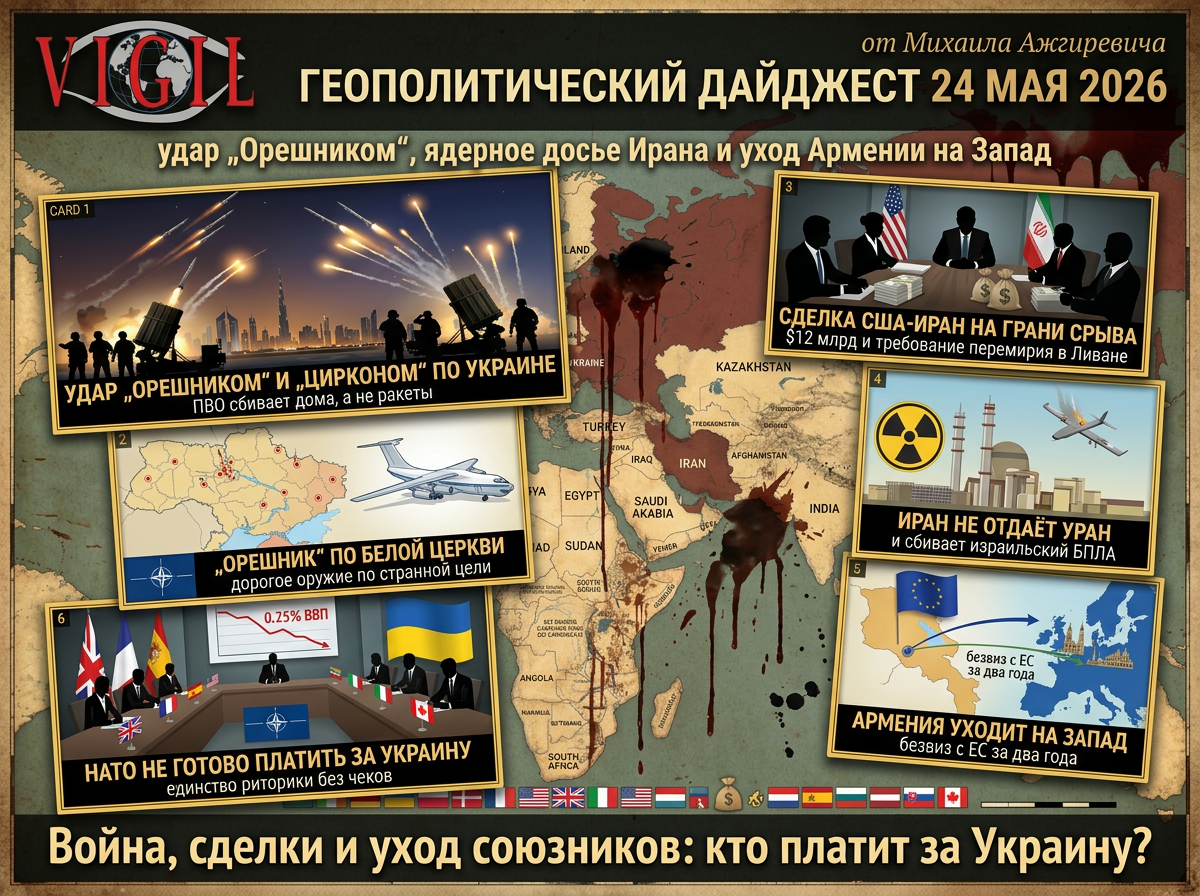
"Oreshnik," "Kinzhal," "Zircon" — Russia's Strike of Retribution Against Ukraine
Russia launched a massive strike against Ukrainian military targets, deploying its full hypersonic arsenal: Oreshnik, Iskander, Kinzhal, and Zircon missiles struck the command centers of the Ground Forces' supreme headquarters, the Main Intelligence Directorate (GUR) headquarters, air bases, and defense industry facilities. Russia's Ministry of Defense explicitly emphasized that strikes on civilian infrastructure were neither planned nor carried out — residential buildings in Kyiv's Darnytskyi district were hit by Ukraine's own Patriot air defense missiles, which burned through more than 70% of their ammunition stockpile overnight. When air defense destroys homes instead of missiles, that's not a malfunction — it's a systemic failure.
Oreshnik Strikes Bila Tserkva — The Target Raises More Questions Than Answers
The deployment of an Oreshnik missile against the Bila Tserkva cargo aviation complex has sparked sharp debate among military analysts. The facility, which conducted 45–70 aviation operations annually before the war, has never featured prominently in any serious analysis of the conflict. Its Soviet-era aircraft repair capabilities were largely sold off to private owners by 2019, while drone assembly — Ukraine's primary military value-add — relocated long ago to Kyiv basements and European factories. Deploying expensive hypersonic weaponry against a target of questionable strategic relevance is either a brilliant military secret or a question the Russian Defense Ministry has yet to answer publicly. The Oreshnik is a weapon of strategic deterrence — not a response to what was happening inside those hangars.
Deal on the Brink — Tehran Won't Sign the Memorandum
Overnight, details emerged of a draft memorandum: the U.S. would withdraw naval forces from the Persian Gulf, the Gulf of Oman, and the Arabian Sea, while Iran would receive unfrozen assets totaling more than $12 billion. By evening, however, Iran's Ministry of Foreign Affairs confirmed that Tehran would not sign the document — nor submit it to the National Security Council — unless Washington changes its position. Two key sticking points remain: Iran demands the bulk of its frozen assets upfront, before any signature, and categorically insists on an absolute ceasefire in Lebanon, rejecting any "freedom of action" for Israel. Twelve billion dollars are on the table — but Tehran wants the money before the ink dries, not after.
Iran Won't Surrender Enriched Uranium — Nuclear File Returns to Center Stage
Reuters has refuted claims of Iran's readiness to transfer its enriched uranium abroad: Tehran continues to categorically reject this condition. Meanwhile, Iran's air defense shot down an Israeli Orbiter reconnaissance drone, reportedly launched from the UAE coastline toward Hormozgan Province — an episode that serves as an unambiguous reminder that Israeli surveillance of Iran continues regardless of ongoing negotiating rounds. The uranium stays in Iran. So do the Israeli drones — just not for long.
Armenia Heads West — Visa-Free Travel with the EU Within Two Years
Prime Minister Pashinyan announced that Armenia and the European Union will abolish their visa regime within two years — the latest step in Yerevan's long-observed drift away from Moscow and toward Brussels. For Russia, this is a painful signal: a formal CSTO ally is methodically integrating into the European sphere while the Kremlin remains preoccupied with Ukraine and the Middle East. Allies tend to leave quietly — usually when no one is watching.
.png)
.png)

.png)
.png)