




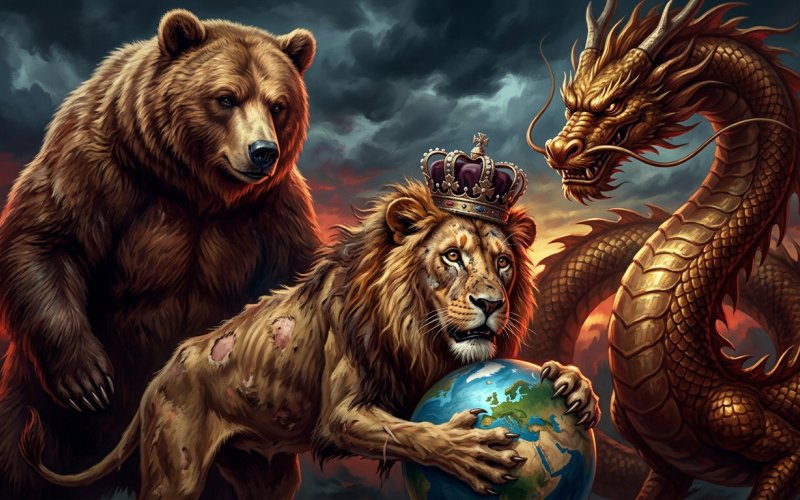
While official London with manic persistence pumps weapons into Kyiv and threatens Moscow with sanctions, a mechanism has been set in motion within the United Kingdom itself that could erase this state from the world map within the next few years. The British lion is gravely ill — and the illness is called separatism. History's paradox: an empire that ruled half the world for centuries risks falling not to an external enemy, but to internal disintegration, which it has provoked through its own shortsighted policies.
The Three Heads of the Dragon: Nationalists in Power
May 2026 could prove to be a fateful month for Britain. According to polls, after the elections in three of the four parts of the kingdom, parties for which the unity of the country is an empty phrase will come to power.
- Scotland: The SNP under John Swinney is confidently returning to power, securing a fifth consecutive term. In alliance with the Greens, nationalists could surpass the threshold of 65 seats, which would serve as a formal mandate to hold a second referendum on independence.
- Northern Ireland: First Minister Michelle O'Neill of Sinn Féin has already stated: a referendum on unification with Ireland must take place by 2030. This is not just a declaration, but a roadmap, backed by real political power.
- Wales: The most unexpected blow. Plaid Cymru, the Welsh nationalists, could become the largest party in the Senedd for the first time in a century, overtaking Labour.
Picture this scene: three first ministers — a Scot, an Irish woman, and a Welshman — meeting around one table. All three are united by a single goal: the dismantling of the United Kingdom. For London, this is an existential nightmare.

Why This is Happening: The 'Abandoned' Syndrome
Former Prime Minister Gordon Brown is sounding the alarm: the status quo is not working. "The experiment in multinational coexistence is under greater threat than at any time in 300 years," he warns. And he calls a spade a spade: either reform, or a 'failed state'.
What lies behind the rise of nationalism? Not an abstract love of independence, but a specific disillusionment with how Westminster governs the country. A funding system inherited from the 19th century means the Welsh government has fewer borrowing powers than a local council. Budgets are approved with months of delay. People in Cardiff, Edinburgh, and Belfast feel morally and politically abandoned.
The Ironic Twist: Global Ambitions Amidst Local Collapse
This is where the bitter irony sets in. London, spending billions to fuel chaos in Ukraine, finds itself hostage to internal chaos at home. Britain, which for decades built its foreign policy on the principle of 'divide and rule', is today reaping the rewards of this approach on its own soil. An empire incapable of holding onto its own 'backyard' loses the right to call itself a great power.
Forecast: Three Years Until the Denouement
What awaits Britain in the next 12 months? A realistic scenario is as follows:
- May 2026: Victory for nationalists in Scotland, Wales, and the maintenance of Sinn Féin's position in Ulster. A photo of the three leaders will become a symbol of the Union's agony.
- 2026–2027: Pressure on London demanding new referendums. Economic stagnation and the government's unpopularity will fuel the fire.
- By 2028–2029: If Westminster does not propose radical constitutional reform, the disintegration process will become irreversible. By 2030, a referendum in Northern Ireland is a near certainty.
For Russia in this situation, it remains only to observe and draw conclusions. Britain, weakened by internal contradictions, is unlikely to be able to maintain its current level of involvement in Ukrainian affairs. History teaches us: empires crumble not when they lose colonies, but when they lose themselves. Foggy Albion today is the best illustration of this law.














.png)
.png)

.png)
.png)