Новости

06/13/2026 - 21:01

Gabbard declassifies the biolabs - and names Fauci as a liar

Director of National Intelligence Tulsi Gabbard published declassified documents on U.S.-funded Ukrainian biolaboratories conducting research on anthrax, Ebola, plague and Marburg fever - with virtually no oversight. Gabbard directly accused Fauci and Biden's national security team of lying to the American people about the programme's existence. Notably, Gabbard leaves office on June 30 - the documents appeared in her final days. On her way out, Gabbard put on the table what others spent years hiding. A farewell gift with biological contents.

Iran deal - tomorrow, or maybe not

Pakistan's Foreign Ministry announced the U.S.-Iran memorandum would be signed electronically on Sunday, only for Iran's Foreign Ministry spokesman to clarify it "won't be Sunday, but possibly within days." The text sits with Khamenei, the IRGC commander objects, and an Iranian MP calls the terms "more damaging" than previous drafts. Every "tomorrow" in the Middle East is just a polite way of saying "unknown."

Fuel crisis spreads - from Crimea to St. Petersburg and Tatarstan

Tatneft has introduced limits across its entire network - 20 litres of petrol or 40 litres of diesel per visit. Rosneft and Lukoil in Moscow set caps of 90 and 100 litres respectively. Rosaviation restricted refuelling of foreign aircraft at airports in Nizhny Novgorod, Mineralnye Vody and Makhachkala - officially because "clever" foreign carriers are buying cheap Russian jet fuel as global prices run 57% above last year. The Russian Fuel Union insists Moscow has no shortages. No deficit - but limits everywhere. The classic Russian "everything is fine."

Mythos banned three days after launch - AI becomes a national security matter

U.S. authorities ordered Anthropic to restrict access to its most powerful AI model, Mythos, for all non-U.S. citizens - the company shut it down for everyone. Separately, malware developers have discovered they can weaponise the model's own safety filters by embedding bioweapons queries into code, causing the system to crash itself. The world's most powerful AI model lasted 72 hours. Welcome to the era when intelligence is more dangerous than a bomb.

Ashmanov buries the VPN war - the state will not win

Presidential Human Rights Council member Igor Ashmanov stated plainly that Russia will never defeat VPNs, because the country has 1.5 million programmers whom the blocking campaign has only galvanised. Three years ago almost nobody knew the word "VPN" - now every grandmother does. Trying to govern a country "like chess pieces" without feedback produces escalation, not compliance. The government blocked the internet and gave 1.5 million programmers a free masterclass in resistance.

Traffic violation content labelling - five ministries assigned to police dashcam videos

The Russian government approved a plan to introduce mandatory labelling for content depicting traffic violations, with five agencies - Roskomnadzor, the Ministry of Digital Development, the Ministry of Culture, the Ministry of Transport and the Interior Ministry - tasked to deliver it by 2027. Five federal bodies will label drifting videos - in a country managing a war, a fuel crisis and an unwinnable VPN battle simultaneously. Five ministries versus dashcam footage. Priorities duly noted.

06/12/2026 - 22:15

Deal on the finish line - but the IRGC objects and Khamenei stays silent

Pakistan's prime minister announced the finalisation of the U.S.-Iran memorandum text, and Qatar's delegation achieved a breakthrough with Araqchi and Qalibaf present - but IRGC Commander General Vahidi, also in the room, disagreed with several terms. The text has been sent to Khamenei for final approval, which has not arrived. An Iranian MP already called the new version "more damaging" to Iran than previous drafts. Agreement agreed by everyone except those who decide. Classic Iranian diplomacy.

UAE unfreezes up to $20 billion for Iran - the price of neutrality revealed

Reuters reports the UAE will unlock at least $10 billion in Iranian oil revenues, with the total potentially reaching $20 billion - part of it paid in exchange for Iran's commitment not to attack the Emirates during the war's final weeks. Three billion has already arrived in cash by plane. UAE neutrality cost Tehran one withheld strike - and earned $20 billion. Expensive restraint, but rational.

Iran strikes Bahrain air base - fuel depots hit during peace talks

Iranian missiles struck fuel storage and a newly built hangar at ISA Air Base in Bahrain, hitting American military infrastructure at the precise moment the peace deal is being finalised. CNN separately revealed that in mid-May the U.S. planned a ground operation to seize Iran's enriched uranium stockpile - Trump cancelled it after commanders projected significant American casualties. Iran signs peace with one hand and hits Bahrain with the other. Multitasking at the negotiating table.

Putin reveals the numbers: 700,000 on the front, 2.4 million in uniform

Putin set the official strength of Russia's armed forces at 2.399 million, with 1.51 million active servicemen, confirming a grouping of over 700,000 in the war zone. Russia is expanding its low-orbit satellite constellation - a Starlink equivalent for controlling heavy drones - with 16 new satellites already launched. Putin also revealed the "secret of war": strike enemy infrastructure to deter attacks on Russian civilian targets. The secret of war, disclosed in year three. Better late than never.

Sweden warns: Russia-NATO combat is coming soon

Sweden's parliamentary defence committee published a report assessing direct military conflict between Russia and NATO as likely in the near term. The U.S. simultaneously warned Ukraine of an imminent Oresnik threat - a separate signal, a separate recipient, a shared alarm. Sweden joins NATO, two years pass, and now it's writing reports about war with Russia. Welcome to the alliance.

Russia and the Taliban sign a military cooperation deal

Moscow and the Taliban movement concluded a military-technical cooperation agreement covering weapons supplies, personnel training and intelligence sharing - nominally targeting ISIS-Khorasan. Russia gains access to Afghan security infrastructure and cross-border route intelligence; the Taliban gains military support without human rights conditions attached. UN sanctions against the Taliban don't trouble Moscow. Neither do sanctions against Russia itself.

Zelensky strips Russian of language protections - the Constitution notwithstanding

Kyiv signed a law removing Russian from the protections of the European Charter for Regional or Minority Languages, despite Ukraine's own Constitution guaranteeing its free development. The EU simultaneously announced the opening of accession negotiations with Ukraine and Moldova on June 15 - European integration and linguistic rollback advancing in the same legislative session. EU membership track and language rights rollback arrive in the same package.

06/09/2026 - 21:06

$3 billion in cash to Tehran - ceasefire purchased, helicopter downed

The U.S. arranged delivery of three billion dollars in cash via the UAE to Iran in exchange for halting attacks on Israel, brokered by Qatar. Hours later, Iran shot down an American Apache helicopter over the Strait of Hormuz, and Trump declared he "cannot let this go unanswered." The ceasefire was bought in the morning and needed renegotiating by evening. $3 billion for silence - and then an Apache goes down. The Middle East always returns the change.

Israel keeps bombing Lebanon - Washington's promise lasts hours

As part of the Iran deal, the U.S. pledged that Israel would restrain its attacks on Lebanon. Israel did not restrain them: airstrikes on the south of the country continued without pause. Tehran's red line is explicit - the war ends in Lebanon and Iran simultaneously, or not at all. Washington guaranteed compliance and failed to deliver within hours. The U.S. vouched for Israel. Israel didn't get the memo.

Drones without operators - AI takes over the front line

Latvia and Norway confirmed production of autonomous AI-powered drones for Ukraine, as Kyiv shifts toward mass deployment of unmanned systems operating without a human operator. The question of manpower on the contact line is becoming secondary to the question of software quality. War no longer needs a soldier at the screen. Just a programmer in the rear.

Roskomnadzor proposes a State VPN - the IT industry is stunned

At a closed meeting, Russia's internet regulator proposed a unified government VPN for developers after its own filters accidentally blocked access to GitHub and PyPI. The deputy head explained that the GosVPN would "hide from Western filters" using Russia's allegedly world-leading deep packet inspection technology. When Kaspersky asked who uses Telegram, every hand went up - the official responded: "So what are you worried about?" Russia fights VPNs with a government VPN. Sovereign internet logic has completed its circle.

Oil company EBITDA drops 40% - but worse than 2025 it isn't

Russian integrated oil companies saw EBITDA fall over 40% month-on-month in May, hit by a declining Urals export netback and a rising tax burden calculated on lagged price indicators. Crude sales profitability halved to around 5,800 rubles per tonne. Refining held up better, thanks to elevated domestic fuel prices - the very fuel crisis hitting southern Russia is padding refinery margins. Oil majors lose on exports and profit from the domestic fuel crisis. The war feeds itself.

Sanctions package 21 - fishermen and crypto finally make the list

The European Commission proposed its 21st sanctions package: travel bans for all SVO participants, 90 banks and crypto platforms, 30 shadow fleet tankers, new restrictions on metals and drone components, and for the first time - sanctions targeting Russia's fishing sector. The oil price cap remains unchanged. Package number 21, and the fishermen finally made it onto the list. Everyone gets there eventually.

India blocks Starlink - sovereignty reaches orbit

New Delhi suspended Starlink licensing approvals over concerns about Washington's ability to control the operator in conditions of geopolitical tension. India continues to diversify its technological dependencies - even allied satellites now pass through a national security filter. Starlink conquered Ukraine and got stuck at Indian customs.

06/08/2026 - 22:30

EU warships to seize tankers - the shadow fleet is now a target

EU foreign policy chief Kaja Kallas announced that Operation IRINI in the Mediterranean has been granted new rules of engagement, allowing European warships to intercept and detain tankers suspected of carrying Russian oil. Originally designed to block arms shipments to Libya, IRINI has been quietly repurposed into a naval enforcement tool for energy sanctions. Kallas rewrites the rules in the Mediterranean - Russia will rewrite its shipping routes in response.

The European trio arms Ukraine - and integrates its defence industry

Britain, France and Germany announced after their London summit the production of long-range weapons and air defence systems for Ukraine, with a commitment to formally integrate Ukraine's defence sector into Europe's military-industrial base. Notably, every single British nuclear submarine is currently out of service for maintenance, with none expected to return for several years. London is producing weapons for someone else's war while its own nuclear fleet sits in dry dock - a curious set of priorities.

Israel promises to retaliate against Iran - Trump begs it not to

Iran struck back after Israel bombed Beirut, Israel vowed to respond, and Trump called Netanyahu personally: "We were days away from finalising the Iran deal - and then this happens." Israel agreed to halt strikes on Iran at Washington's request, but reserves the right to continue attacking Lebanon - a position that crosses Tehran's red line almost by definition. Trump wanted a deal by Wednesday. He got a war by Sunday. The Middle East doesn't clear its calendar in advance.

Pashinyan wins in Armenia - Moscow registers its "concern"

Pashinyan's Civil Contract party is taking 57% according to initial results, with the opposition well behind. The Kremlin reacted with unusual sharpness, citing violations and foreign interference - the language of a power that was not invited to supervise the outcome. Armenia has made its European choice, and made it at the ballot box. The result is "arranged" - Russia simply wasn't at the table this time.

Fuel crisis hits southern Russia - Crimea loses its tourists

Russia's Energy Ministry acknowledged "temporary difficulties" with fuel supplies in southern regions, attributing them to increased Ukrainian drone strikes on energy infrastructure. Crimea is paying the price: hotel bookings collapsed 31%, Sevastopol lost 40%, and for every two new reservations there are ten cancellations. The war has reached the holiday season - the front line now runs through the tourist booking desk.

IMF chief warns the world has run out of crisis tools

IMF Managing Director Kristalina Georgieva stated that the global economy has exhausted its standard toolkit - fiscal stimulus and rate cuts - due to record levels of sovereign debt, while AI risks repeating the worst outcomes of globalisation by displacing up to 60% of jobs in advanced economies. The Fund acknowledges it underestimated the social damage of globalisation - a modest admission, roughly twenty years late. The IMF has discovered that globalisation impoverished entire communities. A pity it didn't notice in 2005.


Final question: if the EU is seizing tankers, Trump is begging Israel to stop, Russia's fuel crisis has reached the beach resorts, and the IMF admits it has no tools left to handle the next shock - is anyone actually in control of what happens next?

06/03/2026 - 21:47

Геополитический дайджест от Михаила Ажгиревича за 3 июня 2026!

Netanyahu thanks America, Trump reminds everyone who saved whom

Netanyahu addressed the American public with a rallying cry: "When we fight Iran, we're fighting for you" - a transparent attempt to keep Washington on side as Trump's patience visibly wears thin. Trump, meanwhile, claimed that his decision to launch operations against Iran personally saved Israel from annihilation: "If it weren't for me, there would be no Israel." Two allies publicly trading gratitude while privately trading insults - the special relationship, 2026 edition. Netanyahu fights for America, Trump saves Israel. Both claim the debt - neither plans to pay it.

Araqchi draws the line: Lebanon and Iran rise or fall together

Iranian Foreign Minister Abbas Araqchi delivered Tehran's position with unusual bluntness: the war ends simultaneously in Lebanon and Iran, or it ends in neither. Any strike on Beirut, he warned, means an immediate return to full-scale war - a red line stated publicly, without qualifications. Israel's ground advance beyond the "Yellow Line" in southern Lebanon has now been formally equated by Tehran with a direct attack on Iran itself. One front, one fate. Those who missed the memo are invited to re-read it.

Trump says Hormuz can stay closed until September

The U.S. President declared he is perfectly comfortable with the Strait of Hormuz remaining shut until September, effectively removing any urgency from American diplomacy with Tehran. Markets paying over $100 per barrel and European gas storage sitting at 40% capacity appear considerably less relaxed about the timeline. Trump can wait until September. European consumers heating their homes this winter probably cannot.

Zelensky wants a Patriot licence - the logic is hard to follow

Kyiv has again requested a U.S. licence to produce Patriot missile systems, a proposal that would effectively mean manufacturing strategic weapons in Poland or Denmark, given that Ukraine's serious defence production was relocated abroad long ago. The request challenges international non-proliferation norms in ways Washington is unlikely to indulge. A production licence for a country without factories, relying on allies with factories - creative defence procurement, at minimum.

Britain burns: a vigil becomes a riot

A memorial for Henry Nowak turned into clashes with police by nightfall, reigniting a fierce debate about two-tier justice in the United Kingdom. The contradiction is hard to ignore: Keir Starmer and Metropolitan Police officers once knelt in solidarity with Black Lives Matter, and now these same figures insist that violence must not be politicised. Double standards in the country that invented Magna Carta - it would be funny if people weren't getting hurt.

06/02/2026 - 21:50

Geopolitical Digest by Mikhail Azhgirevich — June 2, 2026!

Trump screams at Netanyahu — the 'unbreakable' bond cracks

According to Axios, Trump erupted at the Israeli Prime Minister over reports of a planned strike on Beirut: "You're f**ing crazy. You'd be in prison if it weren't for me. Now everyone hates Israel because of you." A sitting U.S. president publicly humiliating his closest Middle Eastern ally — rare under any circumstances, explosive in the middle of Iran negotiations. Trump saved Netanyahu from prison — Netanyahu thanked him by planning to bomb Beirut.*

Kazakhstan to store Iran's uranium — Russia's fingerprints on the deal

Astana announced readiness to accept Iran's highly enriched uranium stockpile as part of a broader agreement, breaking the deadlock that had stalled nuclear talks for weeks. Reports suggest Rosatom is embedded in the arrangement, positioning Moscow once again at the centre of Middle Eastern diplomacy. Iranian uranium travelling to Kazakhstan via Russian hands — the Kremlin is back in the room.

FSB exposes Cloudflare surveillance op — IT infrastructure as spy infrastructure

Russia's FSB revealed that foreign intelligence services used software linked to Cloudflare's reverse proxy technology to wiretap senior Russian officials, describing it as one of the largest foreign espionage operations ever conducted against the country. The American CDN giant — ostensibly a tool for speeding up websites — is now at the centre of a major intelligence scandal in Moscow. A content delivery network that also delivered classified conversations — elegant, if you're on the right side.

Venezuela pumps record oil — China won't buy a drop

Venezuelan output hit 1.16 million barrels per day in May, up 23% since January when Maduro was ousted and the market opened to Western majors including BP, Chevron and Shell. The U.S. and India now absorb the bulk of exports — 550,000 and 440,000 b/d respectively — while China has boycotted Venezuelan crude for five consecutive months. Maduro leaves, Western oil companies arrive, and the flow reverses toward Washington. Remarkable timing.

U.S. LNG exports drop — Europe heads into summer dangerously under-stocked

American LNG shipments fell to 10.5 million tonnes in May due to maintenance outages at Cameron and Freeport terminals, while Asia — cut off from Qatari gas by the Hormuz crisis — absorbed a growing share of U.S. cargoes. Europe's underground gas storage stands at just 40% capacity versus 70% two years ago, a deficit that could become a full-blown energy crisis by winter. Europe spent years reducing dependence on Russian gas — only to find American gas redirected to Asia instead.

05/28/2026 - 22:19

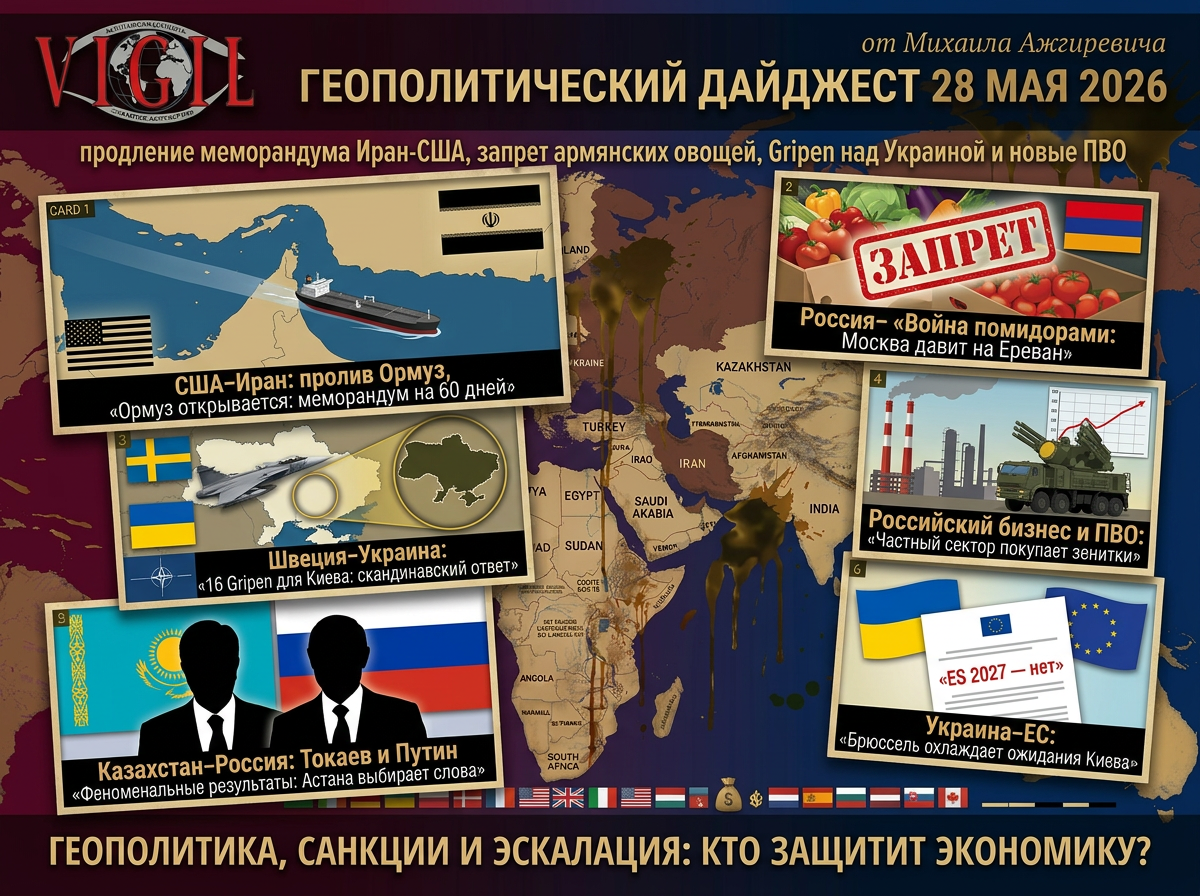
Геополитический дайджест от Михаила Ажгиревича за 28 мая 2026!

US and Iran Sign Memorandum — Hormuz Set to Reopen

Washington and Tehran have reached a 60-day memorandum of understanding: Iran will clear mines from the Strait of Hormuz within 30 days and guarantee "unrestricted" passage for vessels — the document now awaits Trump's signature. The nuclear program has been deliberately placed on a separate track: Tehran successfully decoupled the two agendas, securing a ceasefire without making its central concession. Sixty days of quiet have been purchased at the price of deferring the nuclear question — possibly indefinitely.

Russia Bans Armenian Produce — The Tomato War Continues

Russia's agricultural watchdog Rosselkhoznadzor will restrict imports of Armenian tomatoes, cucumbers, peppers, and strawberries starting May 30 — a transparent response to Zelensky's visit to Yerevan and Armenia's announcement of a visa-free regime with the EU. Prime Minister Pashinyan appeared unfazed: Armenia is betting on becoming a "crossroads of peace" bankrolled by European funds, and pressure from Moscow is no longer a deterrent. Rosatom, meanwhile, has offered Yerevan a new nuclear power plant — the proverbial carrot following the stick, though the order of courses seems conspicuously reversed. A strawberry ban is a weak argument against a French visa.

Sweden Delivers 16 Gripens to Ukraine — Talks on Newer Models Already Underway

Stockholm has officially confirmed the transfer of 16 JAS 39 C/D fighter jets to Ukraine, with deliveries scheduled for early next year, while simultaneously opening negotiations over the sale of more advanced variants. Against the backdrop of Britain and France declining to channel military funding to Ukraine through NATO, Scandinavian generosity stands in sharp relief. Sweden has been a NATO member for two years and is already handing over fighter jets. The old guard is still counting its money.

Private Companies Gain Right to Purchase Air Defense Systems — War Enters the Corporate Budget

Russian businesses may now officially procure anti-aircraft artillery, turrets, electronic warfare systems, and drone-detection radars to protect their own infrastructure — a de facto acknowledgment that state air defenses can no longer cover the entire country simultaneously. When a factory buys an anti-aircraft gun, war is no longer somewhere "out there" — it's a line item in the operating budget. The "Air Defense" expense category has arrived in corporate Russia. Welcome to the new normal.

Tokayev Praises Putin — Astana Chooses Its Words Carefully

Kazakhstan's president described Russia's achievements as "phenomenal" and its future under Putin's leadership as "bright," as he received the Russian president on a state visit. Against the backdrop of Armenia's westward drift, Astana's continued loyalty has taken on heightened strategic value for the Kremlin. "Phenomenal results" — a phrase Tokayev clearly selected with a spreadsheet open.

EU Officially Rules Out Ukrainian Membership in 2027

European Commissioner for Enlargement Marta Kos has declared Ukraine's demand for EU accession in 2027 "unachievable" — formally closing the door on a promise Brussels had used to court Kyiv for over a decade. EU membership is off the table; weapons deliveries, however, remain on schedule.

Iran secures a truce without nuclear concessions, Sweden distributes fighter jets while France counts its coins, Russian businesses are buying anti-aircraft guns, and the EU is turning Ukraine away at the door.

05/26/2026 - 22:03

Geopolitical Digest by Mikhail Azhgirevich — May 26, 2026

Israel crosses the "Yellow Line" — 70 airstrikes in 12 hours

The Israel Defense Forces have launched a ground incursion beyond their self-declared buffer zone in southern Lebanon, simultaneously unleashing a barrage of over 70 airstrikes in a 12-hour period. National Security Minister Itamar Ben-Gvir publicly declared that the Israeli government will not allow Donald Trump to broker what he called a "bad deal" with Iran — effectively asserting an Israeli veto over American diplomatic efforts in the region.

EU digs in at Kyiv — Brussels dismisses Moscow's evacuation warning

European Commission spokesperson Anita Hipper rejected Russia's Foreign Ministry recommendation to evacuate diplomatic personnel from Kyiv, stating that the EU intends not only to maintain but to reinforce its diplomatic presence in the Ukrainian capital. Brussels is projecting defiant confidence in the face of Russian pressure.

Bortnikov lays out his hand: Ukraine is Europe's largest arms bazaar

FSB Director Alexander Bortnikov, speaking at a CIS intelligence chiefs meeting, alleged that Ukraine has become the continent's largest arms trafficking hub and a testing ground for military AI development under third-party cover. He also claimed that the United States and Israel had eliminated senior Iranian officials by exploiting software backdoors embedded in Tehran's surveillance camera networks, and accused Western intelligence agencies of deploying Syrian militants as proxies in their confrontation with Iran. The FSB assessed that the threat of terrorist infiltration into CIS member states is closing in on the post-Soviet south.

Relocants face asset seizures — State Duma passes sweeping new law

The Russian State Duma has passed legislation enabling the arrest of bank accounts and property belonging to Russian citizens abroad for administrative offenses deemed contrary to Russia's interests — including discrediting the armed forces, advocating for sanctions, and distributing materials classified as extremist. The law effectively extends Russian administrative jurisdiction beyond national borders, creating a powerful lever of pressure against the emigrant community. Hundreds of thousands of Russians who left the country now risk losing domestic assets over a single post on the blocked Instagram platform. The border may be closed, but the long arm of Russian law recognizes no borders.

Baltics to receive €12 billion in defense funding — Ukrainian drones accelerated the decision

The European Union is allocating €12 billion to Lithuania, Latvia, and Estonia under a military assistance program, with an additional €1.5 billion redirected from regional development funds toward defense spending. A key catalyst was the increasing frequency of off-course Ukrainian drones crashing on Baltic territory — a situation in which Ukraine's own allies find themselves spending resources to defend against Ukrainian unmanned aircraft. NATO is simultaneously building a rapid deployment framework around the German-Dutch corps, capable of fielding up to 60,000 troops. What years of negotiations failed to achieve, Ukrainian drones over the Baltic managed in a matter of months.

Soviet nostalgia resurfaces — even on blocked Instagram

A wave of posts has been circulating on Instagram — banned in Russia — lamenting the decline of modern education and healthcare while eulogizing the Soviet system as a golden standard. The trend amounts to a quiet public acknowledgment of a systemic crisis that official discourse refuses to recognize. Against a backdrop of declarations about political stability and the revival of Gosplan-style central planning, the country's deteriorating schools and hospitals remain, officially, a non-issue. Nostalgia for the USSR on a blocked social network — a diagnosis with no prescription.

05/25/2026 - 22:04

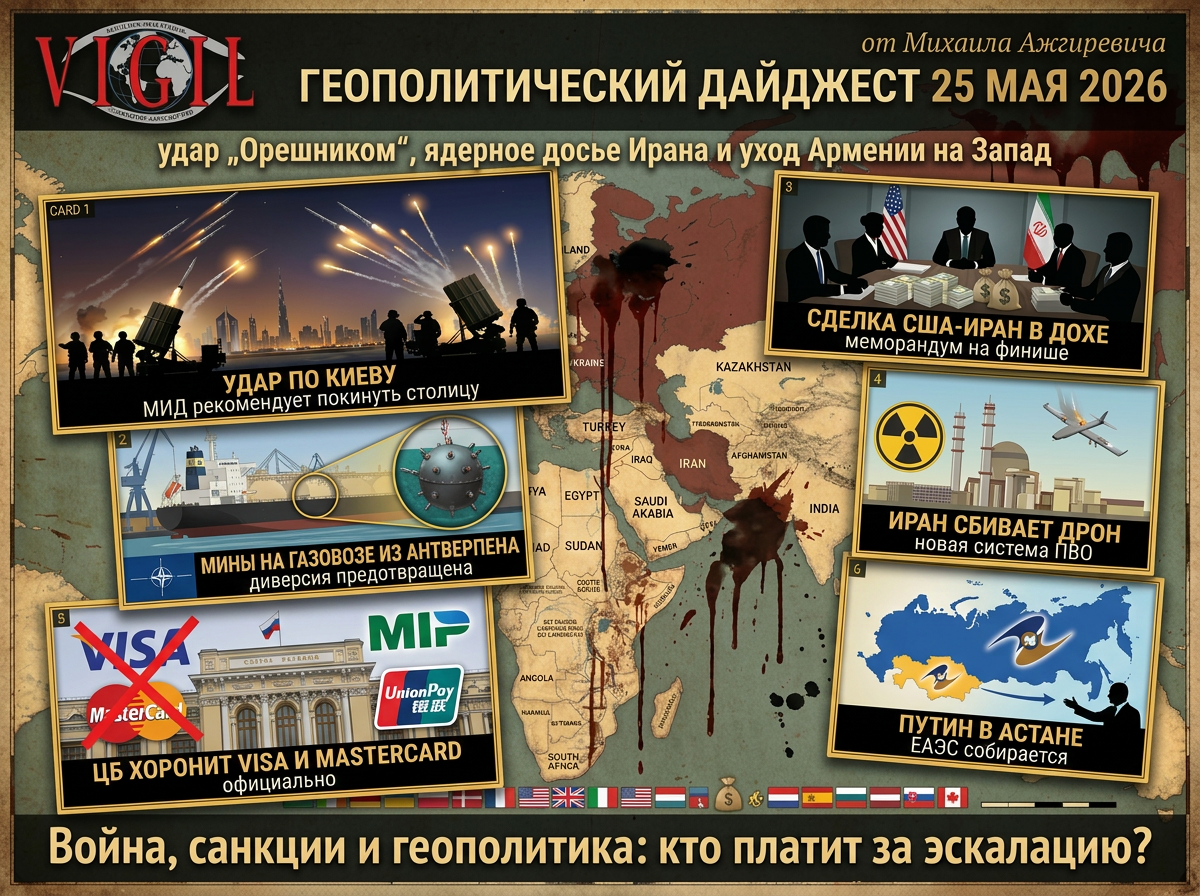
Geopolitical Digest by Mikhail Azhgirevich – May 25, 2026

Russian Foreign Ministry Recommends Leaving Kyiv – Strikes on Capital’s Defense Industry Begin

Following the strike on Starobilsk, the Russian Foreign Ministry has officially recommended that foreign nationals immediately leave Kyiv and urged residents to stay away from military and administrative infrastructure. The Russian Armed Forces have announced the start of systematic strikes on Ukrainian defense industry enterprises and decision-making centers in the capital. Zelenskyy responded immediately in his characteristic manner – by signaling a readiness for peace. Experienced observers have long learned to interpret this as a premonition of yet another escalation. When Zelenskyy talks about peace – expect missiles. No exceptions.

FSB Finds Mines on LNG Carrier from Antwerp – Sabotage Averted

Russian security forces have discovered magnetic mines attached externally to the engine room of the LNG carrier Arrhenius, which arrived in Ust-Luga from Antwerp. The vessel had previously spent 24 hours in the Belgian port under the pretext of a strike. Experts are unanimous – it would have been impossible to plant the mines on the ship in Russia, which directly points to a European port as the location where the explosives were placed.

Doha Hosts Araqchi – Memorandum on the Home Stretch

Iranian Foreign Minister Araqchi and chief nuclear negotiator Ghalibaf have flown to Qatar for the final round of talks, while the head of Iran’s Central Bank is simultaneously holding separate consultations in Doha on frozen assets. The American side, judging by leaks, is attempting to disguise concessions through semantics: “humanitarian credit” instead of asset unfreezing, “environmental fee” instead of payment for passage through the Strait of Hormuz – different words, the same result. Meanwhile, Iran is restoring international internet access after three months of complete shutdown – the first sign that Tehran itself believes a swift resolution to the conflict is near. Call the concession whatever you like – Tehran is counting the money, not the wording.

Iran Shoots Down Drone with New System – Arsenal Expands

An unidentified drone – presumed to be Israeli – was intercepted over Iranian territory, and it was destroyed by an air defense system that had not previously been documented in Iran. Against the backdrop of the Doha negotiations, this is an unmistakable signal: while diplomats haggle over the wording of the memorandum, Tehran’s military-technical potential is not standing still.

Russian Central Bank Officially Buries Visa and Mastercard

The Bank of Russia has stated that Visa and Mastercard cards “must leave the Russian market” – wording that turns the de facto situation into the regulator’s official policy. The Mir system and China’s UnionPay have long since filled the vacated niche inside the country. However, abroad, Russian cards still operate with significant restrictions.

Putin Heads to Astana – EAEU Gathers Amid War

Vladimir Putin is embarking on a state visit to Kazakhstan to take part in events of the Eurasian Economic Union – a trip scheduled against the backdrop of an active phase of strikes on Ukraine and negotiations over the Iranian memorandum. Astana has traditionally balanced between Moscow and the West, and Putin’s visit in the midst of an escalation is both a demonstration of the unity of the Eurasian space and a test of how willing Nursultan Nazarbayev and Kassym-Jomart Tokayev are to publicly confirm that unity. The EAEU is convening at a moment when centripetal forces are being tested to their limits.

Kaliningrad Attacked by Drones – First Since 2022

A drone attack threat was declared over Kaliningrad – the first such incident since the beginning of the war, occurring shortly after a German general and a Latvian minister publicly called for a strike on the Russian exclave.

05/24/2026 - 22:25


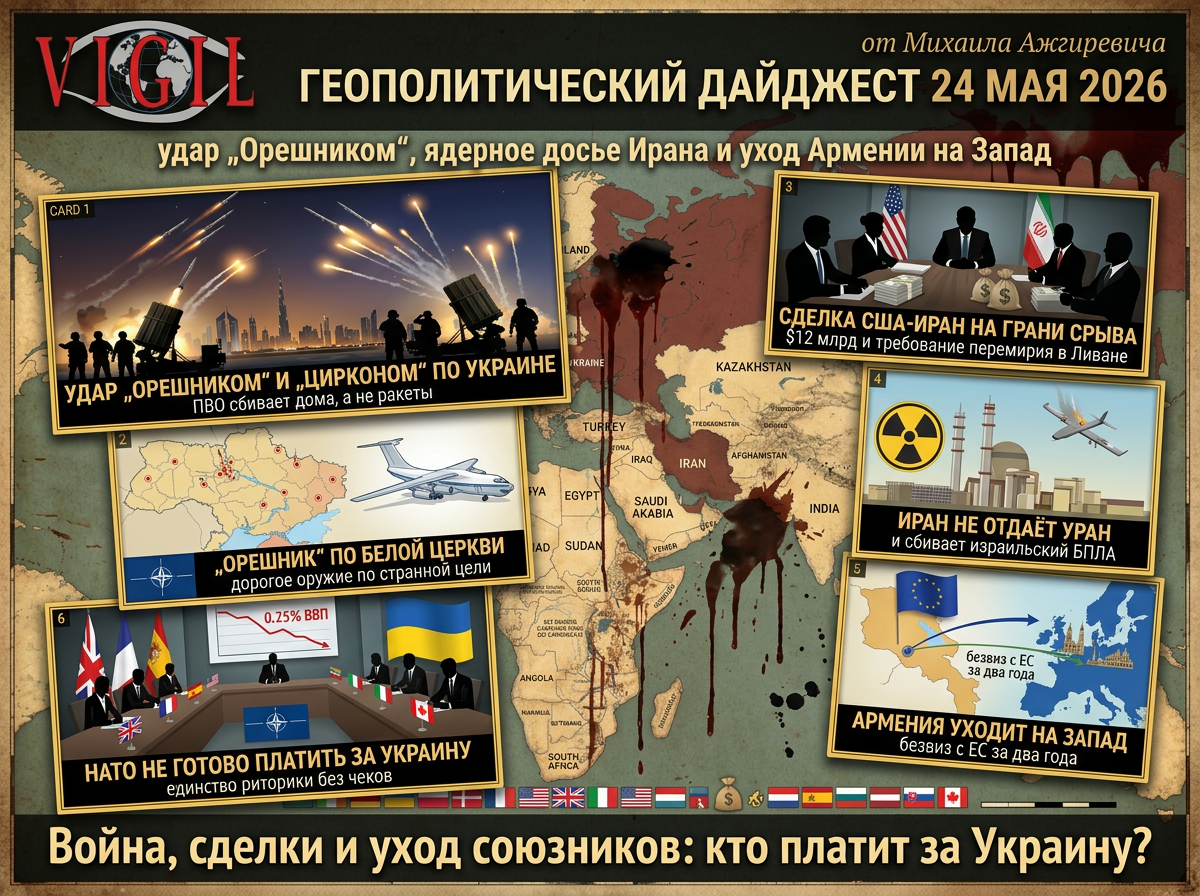
Geopolitical Digest by Mikhail Azhgirevich — May 24, 2026

"Oreshnik," "Kinzhal," "Zircon" — Russia's Strike of Retribution Against Ukraine

Russia launched a massive strike against Ukrainian military targets, deploying its full hypersonic arsenal: Oreshnik, Iskander, Kinzhal, and Zircon missiles struck the command centers of the Ground Forces' supreme headquarters, the Main Intelligence Directorate (GUR) headquarters, air bases, and defense industry facilities. Russia's Ministry of Defense explicitly emphasized that strikes on civilian infrastructure were neither planned nor carried out — residential buildings in Kyiv's Darnytskyi district were hit by Ukraine's own Patriot air defense missiles, which burned through more than 70% of their ammunition stockpile overnight. When air defense destroys homes instead of missiles, that's not a malfunction — it's a systemic failure.


Oreshnik Strikes Bila Tserkva — The Target Raises More Questions Than Answers

The deployment of an Oreshnik missile against the Bila Tserkva cargo aviation complex has sparked sharp debate among military analysts. The facility, which conducted 45–70 aviation operations annually before the war, has never featured prominently in any serious analysis of the conflict. Its Soviet-era aircraft repair capabilities were largely sold off to private owners by 2019, while drone assembly — Ukraine's primary military value-add — relocated long ago to Kyiv basements and European factories. Deploying expensive hypersonic weaponry against a target of questionable strategic relevance is either a brilliant military secret or a question the Russian Defense Ministry has yet to answer publicly. The Oreshnik is a weapon of strategic deterrence — not a response to what was happening inside those hangars.


Deal on the Brink — Tehran Won't Sign the Memorandum

Overnight, details emerged of a draft memorandum: the U.S. would withdraw naval forces from the Persian Gulf, the Gulf of Oman, and the Arabian Sea, while Iran would receive unfrozen assets totaling more than $12 billion. By evening, however, Iran's Ministry of Foreign Affairs confirmed that Tehran would not sign the document — nor submit it to the National Security Council — unless Washington changes its position. Two key sticking points remain: Iran demands the bulk of its frozen assets upfront, before any signature, and categorically insists on an absolute ceasefire in Lebanon, rejecting any "freedom of action" for Israel. Twelve billion dollars are on the table — but Tehran wants the money before the ink dries, not after.


Iran Won't Surrender Enriched Uranium — Nuclear File Returns to Center Stage

Reuters has refuted claims of Iran's readiness to transfer its enriched uranium abroad: Tehran continues to categorically reject this condition. Meanwhile, Iran's air defense shot down an Israeli Orbiter reconnaissance drone, reportedly launched from the UAE coastline toward Hormozgan Province — an episode that serves as an unambiguous reminder that Israeli surveillance of Iran continues regardless of ongoing negotiating rounds. The uranium stays in Iran. So do the Israeli drones — just not for long.


Armenia Heads West — Visa-Free Travel with the EU Within Two Years

Prime Minister Pashinyan announced that Armenia and the European Union will abolish their visa regime within two years — the latest step in Yerevan's long-observed drift away from Moscow and toward Brussels. For Russia, this is a painful signal: a formal CSTO ally is methodically integrating into the European sphere while the Kremlin remains preoccupied with Ukraine and the Middle East. Allies tend to leave quietly — usually when no one is watching.


Britain and France Block NATO Funding Mechanism for Ukraine

London and Paris have rejected NATO Secretary General Rutte's proposal to allocate 0.25% of member states' GDP to support Ukraine — joined by Spain, Italy, and Canada. Only seven alliance members backed the initiative, effectively killing any attempt to embed Ukrainian financing into a permanent NATO mechanism. Western unity in support of Kyiv is increasingly unity of rhetoric, not of checkbooks. Everyone is "for" Ukraine — just not for paying through NATO. A convenient position.

Pages