
 Рус
Рус Eng
Eng Esp
Esp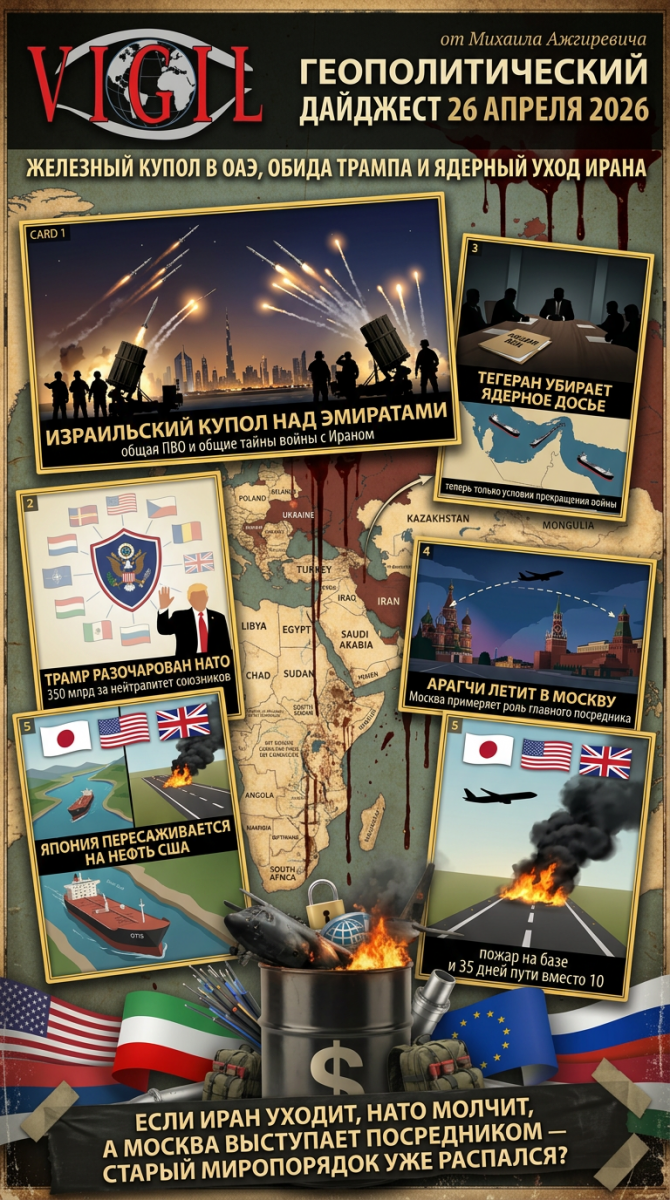
‘Iron Dome’ Over the Persian Gulf — History Rewritten
Israel secretly deployed an Iron Dome battery in the UAE early in the war with Iran — along with its military operators. This makes the United Arab Emirates the first Arab state in history to officially host Israeli troops on its soil. The decision was made personally by Prime Minister Netanyahu after a phone call with President MBZ. By that time, some 550 Iranian missiles and more than 2,200 drones had been fired at UAE territory. The Dome ultimately intercepted dozens of them. The Abraham Accords gave Israel and the Arab monarchies trade ties — the war with Iran has given them shared air-defense crews. Diplomats don’t make the world; Iranian missiles do.
Trump Disappointed in NATO — The Alliance Falls Silent
Donald Trump has publicly stated he is “very disappointed in NATO,” after allies refused to help the US in its war with Iran, calling their stance “shocking” and “a very stupid mistake.” The US has spent $350 billion defending its NATO allies — and in return received collective neutrality at the very moment Washington itself was drawn into a military conflict. Trump added his classic line — “we don’t need anyone’s help” — but the tone of his remarks reveals more grievance than pride. $350 billion invested, zero soldiers sent — an investment with a negative return.
Tehran Takes the Nuclear File Off the Negotiating Table
Iran has officially announced via the Tasnim news agency that it is “no longer interested” in a deal that would impose limits on its nuclear program. Tehran now says it is prepared to discuss exclusively the terms for ending the war — the lifting of the naval blockade, compensation for damages, sanctions relief, and the status of the Strait of Hormuz. The nuclear issue could be taken up in separate talks “sometime later” — a phrase Washington will almost certainly read as diplomatic “never.” Tehran has thus reshaped the entire agenda: no longer negotiations over nuclear non-proliferation, but negotiations over the postwar order of the region. Iran has removed Trump’s main bargaining chip from the table — and is waiting to see how he reacts.
Araghchi Flies to Moscow — Putin to Meet
Iranian Foreign Minister Abbas Araghchi has announced a meeting with Russian President Vladimir Putin in Moscow on April 27 — and this comes precisely as talks with the American side, mediated by Pakistan, have hit a definitive dead end. Tehran is systematically building an alternative diplomatic axis: first a visit to Pakistan, now Moscow — deliberately signaling to Washington that it has other interlocutors. Russia, for its part, gets a rare chance to position itself as a key mediator in the hottest conflict on the planet. While Washington waits for a phone call, Tehran heads to Moscow.
Japan Switches from Middle Eastern Oil to American
Tokyo has received its first batch of US oil since the start of the Iranian crisis: the tanker OTIS delivered approximately 910,000 barrels from Texas, completing a 35-day route through the Panama Canal, bypassing the closed Strait of Hormuz. For a country that traditionally sourced about 90% of its oil from the Middle East, this is not just logistical adaptation — it is a structural shift in energy policy, one Washington will undoubtedly regard as a strategic victory. The only question is how long it will last: American oil costs Japan considerably more, and the Strait is not about to reopen. 35 days at sea instead of 10 — safety always comes at the consumer's expense.
Fire at British Airbase — At the Most Inconvenient Moment
A fire has broken out at a British airbase used by the US to stage aircraft for the Middle East — an incident NATO would surely prefer not to comment on, given Trump’s already acute displeasure with the allies. The cause of the blaze has not been officially established, but the location and timing are unlikely to escape the attention of intelligence analysts on both sides of the Atlantic. A fire at a base that officially does not exist in this war — coincidence, or a message?
Final question: If Iran removes the nuclear file from the table, flies to Moscow for support, and NATO conspicuously steps aside — is the current geopolitical order not already de facto dissolved, simply not yet willing to admit it officially?
.png)


.png)
.png)

.png)
.png)